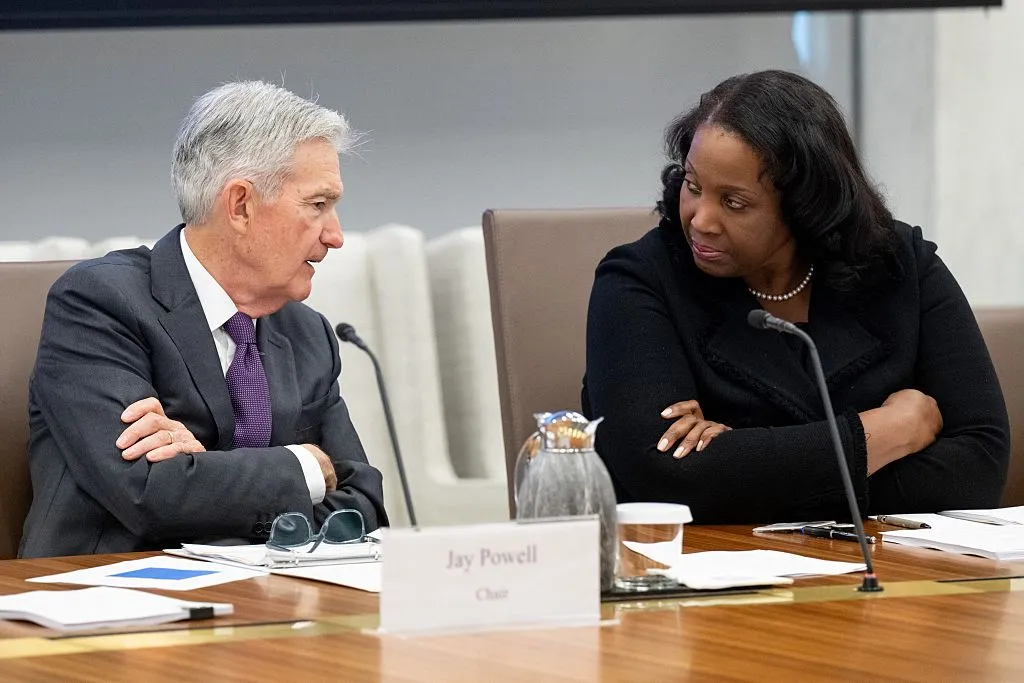
The Supreme Court on Wednesday appeared likely to leave Lisa Cook, a member of the Federal Reserve’s Board of Governors, on the job while her challenge to President Donald Trump’s attempt to fire her continues. Although the Trump administration contends that the president acted within the law, a majority of the justices seemed ready to reject the government’s request to allow him to remove her, even if it was not clear whether the justices would send the case back to the lower courts or instead go ahead and rule that Trump does not have a good reason to fire Cook.
Wednesday’s arguments in Trump v. Cook implicated two related issues – the president’s power to fire the heads of multi-member, independent agencies and his ongoing frustration with the actions (or lack thereof) of the Federal Reserve. Since Trump took office last year, the court – on its interim docket – has allowed him to remove members of the National Labor Relations Board, Consumer Product Safety Commission, and the Merit Systems Protection Board. The justices also heard arguments in December in the case of Rebecca Slaughter, a member of the Federal Trade Commission whom Trump fired in March. They are expected to decide by summer whether a federal law that bars him from removing members of the FTC except in cases of “inefficiency, neglect of duty, or malfeasance in office” violates the constitutional separation of powers.
Trump has also been sharply critical of the Fed and its chair, Jerome Powell, since he was sworn in for a second term last year, particularly for its reluctance to lower interest rates. The Fed eventually lowered rates at meetings this fall.
Powell disclosed earlier this month that he is under investigation by Jeanine Pirro, the U.S. attorney for the District of Columbia, for alleged irregularities in the $2.5 billion renovation of the Fed’s headquarters and Powell’s statements to Congress about the renovation. The White House has said that Trump did not direct Pirro to investigate Powell, who attended Wednesday’s argument.
Cook was first appointed to the Fed in 2022; then-President Joe Biden reappointed her to serve a new 14-year term on the board in 2023. Under the Federal Reserve Act, Trump can only fire Cook “for cause” – a term that the law does not define.
In August 2025, Trump posted screenshots on the social media site Truth Social of a letter in which he fired Cook from the Fed. Trump contended that, before joining the Fed, Cook had committed mortgage fraud by designating both a house in Michigan and a condo in Atlanta as her “primary residence” when taking out loans within a two-week period. (Cook “unequivocally” denies the allegations and says that she is “prepared to refute the allegations in an appropriate forum.”)
Cook went to federal court in Washington, D.C., where U.S. District Judge Jia Cobb issued an order that allowed Cook to stay at the Fed while her challenge continued. When a federal appeals court declined to disturb that decision, the Trump administration went to the Supreme Court, asking the justices to intervene and allow it to remove Cook. In an order on Oct. 1, the court put that request on hold but agreed to hear arguments in January.
U.S. Solicitor General D. John Sauer, representing the Trump administration, told the court on Wednesday that deceit or gross negligence by a financial regulator in a financial transaction should be cause for her removal. It “sends the wrong message,” he suggested, for someone like Cook to be setting interest rates for the American people.
Former U.S. Solicitor General Paul Clement, representing Cook, emphasized that the Federal Reserve is a “uniquely structured entity with a distinct historical tradition.” Adopting the administration’s view of the “for cause” removal provision, Clement contended, “would reduce removal restrictions to something that could only be recognized as at-will removal.” There was no reason, Clement continued, for Congress to create the Fed as an independent entity only to give it a removal restriction as “toothless” as the president contends.
During just over two hours of oral arguments, the court wrestled with a variety of difficult questions. One such question stemmed from Cook’s contention that she was entitled to notice and an opportunity to be heard before she could be fired. The Trump administration disputed that Cook has such a right, pointing to the lack of any provision for notice and a hearing in the removal law.
But even if she has such a right, some justices asked, what kind of procedures would be required? Clement cited the system used by former President William Taft, which gave officials notice and an opportunity to be heard before a full tribunal. For Clement, the key point was that if an administration created a more detailed system, there would be “less room for judicial review” and for “judicial second-guessing of factual determinations.”
The court also grappled with what it would mean for the president to fire a member of the Fed “for cause,” and whether that standard had been met in Cook’s case. Clement insisted that, as Cobb had held, a member of the Fed cannot be fired for conduct that occurred before she took office. When some justices questioned whether that standard would allow a Fed governor to remain in office despite severe misconduct, Clement pointed out that (among other things) Congress could always impeach the governor.
Other justices disputed Sauer’s contention that the allegations against Cook rose to the level of “deceit” or “gross negligence.” Chief Justice John Roberts, for example, observed that the allegations were “contradicted by other documents in the record,” and he noted that any representations about her residences would have been made as part of a “stack of papers you have to fill out.”
Justice Ketanji Brown Jackson suggested that the facts of Cook’s case still needed to be developed – for example, when Cook signed the mortgage applications and what she thought she was attesting to.
Several justices expressed dissatisfaction with the posture in which the dispute came to the court – on its interim docket, rather than after full briefing on the merits. This included Justice Samuel Alito, who pressed Sauer to explain why the case had “to be handled by everyone” – including the lower courts – “on an expedited basis?” Even the executive branch, Alito complained, handled Cook’s termination “in a very cursory manner.”
Justice Brett Kavanaugh cited what he described as the “real world effect” of a ruling for the Trump administration: if the court allows Trump to remove Cook, “what goes around comes around,” and a future Democratic president will remove Republican appointees to the Fed. When Sauer demurred, telling Kavanaugh that he “can’t predict” what might happen in the future, Kavanaugh retorted that “history is a pretty good guide. Once these tools are unleashed, they will be used a second time.”
Cases: Trump v. Cook (Independent Agencies), Trump v. Cook
Recommended Citation:
Amy Howe,
Supreme Court appears inclined to prevent Trump from firing Fed governor,
SCOTUSblog (Jan. 21, 2026, 1:47 PM),
https://www.scotusblog.com/2026/01/supreme-court-appears-inclined-to-prevent-trump-from-firing-fed-governor/