
Gone are the days of app growth at any cost. Gone are the days of unlimited budgets. Gone are the days when simply getting more users was enough to succeed. That was all yesterday.
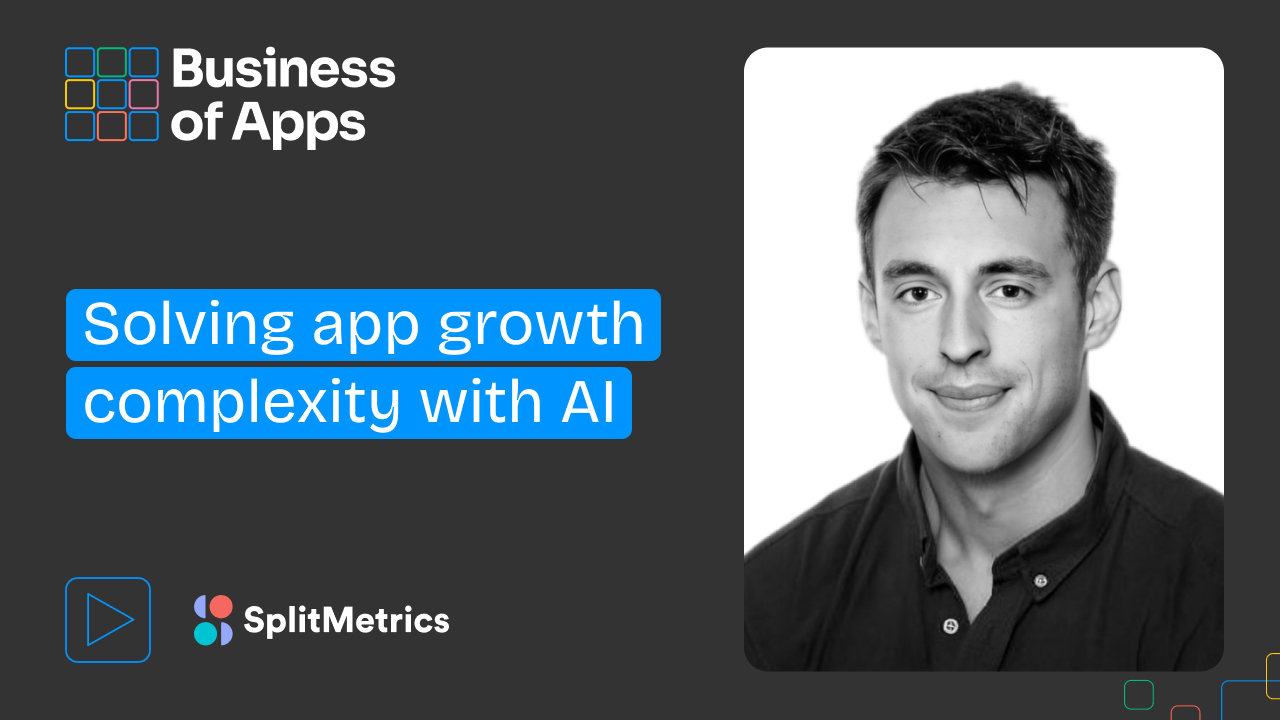
In our latest episode of App Talks, David Murphy sat — in the unparalleled comforts of virtual interview room — with Eoin Hallahan, Chief Revenue Officer at SplitMetrics, to discuss the world after yesterday.
The state of play today
“Conditions today are more volatile and unpredictable than ever, with trends shifting all the time,” began Eoin after David asked him to quickly sketch what it is like to be growing an app today.
Eoin continued. From changing privacy regulations and signal loss to channel and tool fragmentation as well as data silos, UA managers today face a veritable juggernaut of problems, a full course of obstacle they need to surmount to “correctly and efficiently connect the dots across paid and organic and ultimately drive performance.”
Furthermore, while AI has blown open the industry and created many new opportunities, it has also created confusion and uncertainty, according to Eoin. As he put it, “many tools simply are not designed to facilitate mobile app growth, and they give you generic responses that can distract you from what’s actually happening. Ultimately, they can be disconnected from real world marketing needs and workflows.”
Finally, UA teams often find themselves under a lot of pressure to deliver, to improve, to grow, with new requirements and expectations coming their way by the hour — a very sour cherry on a decidedly undelectable cake.
Solving app growth complexity with AI
Source: Business of Apps vis YouTube
Iris: SplitMetrics’s solution to UA team’s plight
To address the above problems and simplify the complexity of app growth in the AI era, SplitMetrics created Iris — the very first AI agent purpose-built for Apple Ads and ASO.
What is Iris?
As Eoin explained, “we would like everybody to think of Iris as a strategist in your Slack workspace. You can ask a question in whatever language you speak, and Iris will give you recommendations in seconds. How this differs from how people would have worked with insight tools in the past is that there is no longer a need to check six or ten different tools, or download reports, or wait for a weekly sync with your data team.
“Iris lives where you already work — in the majority of cases, Slack — and gives you instant clarity on your most important questions. This could be competitor-related. This could be market-related. This could be campaign-related. Iris separates what actually matters from the noise. She takes complex market data and turns it into structured, simple, and clear actions in seconds.”
What are the types of questions people ask Iris?
“For the most part, the types of questions fall into three main buckets. First and by far the most, everything about their competitors. People are competitor-obsessed, and this is a no brainer. It’s highly competitive industry, especially when we think of paid user acquisition channels. What are my competitors are doing in this market? What are my competitors doing overall? How much are their spending? Which keywords are they bidding on?
“The second bucket is all about growth opportunities. For example, where should I invest next? Which GEOs have untapped potential? How can I scale my campaigns more efficiently? And what are my competitors doing in different markets?
“Finally, I would say the third most common is about execution-level support, aka more hands-on, in-the-weeds questions. For example, what keywords should I use for my campaign in Germany? Or, can you help me rewrite this app store listing?”
What does Iris deliver for users?
“The first would be speed. AI slashes the time it takes to go from question to action. Instead of hours spent in dashboards or spreadsheets or meetings with your data and analytics and insights teams, our customers and our Iris users get answers in seconds and right inside Slack.
“The second would be results. Iris helps teams to increase return on ad spend without increasing spend.
The third big thing is productivity. Manual work doesn’t scale. Iris automates all of this research. It flags issues and changes and trends in real time, and continuously adapts so that your team can focus on strategy and hopefully not spend too much time buried in spreadsheets or kicking through reports.”
Why does Iris perform so well?
“I would say what sets Iris apart is quite simple: it’s deep specialisation, trusted data, and over a decade of domain expertise. AI is only as good as the data and the context it’s built upon, and that’s where the most generic tools fall short. As I mentioned before, on a daily basis, we’re comparing the outputs and the quality of answers from Iris to all of the standard LLMs. These LLMs were not trained on mobile growth signals. They don’t understand the nuances of app marketing or of Apple Ads as a channel.
“Iris is completely different. It’s purpose-built for mobile marketers and trained specifically on SplitMetrics data, which includes over 40 million keywords and 2 million apps in almost 100 storefronts. Iris will be useless if you ask her to help you to plan your holiday or give you a recipe for Russian salad Iris is, however, bloody good when it comes to giving you clear directions on what you should be doing to scale and grow your your app or apps in the stores and paid channels, especially Apple Ads.”
Why is Iris a game changer?
“There’s a few reasons for this. The first is, I would argue, Iris doesn’t just change what you do, it changes how you work. For well over a decade now, we have seen mobile marketers who have been forced into reactive workflows. They’ve been juggling disconnected dashboards. They’ve been analсzing fragmented signals and running manual competitor research.
“Iris changes all of this. It flips the model entirely. Instead of dashboards, you get conversations. Instead of lagging indicators, you get proactive strategy and reports and prompts. Instead of guesswork, you get clarity instantly. And not just clarity. It’s clarity built on millions of keywords, ten years of app marketing-specific, complex data. I would argue this isn’t just automation; it’s a new operating system for mobile growth.
“Finally, Iris was built to work with you. It speaks your language. It understands your category. It adapts to your KPIs and delivers strategy-level recommendations.”
This episode of App Talks was created by Business of Apps and David Murphy for SplitMetrics. Find out more about the company on their website.
Watch the full video, embedded above, to learn more about Iris. You can also watch all episodes of App Talks here.
Eoin’s responses have been slightly edited for clarity.