Hamas says it won’t disarm while the IDF is in Gaza and suggests a long-term truce or ‘storing’ its arms. Meanwhile, the IDF likely won’t leave half of Gaza until Hamas disarms.
Hamas is trying to slow-play the Gaza ceasefire deal so that it can eke out as much wiggle room as possible and remain in charge of Gaza.
“We accept the deployment of UN forces as a separation force, tasked with monitoring the borders and ensuring compliance with the ceasefire inGaza,” Hamas official Khalil Al-Hayya said recently.
The goal of the terror group now is to perpetuate a Catch-22 in Gaza, where it says it will only disarm if the IDF withdraws, knowing the IDF won’t agree to that until Hamas disarms.
As such, the terror group created a situation where it always has an excuse not to stick to its part of the deal.
Hamas is assuming that time is on its side. The terror group knows Israel doesn’t want to return to fighting, especially when there is still one hostage that must be returned.

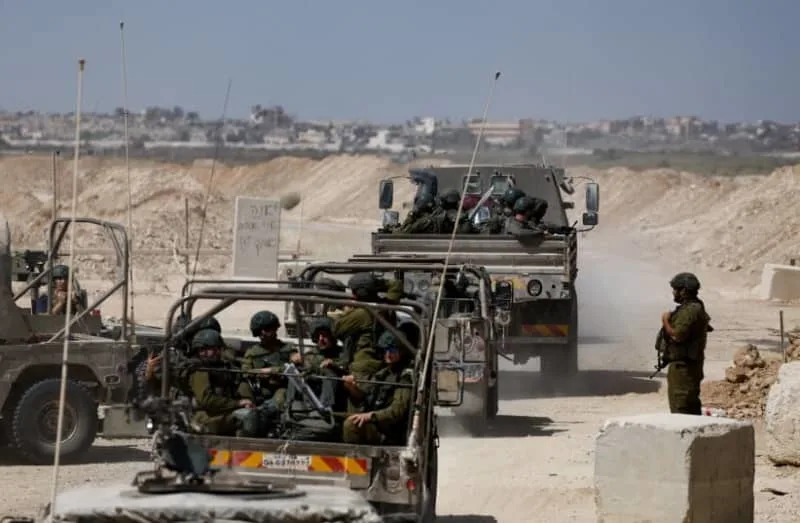
Israeli soldiers enter Gaza at the border as seen from Israel, October 3, 2025 (credit: REUTERS/AMIR COHEN)
There is no major pressure in Israel or incentive to go back to war.
Hamas also knows that Israeli officials don’t want the Palestinian Authority to run Gaza. As such, the terror group knows that the power vacuum in the Strip will also lead to de facto Hamas control.
For almost two decades, Hamas has relied on its control of power. It has relied on assuming Israeli officials prefer Hamas in Gaza in order to divide the Strip from the West Bank, and the group thus benefits from this situation.
Disarmament is also an amorphous term; Hamas assumes it can quietly find a way out of the obligation.
What are the regional media saying?
Arab News noted last week that “Hamas said Saturday it was ready to hand over its weapons in the Gaza Strip to a Palestinian authority governing the territory on the condition that the Israeli army’s occupation ends.”
As noted above, Hayya said that “our weapons are linked to the existence of the occupation and the aggression…If the occupation ends, these weapons will be placed under the authority of the state.”
The terror group stated: “We accept the deployment of UN forces as a separation force, tasked with monitoring the borders and ensuring compliance with the ceasefire in Gaza.”
Another Hamas official, Bassem Naim, was quoted by Al-Ain media as saying that the group was open to “freezing or storing” its weapons, which also came in a comment to the Associated Press.
Al-Ain noted that this presents a “possible formula for resolving one of the most contentious issues in the US-brokered deal.”
The report noted that “since the ceasefire took effect in October, Hamas and Israel have carried out a series of prisoner exchanges, releasing hostages in exchange for Palestinian prisoners. With the remains of only one hostage still held in Gaza, an Israeli policeman killed in an attack on October 7, both sides are preparing to enter the second phase.”
It added, “The new phase aims to chart the future of war-torn Gaza. It is more difficult, as it addresses issues such as the deployment of an international security force, the formation of a Palestinian technocratic committee in Gaza, the withdrawal of Israeli forces from the Strip, and the disarmament of Hamas.”
Furthermore, “Israel’s demand that Hamas lay down its arms is expected to be extremely difficult, with Israeli officials saying this is a key demand that could hinder progress in other areas.”
Naim said that Hamas retains “its right to resist,” but added that “the movement is prepared to lay down its arms as part of a process aimed at establishing a Palestinian state,” the report noted.
“Naim offered few details on how this would be achieved, but suggested a long-term truce of five or ten years to conduct the discussions. Regarding the weapons, he continued, ‘We can talk about freezing them, storing them, or throwing them away, with Palestinian guarantees that they will not be used at all during the current ceasefire or truce.’”
Now, the ceasefire plan is facing a hurdle in reaching phase two. While most countries want progress, the majority of them aren’t willing to do what is necessary, such as commit forces to Gaza. Most countries won’t define or press for disarmament.
Israel is committed to staying in the Strip, and Israeli leaders believe this will keep Hamas in check. The Israeli State also retains its freedom of operations in Gaza.
“One of the most urgent issues is the deployment of the international force. Several countries, including Indonesia, have expressed their willingness to contribute, but their composition and mandate remain unclear,” the Al-Ain report added.
Meanwhile, the Hamas official said, “We welcome a UN force to monitor violations and prevent escalation, but we do not accept that it should have any powers inside the Gaza Strip.”
Al-Ain is still hopeful. “In a sign of progress, Naim revealed that Hamas and the Palestinian Authority have agreed on the head of the new technocratic committee, a Palestinian minister from Gaza who lives in the West Bank, believed to be Health Minister Majid Abu Ramadan.”