I made a Frank Costanza reference in a meeting this week and my 20-something social media manager said, “Sorry, who is that?” All I can say is … SERENITY NOW! And according to one indicator, that might be a good slogan right now.
Here are five things to know this week:
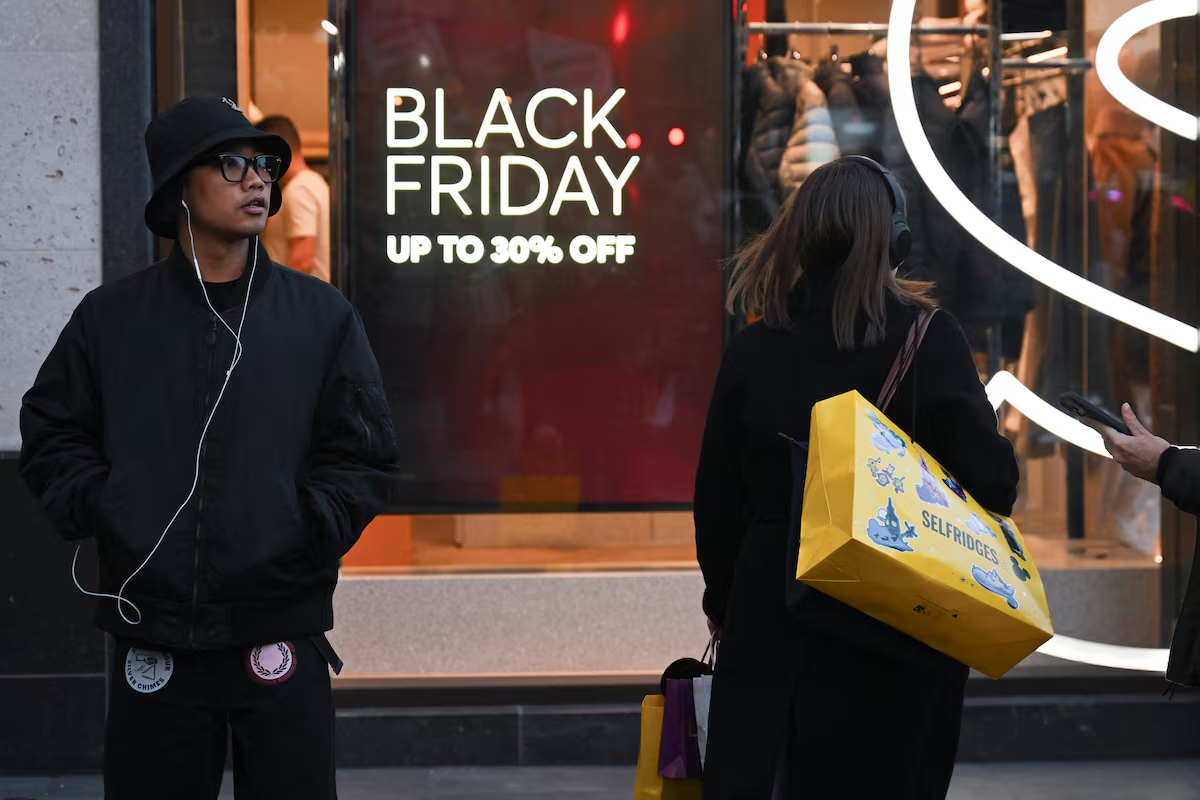
Black Friday: It’s a shortened U.S. trading week because of Thanksgiving on Thursday and investors might be grateful for the reprieve. Despite a rally on Friday, stocks in the U.S. and Canada put in a weekly loss. November is on track to be the first money-losing month since April. The twin anxieties of an AI bubble and concerns that a U.S. rate cut won’t materialize in December have sentiment in the toilet. The CNN Fear & Greed Index – which looks at several measures driving market movements – is registering extreme fear. How will that be reflected on Black Friday? Earnings did not give us a homogenous picture of the consumer. For every Walmart WMT-N beat, we got a Target TGT-N miss. For every Gap GAP-N surge, we got a Bath & Body Works BBWI-N plunge. We will get a read of retail sales and producer prices in September in the United States, which might be as useful as a screen door on a submarine given the pause in data releases last month with the U.S. government shutdown.
Open sesame: Alibaba BABA-N will report Tuesday morning, and all eyes will be on its growing cloud business and spending intentions when it comes to AI. The Chinese tech giant has been a star performer, up 80 per cent so far this year, but like other tech giants has been under pressure recently as investors stress about an AI bubble and whether spending will lead to returns. This fear was particularly acute over Singles Day – China’s anti-Valentine’s shopping season equivalent to North America’s Black Friday – in which sales grew less than the year prior despite deploying AI initiatives. Investors are expecting profit to plunge from a year ago, in part because of the heavy spending on AI. Alibaba was a top pick from Shane Obata, portfolio manager at Middlefield, on my podcast recently. He touted it as a winner as China looks to build out national champions. “The government knows that if China wants to compete on the world stage, they need to partner with and enable their companies,” argued Mr. Obata. He noted that it wasn’t so long ago that Jack Ma, the founder of Alibaba, disappeared. “Now he’s back. He’s back at Alibaba, like in the office working,” said Mr. Obata, who believes this signifies a regime shift within China.
Typecast: Dell Inc. DELL-N and HP Inc. HPQ-N report Tuesday after the bell and neither have been star performers in 2025. Both were recently downgraded at Morgan Stanley on concerns they would take a hit to margins because of the rising cost of memory chips – a key input for the PC makers. Bank of America senior equity research analyst Wamsi Mohan is taking the other side and is confident it’s manageable, particularly for Dell. If memory chip prices continue to rise he sees only a 1.3-per-cent hit to gross margins. Mr. Mohan also says Dell has room to increase prices. “[We remain buyers] as we are in early stages of AI adoption and tailwinds from PC refresh and AI PCs,” wrote Mr. Mohan.
GDP and me: Canadian GDP will be released Friday morning and is expected to show a modest rebound in quarterly output. Economists are expecting the Canadian economy expanded 0.5 per cent in the third quarter compared with a decline of 1.6 per cent in the previous quarter. Trade is expected to continue to be weak, but other parts of the economy are keeping us above water, according to RBC economists Claire Fan and Nathan Janzen. “Offsetting weakness in the trade-exposed sectors is domestic Canadian demand that has remained relatively resilient so far,” the pair wrote in a GDP preview note. “… Our tracking of RBC card transactions points to further, albeit slower growth in consumer spending after a large increase in Q2. Residential investment is expected to have risen again in Q3 as well, following a gradual pick-up in home resales since March.”
U.S.-eh: Alimentation Couche-Tard ATD-T reports Monday evening and analysts are hopeful the business at its U.S. gas stations is improving. Same-store merchandise sales (ie. sales in the gas station, not just at the pump) grew last quarter in the U.S. and Stifel consumer and retail analyst Martin Landry expects even better growth this quarter. “Couche-Tard’s shares have been significantly lagging the market, down 12 per cent [year-to-date],” wrote Mr. Landry in a preview note. “The company needs to demonstrate that its U.S. operations are back in growth mode and that EPS can grow sustainably to restore investors’ confidence.” Mr. Landry believes this quarter could be that inflection point.
In the Money with Amber Kanwar is Canada’s top investing podcast. New episodes out Tuesday and Thursday. Subscribe now! www.inthemoneypod.com

