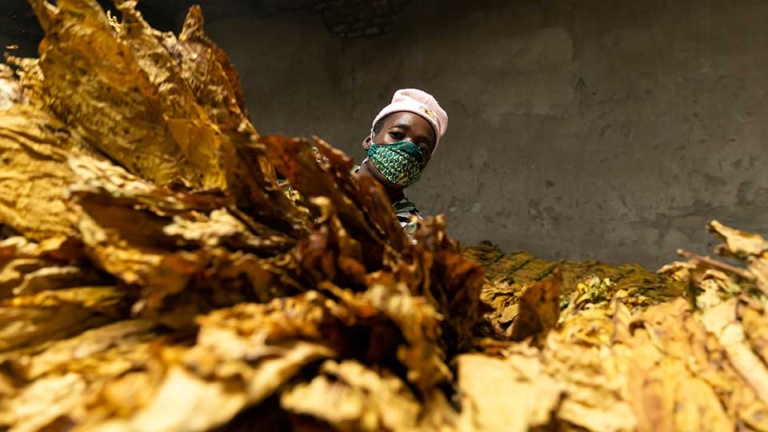
Claude Kaharo stands outside his traditional tobacco curing barn in Marondera, Mashonaland East, watching smoke billow from the thatched structure. Black scorch marks covering the circular hut are evidence of the countless wood-burning curing sessions he has managed over nearly a decade of farming. Now 56, the former civil servant left his government job to pursue tobacco farming, driven by the need to improve his family’s circumstances as the struggled under the weight of economic hardship.
“I am passionate about farming, and I ventured into tobacco farming business, with very little input to start with,” Kaharo explains, gesturing toward his conventional barn. Like many small-scale farmers in Zimbabwe, he has relied on rain-fed water sources and traditional farming methods, facing significant challenges as the result of limited capital, inadequate access to modern inputs and dry periods.
But there is hope for Zimbabwean tobacco farmers like Kaharo. International partnerships are bringing advanced technology to assist farmers grow, cure and market their crops.
Chinese Investment Supports Farming
Much of this technological advancement has been facilitated through partnerships with Chinese companies, such as established tobacco giant Tian Ze, which provides inputs, financial support and technical assistance to farmers. The company has established a joint working arrangement with Mashonaland Tobacco Company, a local merchant that helps small-scale farmers access inputs and precision farming equipment.
Antony Chapoto, an agricultural and development economist at the Africa Network of Agricultural Policy Research Institutes, sees measurable benefits from this collaboration but urges careful assessment of the potential long-term impacts.
“The provision of Chinese technology and technical support to tobacco farmers can yield measurable economic benefits, but it is crucial to assess these impacts comprehensively, taking into account both immediate advantages and long-term developmental consequences,” Chapoto notes.
Research supports the productivity gains. Chapoto cites empirical evidence from African and Asian nations showing that tobacco yields can increase by 20-40% when farmers implement precision planting, use superior fertilizers and modern curing barns, much of which Chinese collaborations have facilitated.
“Chinese support has primarily focused on enhancing productivity at the farm level through improved seed varieties, mechanization and agronomic practices,” he explains.
The Technology Revolution
Modern approaches to tobacco farming come with significant improvements. Where Kaharo once used traditional wood-burning techniques that required one kilogram of fuel wood to cure just one kilogram of tobacco, modern coal-based systems can cure 2.5 kilograms of tobacco with the same amount of fuel, according to a recent Future Agricultures report.
This efficiency gain represents just one aspect of the technological revolution reshaping Zimbabwe’s tobacco sector. Edward Dune, president of the Tobacco Farmers Union Trust, points to widespread adoption of advanced systems across the industry.
“Advanced irrigation systems and tractorization in tillage, ridging, herbiciding and haulage operations have contributed significantly, improving the quality of the crop, thereby ensuring a high selling price,” Dune explains.
The transformation extends beyond mechanization to embrace digital agriculture. Commercial tobacco farming now incorporates sophisticated platforms for weather monitoring, nutrient management, crop rotation and irrigation control. Precision farming tools like those offered by Farmanout promise dramatic improvements, including20-30% increases in crop yield, 30-40% gains in resource efficiency, 25-30% improvements in soil health and up to 40% increases in farm profitability.
Some operations demonstrate the potential of large-scale, technology-enabled farming. Dune highlights Cold Stream farm in Headlands, Manicaland Province, as a success story where the farmer cultivates around 3,000 hectares in partnership with neighbors. Scale provides crucial flexibility for farmers. Dune explains that, if the market price is unsatisfactory, the farmer can withdraw his bales and drive back home, unlike small scale farmers.
This flexibility gives larger, well-capitalized operations the advantage of weathering market volatility and the power to make strategic decisions about when and how to sell their crops.
Financing Strains Farmers
However, the technology revolution has created new challenges, particularly around access and financing. Dune expresses concern about the financial terms facing smaller farmers. While offshore funding is available at 3% interest rates, contractors typically charge farmers a minimum of 13% for the same money.
He says that contractors buying in bulk does not transmit the benefits to the farmer, particularly in the face of skyrocketing input costs. The added value often remains minimal, as most countries still export unprocessed leaves instead of finished products, losing downstream value creation to importing countries.
The financing model also creates operational challenges. Modern implements are not made available on a long-term basis and farmers must repay during the selling season, which doesn’t align with equipment lifespans. This mismatch can create serious problems.
“Farmers end up with court cases and such loans tend to accrue high interest rates,” Dune warns.
A Farmer’s Calculated Risk
Despite the risks of being overwhelmed by debt or excluded by scale requirements, advanced farming systems represent a rare opportunity for small-scale Zimbabwean tobacco farmers to improve their circumstances. Farmers like Kaharo continue to takes loans from Tian Ze, and he has managed to secure farming chemicals and pesticides in this 2025/2026 tobacco farming season. Nearly ten years after starting with minimal inputs, he now farms almost 5 hectares.
According to a 2024 report on the political economy of tobacco production in Zimbabwe, the majority of contract farmers engage in modern practices due to their necessity for inputs. However, the report notes a scarcity of publicly accessible information about operations like Tian Ze, particularly regarding subcontracting arrangements, highlighting the need for greater transparency as the industry evolves.
For local farmers who have long been dependent on traditional methods and rain-fed farming, the promise of improved yields, better quality crops and higher selling prices makes the technological transition, and the risks that comes with it, a necessity.
Sally Nyakanyanga is an independent journalist based in Zimbabwe
