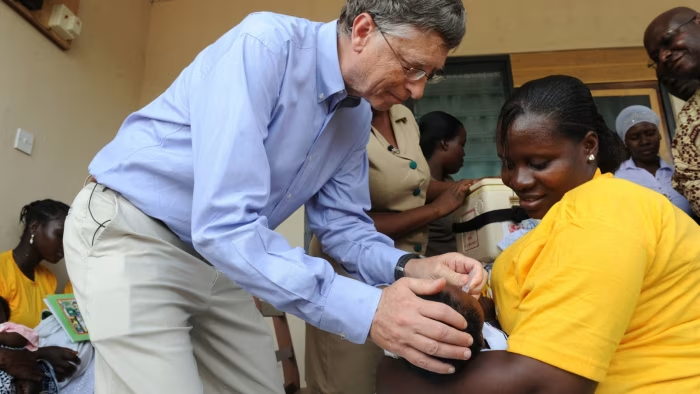
Bill Gates is spot on in his open letter issued ahead of the UN COP30 climate summit (“Gates calls for UN to ‘pivot’ from climate to health and poverty”, Report, October 29).
Families in countries such as Bangladesh or Mozambique often cannot afford the bus fare to the nearest health centre to vaccinate their children, frequently losing half a day’s wages in the process. When school meals and textbooks are beyond reach, it seems tone-deaf for the global community to urge these same families to “climate-proof” their homes with special roofing materials.
Even on a macroeconomic scale, catastrophic disasters such as the 2011 Fukushima tsunami have had limited long-term impacts on GDP, insurance profitability, or the banking sector. Insurance premiums rise in the aftermath of disasters — not necessarily in proportion to actual risk, but according to what the market will bear.
As an epidemiologist, I have always championed better data for evidence-based policymaking. Yet I also know that this requires resources — and that the weakest link often lies not in data scarcity, but in the poor use of affordable technologies and existing datasets. Gates rightly points out that vaccination remains one of the most effective interventions for improving child survival and long-term productivity.
In contrast, there is little systematic evidence — beyond anecdote — showing how much “climate-proofing” initiatives improve lives or at what cost. Vaccination campaigns lack the glamour of COP summits or the dramatic imagery of climate disasters. A child who did not contract polio simply doesn’t make headlines.
Debarati Guha-Sapir
University of Louvain, Brussels, Belgium
Johns Hopkins University, Baltimore, US