TAIPEI (Taiwan News) — Taiwan’s representative office in the US on Nov. 2 mocked the Chinese Embassy’s release of satellite images of Taiwan as “creepy spying.”
The office said on X that FORMOSAT-8, named after the famous documentary filmmaker Chi Po-lin (齊柏林), would launch in mid-November, per CNA. Once fully operational, it will provide ultra-high-resolution images from space.
The office said that no details of the ground would be missed by FORMOSAT-8’s “eagle eye.” It said the satellite is capable of photographing cities like Vladivostok in Russia’s Far East and Mongolia’s capital, Ulaanbaatar.
However, it reassured that the satellite’s mission is entirely for scientific and public service purposes, “not about creepy spying and making fantasy claims.”
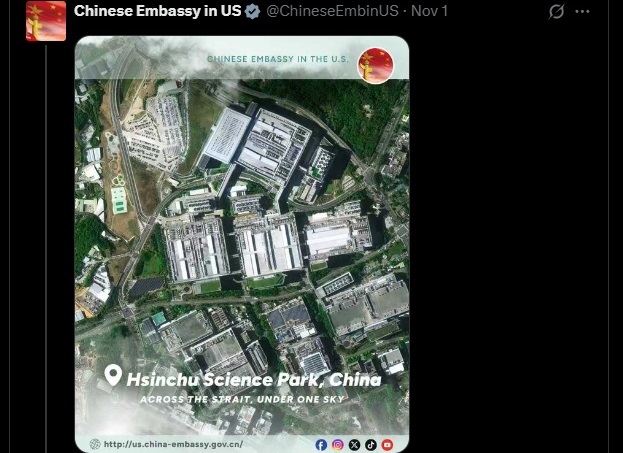
On Nov. 1, the Chinese Embassy in Washington, D.C., posted several high-resolution satellite images of Taiwan, captured by China’s Jilin-1 satellite, on X. It claimed that there is only one China in the world and that “Taiwan is an inalienable part of China’s territory.”
The embassy said that from the Jilin-1’s perspective, “Every inch of Taiwan Province, China, is vibrant,” and it pinned the post to the top of the account. Below were images of well-known Taiwanese locations such as Sun Moon Lake, Alishan, Taipei, Port of Taipei, Hsinchu Science Park, and Cape Eluanbi.
However, a community note later appeared below, which said: “In 1949, the communists won the Chinese Civil War and took over mainland China. The Republic of China government escaped to Taiwan, where it has continued to rule separately from communist China up to today. It never was part of the Peoples Republic of China.”
The tweet attracted the attention of US Senate Foreign Relations Committee Chairman Jim Risch, who said on X that China has never controlled Taiwan’s territory. He described the embassy’s post as an example of “the Chinese Communist Party’s misrepresentation of history and blatant threats against a peaceful democracy.”
On Sunday, Tom’s Hardware pointed out that although the tweet did not directly mention semiconductors, it was unnecessary to do so.
Hsinchu is home to TSMC’s original fabs, as well as the headquarters of MediaTek and UMC. The area also houses key government agencies involved in Taiwan’s aerospace and semiconductor strategies.
US Treasury Secretary Scott Bessent warned in September that the biggest single risk to the global economy is that 99% of high-performance chips are produced in Taiwan. A 2021 White House assessment had already highlighted the potential impact of even a temporary dip in TSMC’s output, affecting everything from data centers to national defense.
Tom’s Hardware said that “China’s embassy didn’t need to mention any of that directly. A single photo of Hsinchu was enough at a moment while tensions remain high.”
