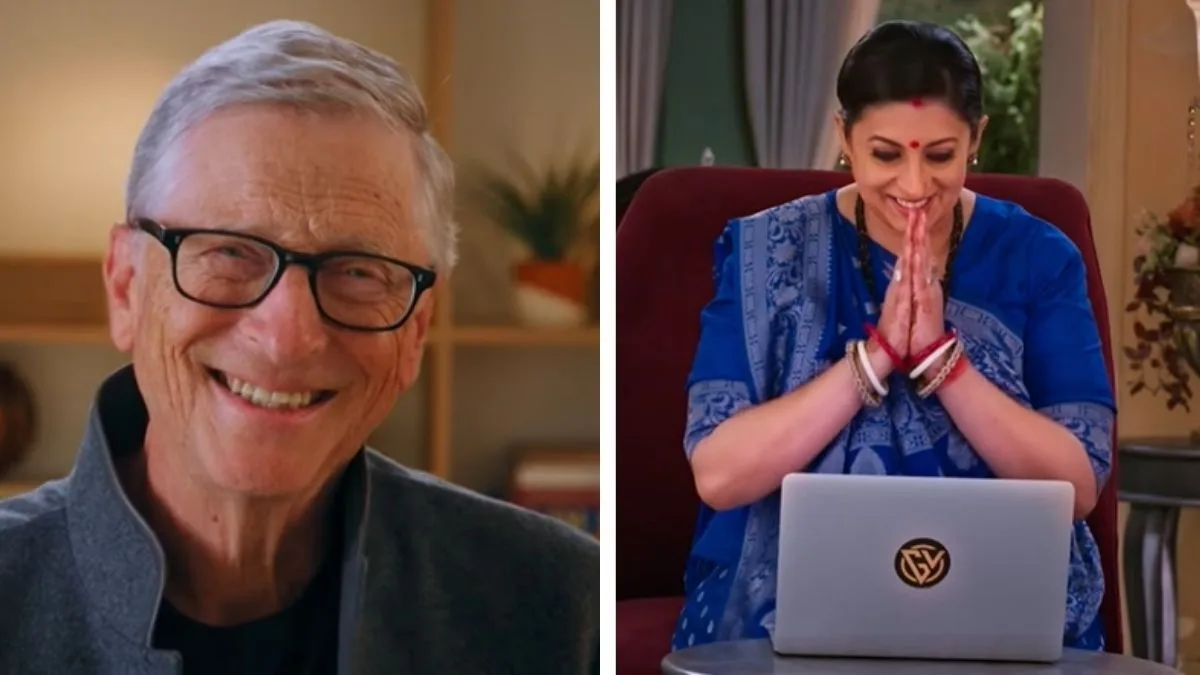
When Bill Gates appears in a Hindi television serial alongside actress and former union minister Smriti Irani, it marks more than an unlikely cultural crossover between Silicon Valley and suburban India. It reflects a shrewd understanding of how ideas travel in this country ~ not through policy white papers or TED-style lectures, but through emotion, ritual, and storytelling.
The four-minute cameo was brief, but its symbolism was immense. The show, Kyunki Saas Bhi Kabhi Bahu Thi (“Because the Mother-in-Law Was Also Once a Daughter-in-Law”), has long been woven into the fabric of Indian popular culture. Its protagonist Tulsi, played by Ms Irani, once embodied the ideal daughter-in-law; today she stands as the wise matriarch guiding her family through moral and social dilemmas. When Mr Gates appears on her laptop screen to discuss maternal and child health, the scene collapses the distance between global philanthropy and Indian domesticity in a way no awareness campaign could hope to achieve. In a nation where television once defined dinner-time rhythms, such moments can revive collective engagement around social causes, reminding audiences that education and empathy can coexist with entertainment and tradition.
Advertisement
For Mr Gates, whose foundation has worked for years in India’s most disadvantaged regions, this was not a publicity gimmick but a cultural intervention. By entering a show that once dictated household routines and conversations, he brought his message into millions of homes in the most natural form possible, through Tulsi’s gentle counsel and the show’s emotional grammar. Public health messaging, especially on maternal nutrition and safe delivery, often struggles against deep social conditioning. But when a beloved fictional character champions these causes, resistance softens.
Indian television has always been more than entertainment; it is a moral theatre. From mythological serials like the Ramayana and Mahabharata to domestic sagas like Kyunki Saas Bhi Kabhi Bahu Thi, these narratives have helped define virtue, family roles, and social order. Embedding conversations on maternal health and women’s well-being into that space is both clever and culturally coherent. Some online reactions found the episode “cringe-worthy” or comically mismatched, but that judgement overlooks its subtle power. In a patriarchal society where women’s health concerns are often sidelined, even symbolic moments of visibility can normalise new norms. Mr Gates’ polite “Namaste Tulsi-ji” may have amused the internet, but it also carried an implicit respect for Indian traditions and a recognition that behavioural change often begins within those traditions, not outside them.
Ms Irani’s evolution ~ from television’s most enduring daughter-in-law to a public figure associated with social themes ~ gives the moment an added layer of credibility. And for Mr Gates, it reaffirms that technology and philanthropy must ultimately serve humanity by speaking its cultural language. Real change in India will not always emerge from boardrooms or bureaucracies. Sometimes, it begins in a living room, amid aarti (prayers), family banter, and a fictional dialogue that feels real enough to move hearts