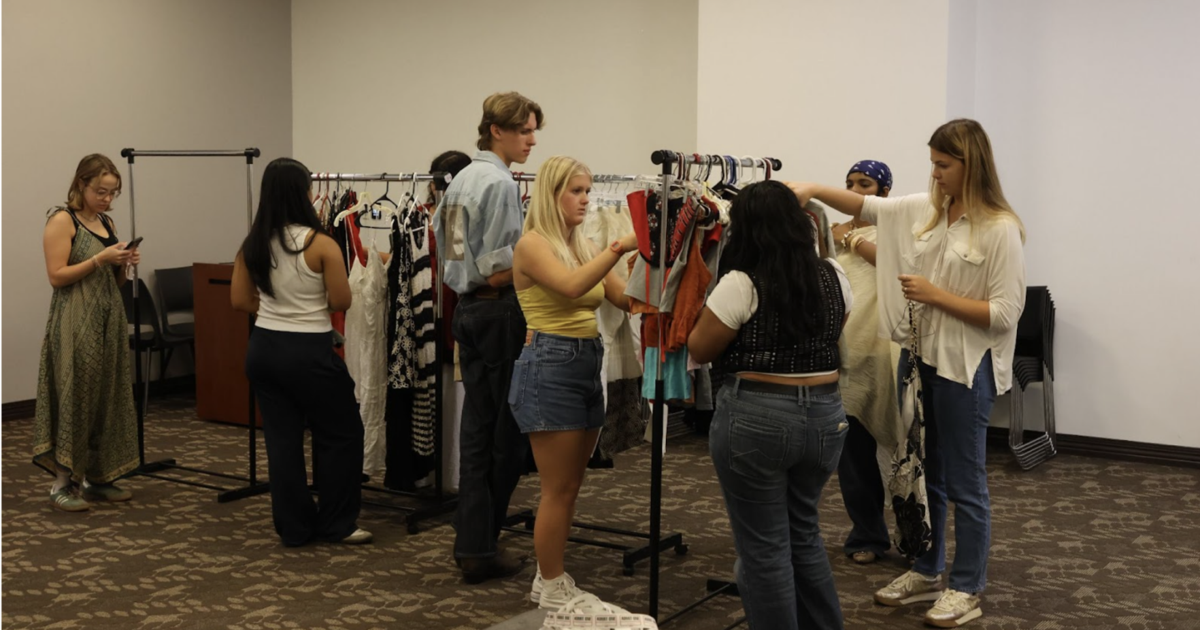
Students sifted through racks and folded piles of secondhand shirts, jeans and jackets on Monday, Sept. 22, as the sustainable fashion club Fair Fashion held its first clothing swap of the semester at the University of Georgia’s Tate Student Center. Club members, volunteers and curious newcomers came from across campus to trade clothes and promote the use of sustainable clothing options.
Visitors and volunteers were able to exchange their clothes for tickets, which could then be exchanged for items brought by other attendees, hung up on a series of clothes racks and fold-out tables. The event lasted for three hours, from 3 to 6 p.m.
“I think the primary purpose of Fair Fashion is to just create a space where everyone feels welcome and everyone feels like they have the opportunity to explore their style in an ethical way,” Ruby Gagnon, co-president of Fair Fashion said.
Co-President Leynie Hester emphasized that fast fashion operates as a harmful cycle.
Fast fashion refers to the mass production of low cost clothing items for short term trends, resulting in a great deal of waste. Hester explained that to her, the primary dangers were not just overconsumption, but also unfair and exploitative labor practices in the fashion industry and the environmental impacts. She referred to their approach as “slow fashion.”
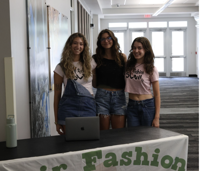
Co-President Leynie Hester (right), Co-President Ruby Gagnon (left) and Treasurer Devyn Humble (middle) stand for a photo by the entry desk to the semester’s first Fair Fashion swap meet at Tate Student Center on Sept. 22, 2025. Fair Fashion is a student organization dedicated to providing students and other Athenians with ways to ethically shop for clothes through swap meets. (Photo/Frank Lowery)
“Keeping things local, keeping things small, consuming less, being a smart consumer — someone who thrifts a lot and doesn’t buy into trends that quickly, they know what they like, they’ve discovered their style, just in general that is already helping,” Hester said.
Hester cautioned against donating to big global donation centers like Goodwill, citing that the clothes are often shipped abroad and then dumped, and instead stressed charities like Project Safe. The latter, she said, is where the bulk of Fair Fashion’s donations go.
Gagnon said that the organization’s outreach consists of tabling at farmers’ markets, social media organizing and working with local artists or students who enjoy making things, emphasizing that people from outside campus are also encouraged to join.
Haley Pearson, a club member and UGA junior who was attending her fifth swap, said she heard about the club first through Instagram during her freshman year.
“When you shop sustainably and when you do these kind of things, it makes a bigger impact than you think it does,” Pearson said.
Gagnon and Hester, both seniors at UGA, got involved with the club in their freshman year. At that point, the club had existed for a while already. Last semester, Gagnon was vice president, but this was her and Hester’s first time running the event as co-presidents.
“Sustainability is definitely a strong passion of both of ours, as well as fashion,” Gagnon said. “So the hope is to promote that positive change, no matter where we are.”