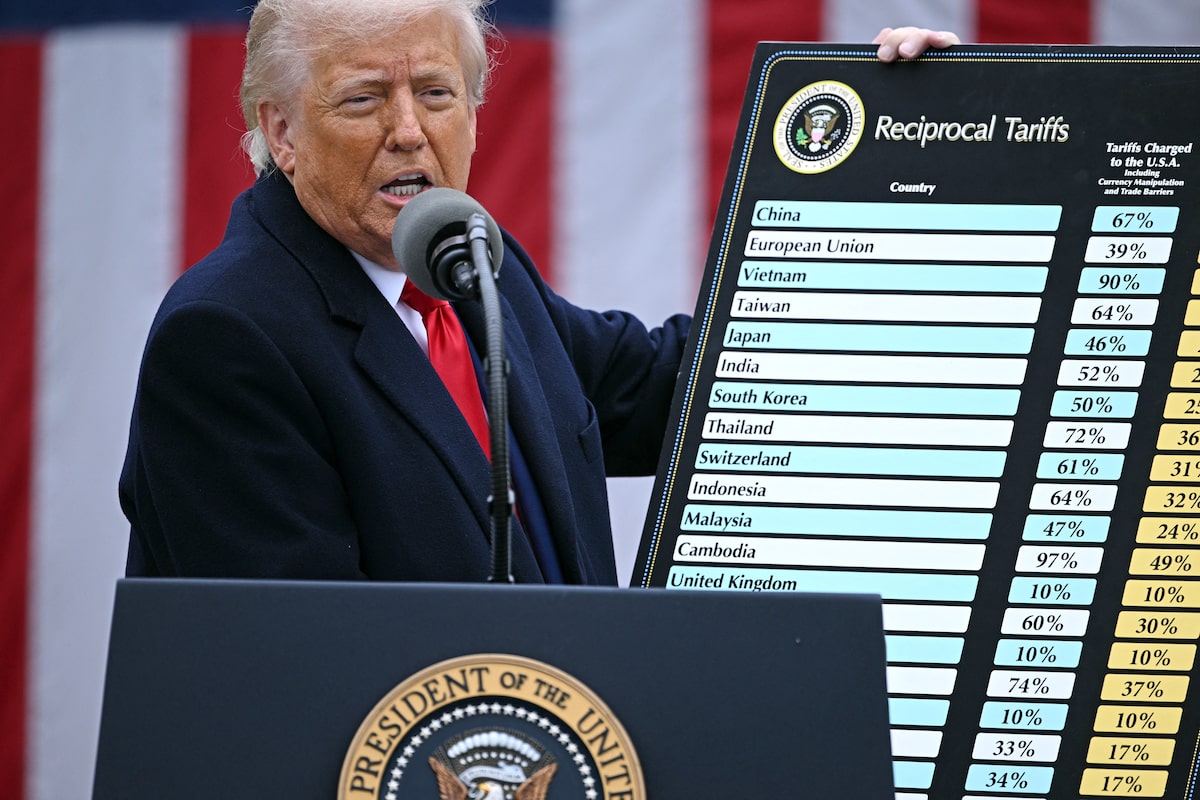
U.S. President Donald Trump holds a chart as he delivers remarks on reciprocal tariffs in April.BRENDAN SMIALOWSKI/AFP/Getty Images
America’s trade partners swept into Washington over the summer hoping to cement new pacts that would yield certainty for their exporters and prevent their economies from plunging into recession. Instead, they’re now facing the prospect of weeks of further chaos affecting trillions of dollars of global trade.
Leaders from the European Union, Japan and other countries who cut commercial trade deals with the White House are now wondering whether those informal agreements will stick after a U.S. court ruling late Friday that struck down the core of President Donald Trump’s tariff strategy. For Canada, the danger could be that the President expands the use of sector-specific import levies – such as those on autos, steel and aluminum – that do not face the same legal test.
A majority of judges with the U.S. Court of Appeals for the Federal Circuit declared Friday that it is illegal for the President to use emergency legislation to impose import tariffs, confirming a separate decision in May by the Court of International Trade. But the panel agreed to delay the ruling’s implementation until Oct. 14 to allow time for a further appeal to the Supreme Court, which means the levies remain in place.
Trump administration has backup plan if Supreme Court rules tariffs are illegal, Bessent says
What happens to Trump’s tariffs now that a U.S. appeals court has struck them down?
“Having experienced countless twists and turns over the past several months, U.S. trading partners must feel dazed and confused as they try to sort this all out,” former U.S. trade negotiator Wendy Cutler told The Globe and Mail in an interview Monday, adding that many of them entered into framework deals with the U.S. while others are still negotiating.
“This definitely complicates the process … And I think raises a lot of questions among our trading partners with respect to their strategies and working with the United States on these issues going forward.”
India, hit by a 50-per-cent tariff, will take this as a cue to forge closer ties with other countries such as China, said Ms. Cutler, who spent 27 years at the Office of the United States Trade Representative before joining the Asia Society Policy Institute as senior vice-president. Japan and Korea, which have made verbal deals with the United States, might slow down their efforts to formalize agreements while the European Union is likely to keep working with the U.S. in earnest on a binding pact because there are other political issues in play in that relationship, including the war in Ukraine, she said.
Appealing the case to the Supreme Court and waiting for that court to rule means it could be several months before an outcome on tariffs is reached. In the meantime, businesses selling into the United States plunge again into the unknown.
“Clearly we’re back to uncertainty,” said Carsten Brzeski, global head of macroeconomic research for ING bank. Companies will avoid making structural decisions as a result, he said, such as relocating more production into the United States. While some will muddle through the fog, others could decide to stop exports to the U.S. temporarily because of doubts over the pricing of their goods, he said.
Defying U.S. pressure, China’s Xi advances his vision for a new global order
The court ruling might strengthen Canada’s resolve to play tough with the United States in negotiations but some other countries will probably be reluctant to do the same, Mr. Brzeski said. “They will all be afraid that if they really reverse too many of their commitments, that Trump will strike back in other ways.”
Earlier this year, Mr. Trump invoked the International Emergency Economic Powers Act (IEEPA) to impose what he dubbed “reciprocal” tariffs, including a baseline 10-per-cent levy on nearly every country in the world. The 1977 legislation, which was intended to let presidents impose economic sanctions or asset freezes on U.S. enemies during a war or other crisis, says nothing about tariffs.
Mr. Trump, however, argued that the U.S.’s long-standing trade deficit constituted a crisis and imposed tariffs as the remedy. In the case of Canada, Mexico and China, he said fentanyl coming into the U.S. – of which Canada was responsible for 0.2 per cent last year – was also a crisis justifying tariffs.
The President signed an executive order in July increasing the tariff on Canadian goods to 35 per cent from 25 per cent in response to what the White House called “this unusual and extraordinary threat to the United States” flowing across its northern border. The tariff does not apply to goods that are compliant with rules of origin under the United States-Mexico-Canada Agreement (USMCA).
Roughly 90 per cent of Canadian goods exported to the U.S. are still trading duty-free. That means the IEEPA tariffs have had less effect on Canada than separate levies on steel, aluminum and autos, which the White House implemented under different legislation.
It’s not clear whether the Supreme Court will side with the lower courts or with Mr. Trump. In the interim, his administration is pressing ahead with its trade strategy, in part to help fund tax cuts and other measures. The United States has generated US$142-billion in tariff revenue this fiscal year through July, most of it from customs duties collected before Mr. Trump’s tariff “liberation day” in April.
“If these tariffs are ruled down, they’ll need to find that revenue in some other way,” said Stephen Brown, deputy chief economist for North America with Capital Economics. “We can kind of guess that they’ll put tariffs on in other forms and aim for some sort of similar impact on the overall tariff rate so that the revenue coming in is broadly similar.”
The President could expand the use of product-specific tariffs, such as those applied to steel and motor vehicles, on national security grounds, Mr. Brown said. “They could certainly make life difficult in other ways.”
U.S. Treasury Secretary Scott Bessent told Reuters on Monday that he was confident the Supreme Court would uphold Mr. Trump’s tariffs but that a backup plan is in place if it doesn’t.


