Several Tacoma leaders spent a week in China this month – mostly on the Chinese government’s dime.
A seven-member delegation from Tacoma that included Mayor Anders Ibsen, Council member Sandesh Sadalge and Ibsen’s chief policy analyst Bucoda Warren spent over a week in China to “strengthen cultural, educational and economic ties” between Tacoma and its sister city Fuzhou, China, according to Tacoma city spokesperson Maria Lee.
The city of Tacoma spent $6,000 to cover Ibsen’s, Sadalge’s and Warren’s airfare and visas. Other delegates were responsible for the costs of their own visa and airfares. The Chinese People’s Association for Friendship with Foreign Countries covered the delegation’s remaining costs for the entirety of the trip, including hotel stays, meals and outings.
Port of Tacoma Commissioner John McCarthy, Tacoma Sister Cities Council president Ria Johnson, interpreter Ron Chow and Jade Monroe, the mayor’s partner, were also part of the delegation.
CPAFFC and NFL China covered all costs for 20 students and four coaches from Lincoln High School’s flag football teams to join for parts of the trip, according to Tanisha Jumper, spokesperson for Tacoma Public Schools. The students were invited to celebrate the 55th anniversary of “ping pong diplomacy”: the beginning of a new era in relations between the U.S. and China in 1971 that was marked by an invitation for the American ping-pong team to play exhibition matches in China.
Fuzhou has been among Tacoma’s sister cities since 1994, and this year’s trip marks roughly the 18th time a delegation from Tacoma has visited the city, Lee said.
Some researchers and leaders at the federal level recently have raised concerns about CPAFFC’s intentions, arguing that the group is a veiled effort from the Chinese government to exert negative influence over local governments in the United States.
CPAFFC representatives did not return a request for comment from The News Tribune.
What is CPAFFC?
According to a report from the Jamestown Foundation, a non-partisan D.C.-based think tank, the group has been part of an effort to advance the goals of the Chinese Communist Party abroad.
The report states that CPAFFC’s leaders and goals are tied to that of the “united front system,” which is “used to control and mobilize organizations and individuals on the Party’s behalf.”
Cheryl Yu, a China studies fellow with the Jamestown Foundation who wrote the report, said the CPAFFC often seeks to establish positive relationships with local governments to use them as leverage in the future. Once it has a positive relationship with local leaders, the association may use it to request those leaders don’t pass legislation or statements in support of human rights-related issues, like the plight of the Uyghurs, an ethnic minority group in China.
“The reason why they’re funding these trips is they want to build good relationships with these people, with the city government,” Yu told The News Tribune. “They think that this would help them eventually, in some way.”
In an October 2020 statement, then-Secretary of State Mike Pompeo criticized the united-front system and CPAFFC.
The group “has sought to directly and malignly influence state and local leaders to promote the [People’s Republic of China’s] global agenda,” Pompeo wrote.
As delegations from Tacoma have visited China, so have delegations from China visited Tacoma. Chinese delegations have made roughly 17 trips in the 32 years Tacoma has had a sister-city relationship with Fuzhou, Lee told The News Tribune.
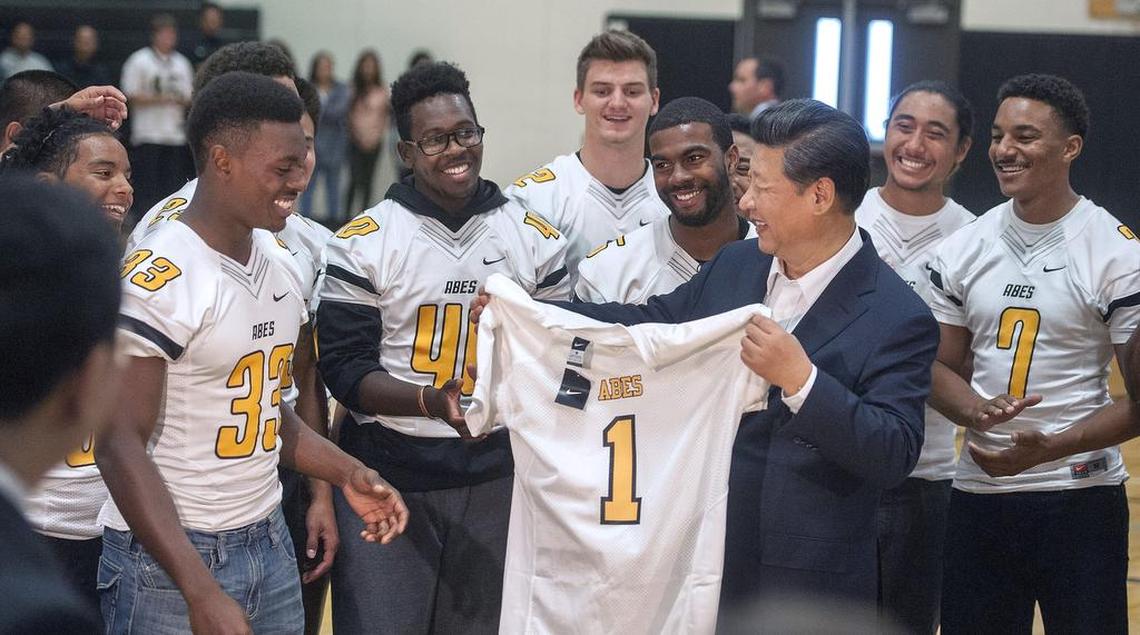
People’s Republic of China President Xi Jinping came to Tacoma in 2015, spending time with local officials like U.S. Rep. Marilyn Strickland – then Tacoma’s mayor – at Lincoln High School. He brought with him an invitation for 100 Lincoln students to visit the following year, three bookshelves of volumes about China and ping-pong equipment, The News Tribune reported at the time.
Part of the reason for his visit was his roots as a government official in Fuzhou. He visited Tacoma in the 1990s to establish the relationship, The News Tribune reported.
What was the purpose of this year’s trip?
The “anchor event” for the trip was a celebration in Beijing of the anniversary of ping-pong diplomacy, Warren said. With this being Ibsen’s first year as mayor, it allowed him to visit Fuzhou and build a relationship with the city’s leaders.
The city’s sister-city relationship and visits to China have resulted in benefits for the city of Tacoma, Warren said. The city of Fuzhou sent artisans to work with Parks Tacoma to develop a plan for the Ting in Chinese Reconciliation Park, and the two cities have worked together to facilitate trade – bringing jasmine tea from the Fuzhou area and products like Tacoma’s Almond Roca to Fuzhou.
Warren said CPAFFC has covered “in-country costs” for Tacoma delegations visiting China in all of its previous visits, but the city has not covered Chinese delegations’ costs when they come to Tacoma.
It’s unclear exactly how much the CPAFFC spent on the trip. Warren said the organization covered all expenses that the seven-member delegation incurred while in China, including stays at five-star hotels and visits to places like Shanghai Sea World and the Great Wall. They spent time in Beijing, Fuzhou, Shanghai and Shenzen, watched various cultural dance performances and met with municipal leaders from Fuzhou and other districts, according to their itinerary.
Jumper, Tacoma Public Schools’ spokesperson, said the district has “no information” on what the trip cost for the Lincoln students and coaches because CPAFFC and NFL China covered all other costs.
How does the city respond?
Warren said CPAFFC is aware of the financial limitations on the city of Tacoma’s government and said the city’s lack of direct financial reciprocity wasn’t a concern for the city. Where Tacoma can’t cover the costs of such a trip it can provide visiting delegations with tours of city hall, the mayor’s office and other government buildings – which is not often as accessible in China, he said.
“There are places where we kind of lean on our own uniqueness to be able to fill that gap of the resourcing and the staffing that they find meaningful in that relationship,” Warren told The News Tribune.
Of the criticism of CPAFFC, Warren said the city wasn’t concerned about the “federal to federal” relationship between countries involved in the sister-city program. The city is more interested in focusing on what the two cities can learn from each other and fostering diplomacy.
“When we’re operating the sister-cities program, it has always been focused on the sister cities’ international mission of people-to-people diplomacy and people-to-people relationships,” he said.
“Sure, every government at the federal level, especially, has their own intentions when they’re sending out these relationships and doing this work. We just keep very focused on why we’re there,” he said.

Isha Trivedi covers city hall and education in Tacoma for The News Tribune. She has previously worked at The Mercury News, the Palo Alto Weekly, the Chronicle of Higher Education and the Pulitzer Center on Crisis Reporting. She grew up in San Jose, California and graduated with a bachelor of arts in journalism and anthropology from the George Washington University. She is a proud alumna of The GW Hatchet, her alma mater’s independent student newspaper, and has been recognized by the Society of Professional Journalists for her work with the publication.