Key Points
Nvidia (NASDAQ: NVDA) has made investors a ton of money over the past few years. If you invested $10,000 into it at the start of 2023, that investment is now worth $125,000. That’s an incredible return on investment. While Nvidia won’t be able to repeat that growth rate over the next three years, it has what it takes to outperform the market.
I think there’s one clear signal investors can’t ignore about Nvidia’s stock, and they should heed it and scoop up shares before the rest of the market catches on.
Will AI create the world’s first trillionaire? Our team just released a report on the one little-known company, called an “Indispensable Monopoly” providing the critical technology Nvidia and Intel both need. Continue »
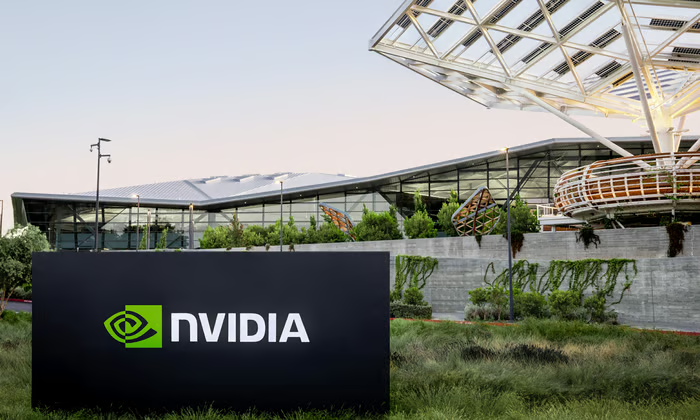
Image source: Nvidia.
The market only expects one more year of strong growth
Nvidia’s stock has somehow gotten the stigma that it’s expensive, but that couldn’t be further from the case. Right now, it trades at 22.1 times forward earnings, nearly the same price-to-earnings ratio as the S&P 500, which trades at 21.7 times forward earnings.

NVDA PE Ratio (Forward) data by YCharts
Normally, market-average premiums are reserved for stocks growing at a market-average pace, but that’s not Nvidia. In its last quarter, it grew revenue by 73%. For this quarter, management expects 77% growth. Normally, the market grows at about a 10% pace each year, so this is a massive mismatch.
The current price tag on Nvidia’s stock assumes that it will have a strong year, but will revert to market-average growth in 2027. But I don’t think that’s true.
Nvidia projects that global data center capital expenditures will reach $3 trillion to $4 trillion by 2030. McKinsey & Company offered a similar projection, estimating that it will take $7 trillion in cumulative spend by 2030 to meet demand for artificial intelligence (AI). That clearly indicates growth for Nvidia will last for multiple years past 2026, crushing the bear case on the stock.
One common misconception out there is that Nvidia cannot grow because AI hyperscalers are maxing out their cash flows devoted to capital expenditures. While that is partly true, investors are forgetting that much of the capital expenditure right now is going toward constructing data centers. It takes years for data centers to come online once announced, and computing units are the last thing to be purchased.
So, while capital expenditure growth may not be as easy to come by, the proportion of that spending devoted to computing units will increase dramatically. Other regions of the world (namely, Europe) haven’t even started on AI infrastructure, so this could be another source of growth.
This bodes well for Nvidia’s future, and investors should use this low price as their opportunity to load up before the market realizes it will deliver strong growth again in 2027 and beyond.
Should you buy stock in Nvidia right now?
Before you buy stock in Nvidia, consider this:
The Motley Fool Stock Advisor analyst team just identified what they believe are the 10 best stocks for investors to buy now… and Nvidia wasn’t one of them. The 10 stocks that made the cut could produce monster returns in the coming years.
Consider when Netflix made this list on December 17, 2004… if you invested $1,000 at the time of our recommendation, you’d have $514,000!* Or when Nvidia made this list on April 15, 2005… if you invested $1,000 at the time of our recommendation, you’d have $1,105,029!*
Now, it’s worth noting Stock Advisor’s total average return is 930% — a market-crushing outperformance compared to 187% for the S&P 500. Don’t miss the latest top 10 list, available with Stock Advisor, and join an investing community built by individual investors for individual investors.
*Stock Advisor returns as of March 14, 2026.
Keithen Drury has positions in Nvidia. The Motley Fool has positions in and recommends Nvidia. The Motley Fool has a disclosure policy.
The views and opinions expressed herein are the views and opinions of the author and do not necessarily reflect those of Nasdaq, Inc.

