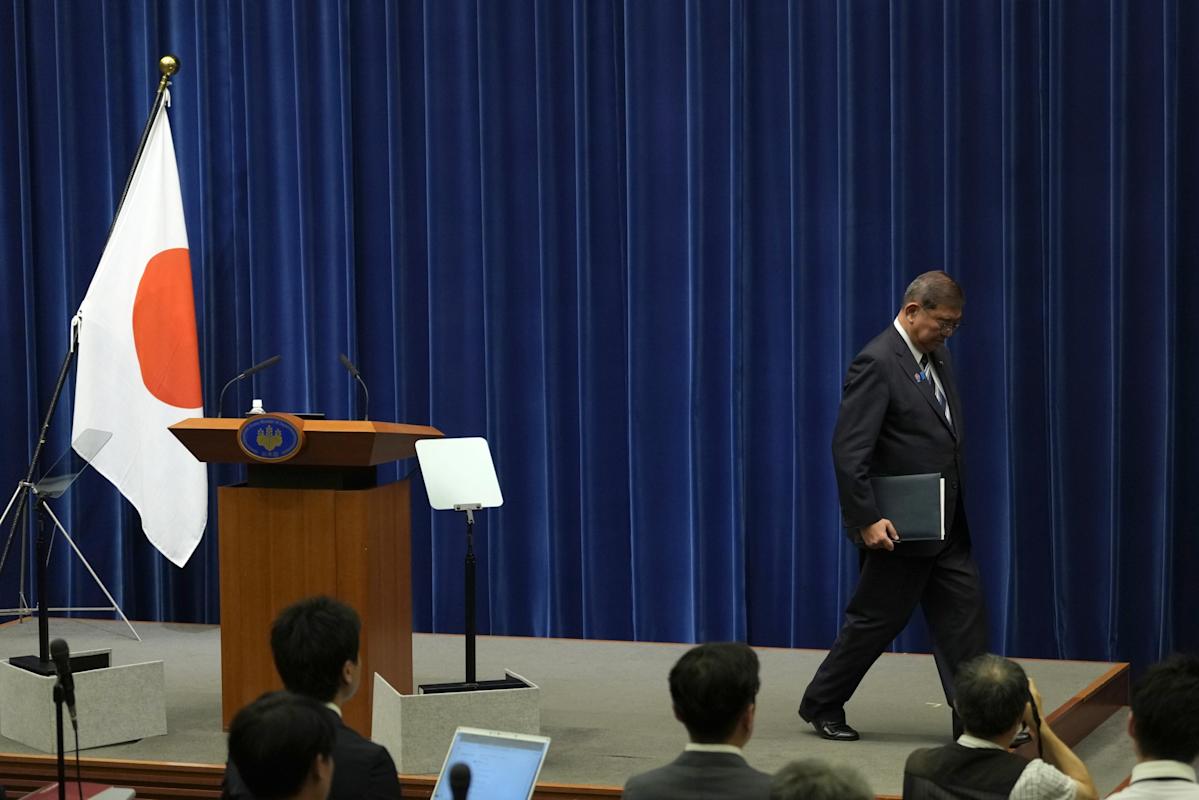
Shigeru Ishiba departs after resigning during a news conference in Tokyo, on Sept. 7.
(Bloomberg) — Japanese markets face more instability as investors prepare for the departure of Prime Minister Shigeru Ishiba and the guessing game of who comes next.
Most Read from Bloomberg
The yen slid 0.7% against the dollar in early trading Monday, after being among the weakest of its Group of 10 peers last week. Japanese stocks, which often benefit from the currency’s depreciation, advanced.
Long-maturity Japanese sovereign bonds stand out as being particularly vulnerable to selling when trading gets underway, given heightened concerns over government spending. The rally in US Treasuries on Friday has some potential to temper the initial moves in Japanese debt on Monday. Futures for the benchmark 10-year bond were fractionally higher.
WATCH: From the US to Japan, governments are having to pay investors more to get them to lend money by buying bonds.Source: Bloomberg
Although expectations for Ishiba’s eventual departure have been present following his ruling party’s poor election showing in July, traders are still trying to determine how much fiscal stimulus may come with potential successors, and to what degree any change could slow the next interest rate hike from the Bank of Japan.
“With the LDP lacking a clear majority, investors will be cautious until a successor is confirmed, keeping volatility elevated across yen, bonds and equities,” said Charu Chanana, chief investment strategist at Saxo Markets in Singapore. “Near-term, that argues for a softer yen, higher JGB term-premium, and two-way equities until the successor profile is clear.”
Any further spike in JGB yields would be of concern to global markets, which have been on guard for more spillover from Japan into debt trading in Europe and the US. Long-end yields have been rising on renewed fiscal concerns across major economies.
“While it remains unclear who will become the next prime minister, it’s difficult to envision anyone with a fiscal discipline stance better than or even equivalent to his,” said Katsutoshi Inadome, senior strategist at Sumitomo Mitsui Trust Asset Management in Tokyo. “The weak performance of ultra-long-term bonds, driven by fiscal concerns, is likely to persist or even intensify.”
What Bloomberg strategists say:
“The narrative will switch to steepening at the super-long end of the curve. The five versus 30-year sector will be a focus for aggressive traders as the short end will garner support from soft Treasury yields.”
— Mark Cranfield, Markets Live Strategist. Read more on MLIV.
The yen, which ended last week around 147.43 to the dollar, is likely to slide toward the 149.10/20 level, said Tony Sycamore, an analyst at IG in Sydney. It traded at 148.45 as of 9:43 a.m. in Tokyo. The Nikkei-225 stock gauge rose 1.8% while the broader Topix index advanced 1.1%.
Nick Twidale of ATFX Global Markets sees a chance that a BOJ rate hike comes off the table this year because of the political backdrop. The yen will be “whippy and horrible to trade,” said Twidale. “Rates traders will also be facing heightened risk.”
Swaps markets suggest almost no prospect of a move by the BOJ at its next policy meeting later this month. They don’t price in a full rate hike until next April, and show a chance of about 44% for an increase by the December meeting of this year.
Takuya Kanda, head of research at Gaitame.com Research Institute in Tokyo, had already warned on Friday that yen was in danger of falling all the way back to 150 on the nation’s political backdrop.
Views were mixed on Japanese shares, which would normally be expected to benefit from any more fiscal stimulus and a weaker yen.
Equities uncertainty
“In the Japanese equity market, uncertainty over the political outlook is expected to ease somewhat, leading to a temporary rise,” said Jumpei Tanaka, head of investment strategy at Pictet Asset Management Japan. Then attention is likely to shift to who will become the next prime minister, said Tanaka.
Potential candidates to replace Ishiba within the ruling party include Sanae Takaichi, a former internal affairs minister who favors stimulus measures and would likely prefer the Bank of Japan to take a more cautious view on interest rate hikes.
Takaichi, Koizumi
Agriculture Minister Shinjiro Koizumi, the son of a former prime minister, will also likely step into the fray. Other names include Takayuki Kobayashi, a former economic security minister, Yoshimasa Hayashi, the current chief cabinet secretary, as well as Finance Minister Katsunobu Kato.
“Our main scenario is Takaichi” replacing Ishiba, and she is widely perceived as being dovish on both monetary and fiscal policy, said Ken Matsumoto, a macro strategist at Credit Agricole, who sees market pricing leaning in that direction.
“Koizumi is kind of neutral, so if he wins, it could swing back. Hayashi is more a fiscal hawk, so there’s more flattening implication, if he wins,” said Matsumoto.
–With assistance from Matthew Burgess, Momoka Yokoyama, Hiroko Komiya, Ruth Carson, Kana Nishizawa, Naoto Hosoda and Mark Cranfield.
(Updates with comment from Bloomberg strategist, latest prices.)