In any discussion of drone defense, Gatling-type guns are often presented as a trump card. These rapid-fire weapons, originally developed to defend U.S. warships against sea-skimming missiles, can easily down bigger and faster threats than a 120 mph Shahed drone. On paper they look devastatingly effective, and news reports speak enthusiastically of their “shredding Iranian drones.” But they are not a magic wand to make all drones disappear, and some Shaheds are getting through.
A closer look at videos of these weapons in action, and at their actual capabilities, gives a fuller picture of what is really happening – and the crucial role of ammunition supply.
The Last Line Of Defense
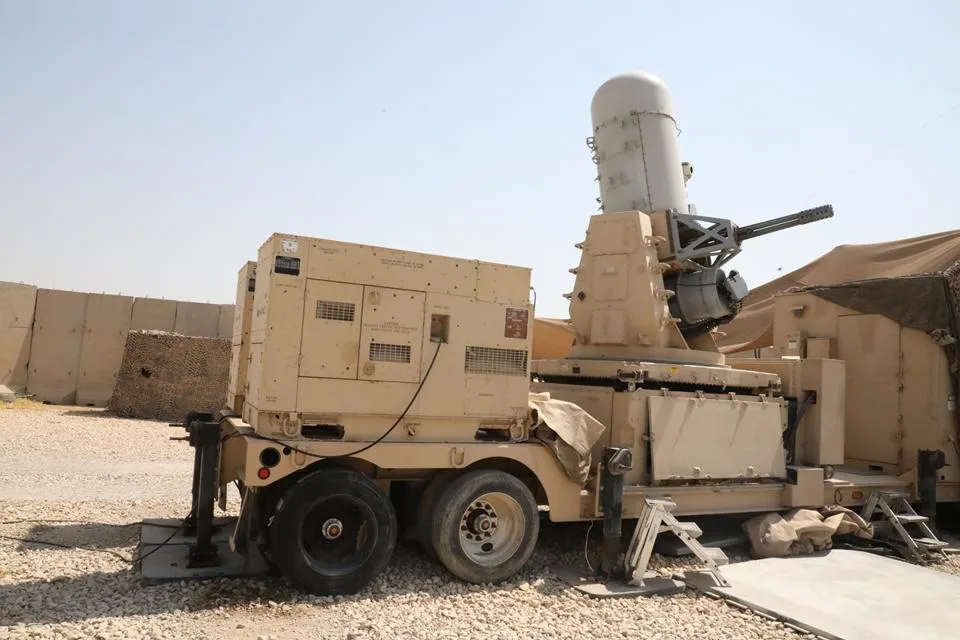
The Centurion C-RAM (“Counter Rocket, Artillery and Mortar”) was first deployed in Iraq in 2006 and is a land-based variant of the original Phalanx CIWS (“Close In Weapon System”) used by the Navy since 1980. It is the last line of defence when urgent action is needed to prevent casualties. The land version is a self-contained unit weighing around 24 tons and costing something over $4 million.

Counter Rocket, Artillery and Mortar (C-RAM) system located at an undisclosed location in the U.S. Central Command area of operations, Aug. 3, 2025
U.S. Army photo by Pvt. Jordan Foster
As the name suggests, C-RAM was introduced to protect bases against rocket, artillery and mortar fire. It has an integrated radar which tracks incoming projectiles as well as the stream of rounds fired by the 20mm M61A1 Gatling gun to put them on target.
The cannon is the same as that carried by F-15 and F-16 fighters. Its distinguishing feature is its phenomenal rate of fire, the six electrically-powered spinning barrels selectively firing 3,000 to 4,500 rounds per minute – that is 50 to 75 per second — producing a sound like a buzzsaw, often rendered as “Brrrrt.”
While the Navy version fires solid tungsten projectiles, CRAM uses the M940 Multi-Purpose Tracer – Self-Destruct round. This weighs 3.5-ounces/99 gram and consists of a tungsten cone to punch through the target skin, and a body which explodes in a dense mass of fragments inside the target. “Tracer” means the round produce a visible glow, and in operation the stream of projectiles appears as a bright ribbon reaching out towards the target. Automated tracking shifts aim until that ribbon overlaps the target.

C-RAM at at Erbil Air Base, Iraq, July 9, 2025 showing ammunition feed.
U.S. Army photo by Sgt. Steve Asfall
The “Self-Destruct” part means that the rounds automatically explode at a range of around 2,300 meters if they miss the target, an effect also highly visible on videos of CRAM engagements. CRAM is a point defense system placed to protect high-value assets. If a drone strikes just couple of miles away the operators can only watch.
CRAM has a magazine of 1,500 rounds. This sounds like a lot, supplying 30 one-second bursts of 50 rounds each. But it is only enough for 10 two-second bursts at the higher rate of fire. It reportedly takes some 30 minutes to reload CRAM manually with 15 boxes of ammunition each weighing around 60 pounds.
Each M940 round costs $168, so a 150-round burst costs around $25k, comparable to the price of a Shahed.
Centurion In Action
Because of the way that CRAM lights up the night sky and how much noise it makes, it is hard to keep its operation secret. In the last month many engagements have been filmed and shared on social media. Some of these are clearly successful.
This video, from the week March 16th-22nd, shows CRAM shooting down a Shahed close to the U.S. Embassy in Baghdad. The drone is visibly hit three times by the stream of rounds in a 2-second burst and falls from the sky.
A second video also from the defence of the Baghdad Embassy and dates March 22nd shows a CRAM firing three bursts – roughly 1 second, 1 second and 3 second duration – downing an incoming Shahed with the third.
In other cases it is hard to tell if the CRAM is finding a target. This video, labeled “CRAM engaging incoming Iranian drones over Erbil, Iraq, earlier tonight” from March 28th shows a 7-second burst of fire with no obvious hits. Another, shot in Syria and posted on March 29th, is a 4-second burst with no outcome. Another showing the U.S. Embassy in Baghdad on March 17th is of a 6-second burst snaking across the sky with no hits.
In some cases the CRAM evidently misses. This March 21st video reportedly shows an attack on a U.S. base in Baghdad, with a 1-second burst followed by an explosion near the firing the location of the CRAM.
CRAM’s Drone Problem
This selective view tells little about the actual rate of hits and misses. A hit on a drone may not be visible in the night sky, as they do not necessarily explode when hit. Equally there may have been many more unsuccessful engagements not filmed.
What we do know is that the reported success rate against rockets and mortar shells in Iraq was reportedly 70-80% with an average of 300 rounds per engagement. These are relatively convenient targets because, although they are moving fast, they come in on a very predictable trajectory and they descend from high in the sky making them easy to pick out on radar.
Tackling drones may be more difficult. Being made of composite material rather than metal, they may have a small radar reflection. And Shaheds can fly at extremely low level, sometimes at under 100 feet with a flight path that takes them between buildings. The level of background clutter will make radar tracking challenging.
In addition, at the Baghdad Embassy the Giraffe 1X radar controlling CRAM was damaged by a drone hit, potentially rendering it useless. This suggests the Iranians knew they had to destroy this first, leaving other targets open to attack.
And unlike rockets and artillery, Shaheds do not need to fly on a predictable path. Some of the Russian versions automatically carry out evasive maneuvers when they sense a threat. As the videos show the stream of rounds can be seen and potentially evaded. This dodging would at the least increase the number of rounds needed for a kill.
And the number of rounds may be a big issue. CRAM was not called on often in Iraq. Multiple systems were deployed across at least five sites in Iraq, but over 16 years of deployments it was reportedly used less than 400 times. This suggests each system on average only fired once every few months nd ammunition was not then a factor.
Judging from what we have seen, CRAM may take several seconds to successfully engage a drone, so they may only be able to shoot down four or five before running out of ammunition. Given that Iran is attacking with waves of Shaheds, one CRAM may not be enough.
There is also the issue of ammunition stockpiles. The U.S. Army only acquired about 20,000 rounds of M940 this year, which one weapon could burn through in five minutes of firing. Additional supplies are likely being procured urgently behind the scenes.
Some Shaheds are getting through, with multiple hits seen in the area around the Embassy in Baghdad. While CRAM looks great and is highly effective in its intended role, it is simply not designed to cope with large numbers of Shaheds.

Sting, a low-cost, long-range alternative to the 24-ton CRAM.
Ukraine MoD
For that task, the sort of small interceptor drones developed by Ukraine, costing a few thousand dollars each and integrated with radar and other sensors may be a far better bet. This is especially true for a long-term conflict when the Shaheds may keep coming night after night.
This article was originally published on Forbes.com