As oil flirts with $100 again, investors are falling back on a familiar script: higher crude, higher inflation.
That reaction is not wrong. Higher crude oil (CL=F, BZ=F) raises the odds of higher prices flowing through the economy. But oil shocks rarely stay boxed inside the inflation story. They spread.
“There is always a release valve,” wrote Alfonso Peccatiello, founder of macro research firm The Macro Compass.
The risk is not only higher inflation expectations. It’s that the shock also lifts the dollar (DX=F) and long-term bond yields before stocks fully reflect the damage. In other words, the first clues may come not from stocks, but from the bond market and the dollar.
Europe offers the clearest example of how an oil shock gets turned into an inflation scare.
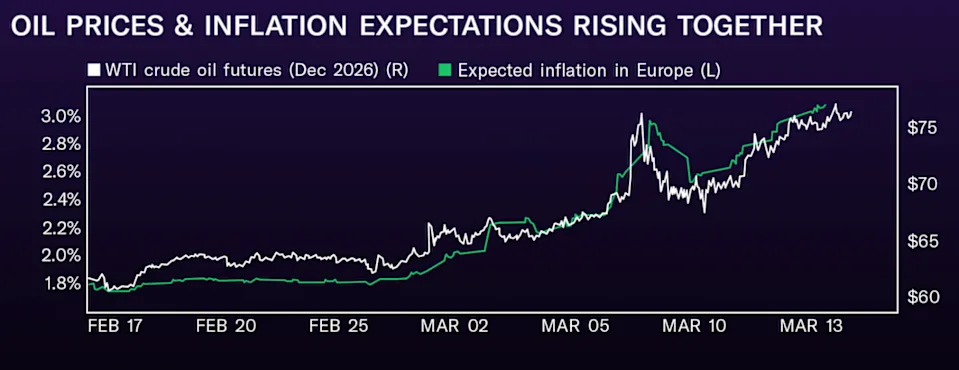
This chart shows expected inflation in Europe rising alongside crude prices for later this year. Europe is more exposed to higher energy costs than the United States, which makes the inflation link easier to see. The bigger question is where the pressure goes next.
Stocks may still not be getting the message.
Bank of America (BAC) analysts argued Monday that markets are focusing more on the inflationary effects of the oil shock than on the risks to growth. Oil is up, the dollar has rallied, and rates markets have scaled back expectations for Fed cuts — yet the S&P 500 (^GSPC) is still within 5% of its all-time highs.
Read more: How to protect your money during turmoil, stock market volatility
The US bond market is already telling a more complicated story.
As I wrote last week, only about half of the recent rise in long-term Treasury yields (^TNX, ^TYX) has come from higher inflation expectations. The rest reflects investors demanding more compensation to hold long-term government debt.
That is one reason the 30-year yield pushing back toward 5% matters so much for stocks. A definitive push above that level risks a fast, disorderly sell-off in bonds that spills over into stocks and other risk assets.
The greenback is sending a similar signal.
The US dollar index (DX-Y.NYB) briefly topped 100 on Friday for the first time since May 2025, before easing back. That pullback, along with softer oil and lower yields on Monday, is taking some immediate pressure off markets. But the bigger risk is that investors may be fading dollar strength too soon if oil stays high and demand for safety returns.
As Peccatiello puts it, when there is cross-asset deleveraging or an energy shock, the US dollar remains a “very viable diversifier.” That is good news for US investors, whose assets are mostly denominated in dollars. But it also tells investors what to watch next.