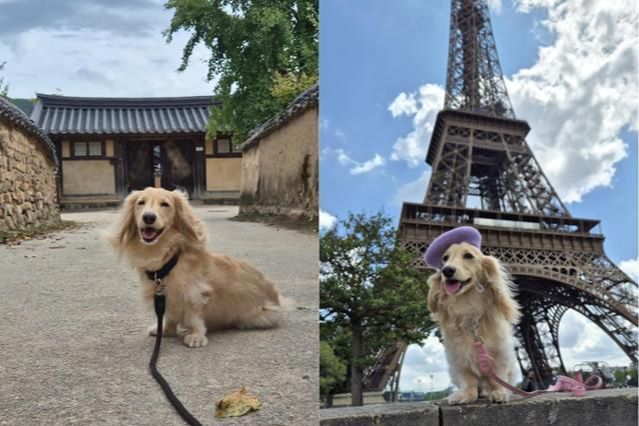
When Kwon, 35, planned a fall camping trip in Yangpyeong, Gyeonggi Province with her husband over the Chuseok holiday, leaving behind their six-year-old dachshund, Malrang, was never an option. “He’s family, so of course he should come with us,” Kwon said.
Malrang, a long-haired cream dachshund, has already traveled to 19 countries — including France, Montenegro and Türkiye — and is now a seasoned “pro traveler.” For Kwon, finding pet-friendly restaurants, cafes and accommodations is as much a part of the trip as sightseeing. This Chuseok, she booked a campsite with a dedicated space where Malrang can roam freely.
According to the Ministry of Agriculture, Food and Rural Affairs, 28.6 percent of Korean households now have a pet, meaning about one in four families lives with an animal companion. And instead of leaving them with neighbors or at pet hotels as they did in the past, more people are choosing to spend time and money to travel together.
Their approaches to pet-inclusive travel are varied. Lee, 28, who adopted a dog earlier this year, purchased a Jeju travel ticket that offers discounted access to pet-friendly tourist attractions and restaurants. “It’s convenient because I don’t have to search for places one by one, and the price is reasonable,” Lee said.
Travel agencies are rushing to meet demand by introducing “petcations” — travel packages that include pet bedding, amenities and even photo shoots. One site’s five-day, three-night pet-friendly trip to Da Nang, Vietnam, is already fully booked, with a waiting list.
Misong and Arong, Ahn’s dogs, sit side by side during a dog trekking event held last year. Courtesy of Ahn
Public agencies and local governments are also supporting pet-friendly tourism. On Oct. 11, the city of Daejeon will host “Dangdang Run,” a dog marathon organized by pet event company 1986 Production and sponsored by the Daejeon Tourism Organization. Participants will receive dog treats and event merchandise, making it a popular choice for those eager to create memories with their pets.
Ahn, 37, who is planning to attend with her dogs Misong and Arong, said, “I wanted to spend quality time with them over the long holiday, so I signed up as soon as I saw the event.” She plans to bring hygiene products, snacks and their favorite blankets.
Taean in South Chungcheong Province, designated as a “pet-friendly tourism city” by the Ministry of Culture, Sports and Tourism and the Korea Tourism Organization in 2023, is receiving 250 million won (about $180,000) in state funding over four years. The county has dubbed October “Go to Taean with Your Dog Month” and launched a range of pet-themed tourism programs. One highlight is the “Mission Tour,” which refunds up to 100,000 won per team for visitors who spend at least one night and complete pet-related travel activities.
Kim, 29, a graduate student and seven-year dog owner, said, “Programs like this make me more likely to choose certain destinations when planning trips with my dog.”
Experts say the rise of pet travel reflects broader changes in family structures and holiday traditions. “The concept of pets as property has shifted — they’re now considered family members,” said Kim Jong-gi, a professor of pet industry design at Tongmyong University. “Spending holidays with pets has become central, and the pet industry is evolving toward shared cultural experiences and a higher quality of life for both humans and animals.”
This article from the Hankook Ilbo, the sister publication of The Korea Times, is translated by a generative AI system and edited by The Korea Times.