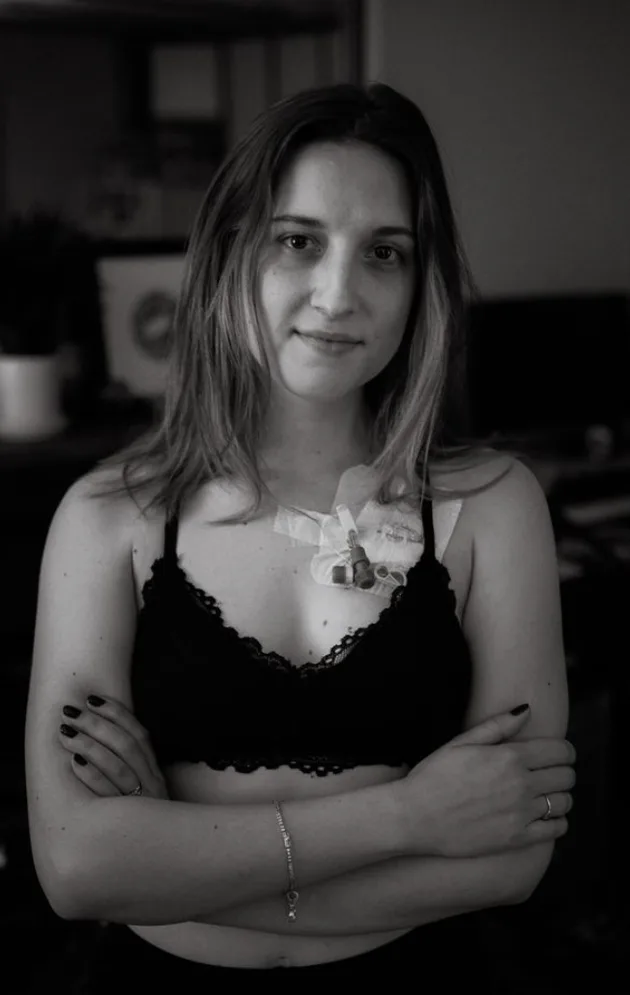
I’m sitting cross-legged on my sofa, trying not to throw up.
Several rounds into a hellish chemo regimen, I’ve whipped up a simple lunch of plain white pasta, but now, I find myself in a tug-of-war against debilitating nausea. I know I’ll feel better if I eat… I just have to will myself to take a bite.
Also Read: The Real Legacy Of ‘ANTM’ Was Showing Young People How To Hate Their Bodies
My phone rings, and it breaks my concentration. I glance at the caller ID, expecting it to show one of the usual suspects: my oncologist’s secretary, the hospital billing department, or maybe my health insurance company. Instead, a friend’s name lights up on my screen. Relieved, I answer.
“Emma!” my friend announces. “I hope I’m not bothering you, but I’ve just read an article online about pasta. Did you know it feeds cancer growth? I wanted to warn you so you can avoid it!”
I stare at the food in front of me. A second ago, it had been the only thing I could bear to think about eating. Now, it’s apparently straight-up cancer fuel.

“This was the evening after my first round of chemotherapy in December 2018,” the author writes. Courtesy of Emma Vivian
When I was diagnosed with aggressive breast cancer at 29, I hadn’t anticipated how many opinions people would have about my illness or how freely they would share them. Friends, family and even strangers began asking me confrontational questions:
Had I eaten too much red meat?
Also Read: I Got Cancer Just As COVID Hit. It’s Shocking How People Reacted In The Years That Followed.
Too much sugar?
Was I — heaven forbid! — chronically stressed?
Each question came with an unspoken implication: If I had only done this or avoided that, I’d never have gotten cancer in the first place. I rationalized that people didn’t mean to hurt my feelings. It was natural to want a tangible reason for a healthy young person to suddenly be facing a life-threatening disease, wasn’t it? I, too, worried I must’ve done something wrong. But when I asked my oncologist, he assured me that nothing I’d done could have caused my illness.
We know that certain risk factors are associated with a higher chance of getting cancer, but only some of these are within our control. Plenty more are not. Environmental hazards and genetic predisposition also have an impact on our chances of getting cancer. And though we may wish otherwise, avoiding known lifestyle risk factors does not safeguard a person from cancer.
Still, it became increasingly difficult to listen to my doctor’s voice of reason while enduring what felt like widespread social judgment. I found myself avoiding social situations for fear of being questioned about my occasional glass of pinot noir or scoop of chocolate chip ice cream.

The author on Haleakala in Maui, Hawaii, a month before her first surgery in May 2019. Courtesy of Emma Vivian
I wasn’t the only one on the receiving end of these unwanted comments. One acquaintance asked my mum if I’d eaten too much meat. Upon learning that I’d been vegan for years, the woman changed her mind entirely and declared I must have eaten too much soy!
On a different occasion, while I was visiting my parents in England, a neighbor waved us over to say hello.
Also Read: I Was 21 When My Doctors Told Me I Had A Year To Live. What Happened Next Left Them Stunned.
“You look well, Emma!” she said to me before turning to Mum.
“This is all your fault, you know, Jane! You must have passed down the genes.”
Another common opinion I heard was that cancer stems from unresolved trauma or suppressed emotions. Countless people suggested that I read “The Body Keeps The Score” by Bessel van der Kolk. Although not primarily focused on cancer, it argues that trauma and chronic stress can weaken the immune system and heighten the production of stress hormones, leading to increased risk of illness. This viewpoint was harder to dispute, not only with others but also with myself. I’d spent years on and off antidepressants and struggling with mental health challenges. I was convinced at times that this must have affected my body.
Still, I can’t help thinking that if anxiety caused cancer, then every one of my friends would have been in the infusion center right along with me.
Also Read: Better Late Than Never: On Friendship, Authoritarianism, And Finally Drawing A Line
Other judgment I experienced centered around how I chose to treat my cancer. I received emails from people trying to convince me not to undergo chemotherapy because they claimed it was unnecessary. Old acquaintances from college — people I hadn’t spoken to in years — were sliding into my DMs and casually asking about my health before suggesting I buy their miracle herbal supplements or invest in some antioxidant mushroom powder.
It hurt that people wanted to make a buck off my illness. And rather than feeling supported, I was expending my already-limited energy trying not to offend the misguided advice-givers and snake-oil salesmen.
Like this article? Keep independent journalism alive. Support HuffPost.

The author at her final chemotherapy session in April 2019. Courtesy of Emma Vivian
Once, while I was in the ER with a fever, a nurse tried to convince me not to have radiation therapy.
“Just look into it,” he warned. “I had a girlfriend who had radiation, and it made her breasts rock hard. You don’t want that at your age.”
Also Read: My Senior Dog Couldn’t Walk Anymore. Before She Passed, She Led Me To My Husband.
Barely covered by a flimsy hospital gown, I felt exposed. Radiation wasn’t even part of my treatment plan!
Victim-blaming is an unfortunate byproduct of the just-world fallacy — a widespread cognitive bias that leads people to perceive the world as fundamentally fair, where good begets good and being “bad” leads to negative consequences. Due to our typically chaotic existence, we seek order and predictability to employ as psychological Band-Aids.
I came to understand that people weren’t only concerned about my health, but their own, too. It seemed they believed — consciously or not — that if they could determine the reason I fell ill, perhaps they could avoid the same fate.
Since my diagnosis, I’ve spent years organizing meet-ups for other young people with breast cancer. Time and again, I hear my own experiences echoed among my peers. At this point, I’ve lost count of how often I’ve had to reassure a newly diagnosed person that they’re not to blame for getting sick.
Tragically, I’ve also lost several friends to metastatic breast cancer. These were women who did everything they could to treat their disease. They ate healthy, home-cooked, organic meals, got plenty of exercise and avoided alcohol. Some participated in community support groups, while others attended spiritual healing retreats. Some took supplements, vitamins and herbs, and others participated in clinical trials. Each of them underwent every medical treatment available to them.
Now, whenever I hear someone parroting the same tired cancer myths, I feel angry on behalf of my friends and all the people who’ve lost their lives to cancer.
If it were as simple as limiting risk, my friends would still be here.
Statistics show young adults are more likely to be diagnosed than ever before. In particular, cancer among young women has skyrocketed, with diagnosis rates in women under 50 now 82% higher than in their male counterparts. Several theories for this alarming increase have been proposed — including the modern diet, exposure to antibiotics, microplastics, and artificial light — but for now, no clear-cut answer has been found.
Some oncologists note that the cancers they see in their younger patients seem to defy explanation and are affecting people who are far more health-conscious than in previous generations. Researchers at Memorial Sloan Kettering Cancer Center are even exploring the idea that an environmental exposure or multiple exposures, present since the mid-20th century, could be partly to blame.
If these increasing diagnosis rates are related to the progressively toxic world we live in, then the sad truth is we have limited power as individuals. We simply cannot protect ourselves from every environmental exposure, many of which are not even fully understood. You can cut out all the sugar and plastic Tupperware you want, but you can’t change the air quality in your hometown.

The author with her dogs Flynn and Suki in May 2025. Courtesy of Emma Vivian
My community work has taught me that the emotional needs of someone with cancer are as diverse as people themselves. So if you’re not sure what to say or not say to someone with cancer, I think it’s best just to ask what kind of support they need. If they want your opinion on staying cancer-free, they’ll likely ask for it. Otherwise, please trust that their oncologist has things covered.
My cancer is now in remission, and I’ve developed a thicker skin. I’ve learned that not everyone knows how to talk to someone who’s sick, and even the most misinformed advice usually comes from people who probably believe they’re helping. Even so, I wish people had spent less time policing my plate and more time providing emotional support.
I long for the day when a newly diagnosed person doesn’t find themselves suddenly responsible for explaining their illness. When, instead of being asked, “Why did this happen to you?” they only ever hear, “How can I be there for you?”
So please, don’t ask me if I still drink wine.
You probably won’t like my answer.
Emma Vivian is a writer based in Los Angeles. She writes Attempts at Optimism, a Substack about staying hopeful in a complicated world, and is currently working on a memoir about surviving breast cancer in her 20s and losing her childhood best friend to the same disease. You can find her at emmavivian.com.
Do you have a compelling personal story you’d like to see published on HuffPost? Find out what we’re looking for here and send us a pitch at pitch@huffpost.com.