As British households prepare to put away the Christmas decorations for another year, many will also be thinking about a clear-out ahead of a fresh start for 2026.
As well as Christmas trees and the odd unwanted gift, expect to see plenty of families scratching their heads over how best to declutter their homes and throw away mountains of ‘stuff’ that should have been discarded months ago – many of which will be made from plastic.
Cheap, light and (mostly) durable, plastic is ubiquitous in UK homes, and used in everything from food packaging to toys to kitchen utensils.
But consumer confidence in what can – and can’t – be recycled often remains an obstacle to more people sifting through their rubbish and putting it in the correct bin.
According to a study by the climate action charity WRAP, 82% of UK households add one or more items to their recycling collection that is not accepted locally. A study by the British Plastics Federation (BPF) found that 70% of people would recycle more plastics if they were better informed on which plastics can be recycled at home.
Worryingly, official figures show that overall recycling rates have ‘plateaued’ in recent years, with the government hoping that a series of initiatives will raise that figure, including a new approach to household recycling that comes into force this March.
But, in the meantime, there’s plenty people can do – including being more aware of what the recycling symbols on plastic packaging actually mean.
What do the recycling symbols mean?
While recycling can be a bit of a minefield, most manufacturers try to help out with labels to indicate what something is made of and if – or how – it can be appropriately recycled.
However, just because a product does not have one of these labels, it does not necessarily mean it cannot be recycled.
If in doubt, check the materials and check with your local authority.
Recycling campaign group Recycle Now, which covers England and Northern Ireland, has put together a handy guide for how to identify which plastic products you can recycle.
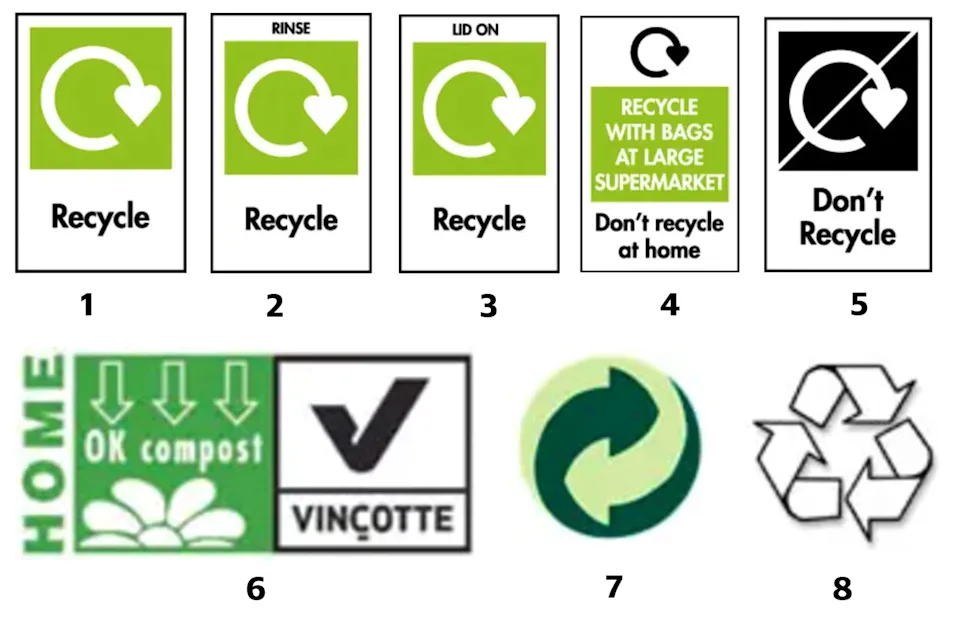
Symbols and icons on products and packaging can give lots of information for recycling – if you know what you’re looking at.
Here’s what they mean:
1. One of the most commonly seen recycling labels, this indicates the packaging is widely collected by local authorities for sorting, processing and recycling.
2. Like the previous label, but with additional instructions for making the product suitable for collection, in this case, rinsing or cleaning. This is often used on food packaging to minimise contamination and deter vermin.
3. Again, like the previous two labels, this indicates a product can be recycled, but with specific conditions. This is usually used for things like soft drinks and milk cartons that have an attached lid.
4. This usually indicates that while the item can be recycled, it may not be accepted by the usual household kerbside collections (although you should always check with your local authority first). Many supermarkets and other large stores can recycle such products.
5. This badge is applied to materials that are collected by less than half of UK local authorities. This is because the product is not recycled or because part of it cannot be.
6. The ‘Seedling’ indicates the packaging it is stamped on is industrially compostable. Compostable plastics which carry this symbol should be recycled with garden waste.
7. The ‘Green Dot’ symbol indicated the company producing the product contributes financially to recycling schemes, but this does not necessarily mean it is recyclable.
8. The ‘Mobius Loop’ is perhaps one of the most recognisable but also misunderstood recycling symbols. This indicates that an object is capable of being recycled, but is not an indicator of how widely accepted for recycling it is. Sometimes it may include a percentage in the middle to demonstrate how much recycled material it contains. Plastic bottles, glass jars and newspapers often carry the ‘Mobius’ symbol to show they have been produced from recycled materials.
What plastic recycling changes are coming in 2026?
Plastic recycling in England is in line for a major overhaul this year thanks to the government’s Simpler Recycling initiative.
From March 31, all local authorities in England will be required to collect “core recyclable waste streams” (glass, metal, plastic, paper and card, and food waste) from all households in England to eliminate the current ‘postcode lottery’ faced by households.
This is also intended to standardise recycling across areas, with paper and card to be collected in one bin, while other recyclable materials – such as plastic, glass and metal – will all be collected in another.
Even heavy snow doesn’t stop bin collections in Aberdeen, Scotland. (Alamy)
Households should eventually have four waste containers for:
-
Other dry recycling such as plastic, metal and glass
-
Food waste (mixed with garden waste if appropriate)
More plastics that previously ended up in landfill or incinerators recycled from kerbside bins are due to be added to this from March 31, 2027.
This includes some plastics that some British people might have assumed are already being recycled, but are not, such as plastic films and so-called ‘scrunchable’ plastics.
Any plastic which is labelled as ‘compostable’ or ‘biodegradable’ will remain unable to be recycled in kerbside plastic collections. That includes popular items such as coffee pods.
Plastic bottles that have contained engine oils, paints, antifreeze or white spirit cannot be recycled.
Polystyrene (often used in foam packaging or packing beads) and polyvinyl chloride (PVC) packaging, used in shrink wrap and blister packs, will not be recycled either.
How much plastic does the UK recycle?
It is hoped new recycling initiatives coming into force this year will keep more plastic out of nature. (Getty)
Plastic waste often does not decompose and can last for centuries in landfill or the environment, where it potentially pollutes rivers, oceans and the soil.
Figures on plastic recycling in the UK can be difficult to collate thanks to the sheer amount in circulation, its wide variety of uses and the myriad different types.
A survey last year by campaigners Greenpeace UK and Everyday Plastic suggested British households were binning 1.7bn pieces of plastic packaging a week.
However, while this will include some items which could be recycled, some of the total will also be products such as food wraps and bin liners which are not intended to be reused. For example, some 35.8 million plastic bottles are used every day in the UK, but only 19.8 million are recycled.
According to Greenpeace UK, just 17% of plastic used in the UK is recycled domestically.
A House of Commons Library report from last year suggested the total figure may be much higher, with 50% of plastic produced in the UK recycled either at home or overseas. It also reiterated the UK’s stated goal of eliminating avoidable plastic waste by the end of 2042.