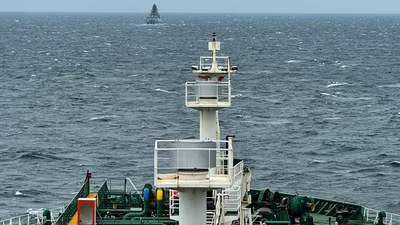
Donald Trump says he is talking to Iran’s leaders about ending his bombing campaign; Iran says he is not. But what he certainly is doing is preparing an alternative, should a negotiated end to hostilities prove elusive. Two amphibious units of US Marines are on their way to the Gulf, one from Japan and the other from California. An elite infantry division which specialises in parachute assault will reportedly soon be following. Their deployment suggests that America’s president is contemplating an attempt to pry open the Strait of Hormuz by force. That is a daunting task.
Around 3,200 ships are stuck in the Gulf, unwilling to risk transit through the narrow Strait. (MEA)
Since the start of Operation Epic Fury, Iran has menaced the strait, snarling roughly 20% of global exports of oil and gas, among other essential cargoes. Nineteen commercial vessels have been struck, inside the Gulf, in the strait and just outside it. Traffic has slowed to a trickle, largely of ships linked to Iran. That has sent commodity markets in particular and financial markets in general into convulsions.
The Pentagon appears to have a three-phased plan to open the strait. The first stage involves hunting down Iranian military assets—speedboats, missiles, drones and mines—that threaten shipping in the strait. (Iran’s warships and submarines seem to have already been destroyed.) The hunters are mainly aircraft, but may soon include ground troops. The second phase is sweeping the strait for mines. Last, once Iran’s ability to prey on shipping has been sufficiently reduced, the US Navy would start escorting tankers through the strait. Each stage could take several weeks and would pose considerable risk to American forces.
Iran has many ways to attack ships. Missiles and drones can strike from above. Speedboats loaded with missiles and explosives can swarm ships or plough into them. Beneath the water, mines of various sorts may lurk. And the soldiers and kit used in such attacks are dispersed and hidden in inlets, caves and underground tunnels scattered along hundreds of kilometres of coastline. That makes them difficult to spot and destroy solely from the air.
In recent days, American warplanes have pummelled Iran’s shores. On March 19th General Dan Caine, America’s top soldier, said that fighter jets had dropped 5,000-pound bombs to penetrate layers of rock and concrete to demolish underground bunkers storing anti-ship missiles. America has also sent helicopters and low-flying attack jets, like the A-10 “Warthog”, essentially a flying machine-gun, to strafe Iranian speedboats. American forces say they have damaged or sunk more than 120 Iranian naval vessels and 44 mine-laying ships. “What the US is doing right now is just hammering every cave, building and garage that might house these weapon systems,” says Bryan Clark of the Hudson Institute, a think-tank in Washington. “But it’s hard to really eliminate all the potential threats.”
An idea gaining currency involves deploying special forces or Marines on nearby islands to spot and destroy targets nestled in rugged terrain. Military officials are reportedly weighing the seizure of Kharg Island, Iran’s main oil-export terminal, or three islands under Iran’s control but claimed by the United Arab Emirates just inside the strait. In addition to searching for threats, these troops could set up short-range air defences to help protect shipping, points out Mark Cancian of the Centre for Strategic and International Studies, a think-tank.
But deploying troops would be risky. They would be well within range of Iranian artillery, not to mention drones. Moreover, they would need to be resupplied, putting yet more planes and ships in harm’s way. Their presence might also bring only a limited benefit. Iran’s Shahed-136 drones can fly more than 1,500km, so can hit anywhere in the strait or the Gulf from nearly anywhere in Iran.
Clearing mines would be equally fraught. There are conflicting reports about whether Iran has deployed any, but shipping firms are naturally reluctant to take their chances. Before the start of the war, Iran was estimated to have stockpiled around 6,000 mines of different types. They include moored mines that linger just below the surface and detonate when struck by a vessel, as well as more advanced devices that sit on the seabed and are triggered by a ship’s magnetic or acoustic signatures. Though America has sunk many of Iran’s mine-laying craft, commercial or fishing vessels can be used instead. “Any ship can be a mine-layer,” points out James Foggo, a retired admiral.
The US Navy has long neglected mine warfare. In January, with terrible timing, it scrapped its last Avenger-class mine-clearing ships based in the region. Two of the three vessels that replaced them, “littoral combat ships” with mine-clearing equipment, are not in the Gulf, and must make their way from Asia. On arrival they can deploy helicopters with airborne detection systems and underwater drones which can both search for and disarm mines. But these systems have not yet been used in battle and have suffered a series of technical glitches in testing. Mr Clark reckons that clearing the strait could take anywhere between one and three weeks. At some point officials will have to “rip off the band-aid” and begin escorting ships without complete certainty that all threats have been eliminated, he adds.
Escorting tankers through the narrow strait would be the most complex and perilous phase of the operation—and potentially an open-ended one. Convoys would require dozens of drones, attack helicopters and fighters circling protectively overhead, as well as airborne warning and control aircraft to spot incoming missiles and drones. Warships would use short-range guns or electronic warfare systems to disable incoming drones and pricier and scarcer interceptors against missiles. Maritime experts reckon that the navy would need a destroyer to accompany every couple of tankers, given how closely they will travel together through the strait.
The navy currently has 14 destroyers in the region, but six of them are busy protecting aircraft-carriers. Bringing more destroyers to the Gulf could take weeks, and would divert yet more American forces from other parts of the world, such as Asia. Although America’s allies might be willing to help, most have baulked at sending ships while the war is still under way. Whoever undertakes it, such a mission would be extremely expensive and use up yet more of America’s and its allies’ dwindling stocks of anti-missile munitions.
The geography of the strait also poses problems. It is barely 50km wide at its narrowest, and hemmed in by mountains, so American warships will have only limited time to detect and parry incoming missiles and drones. They will also need to execute tricky manoeuvres in strong currents to keep close formation with the ships they are escorting. And all of this presumes that there are commercial ships willing to run this gauntlet.
America’s navy has gained valuable experience in recent years battling the Houthis, a militia in Yemen allied to Iran, Mr Foggo points out. But Iran’s arsenal is more sophisticated—and its resolve may be greater, since the regime is fighting for its survival. “They’ve been husbanding their resources for this purpose for decades,” says Mr Clark. “They’ll be able to continue this for as long as we’re willing to do it.”