President Trump hailed the rescue of the two U.S. airmen at a news conference on Monday, and he deserves his share of the credit. God knows he’d have been blamed had the high-risk mission failed. Involving more than 150 aircraft, this was “one of the largest, most complex, most harrowing combat searches” ever attempted, Mr. Trump said. “It’ll go down in the books.”
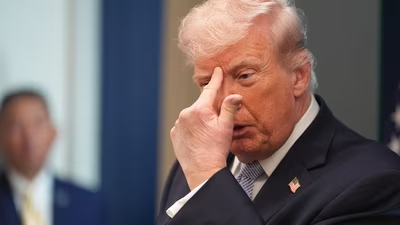
US President Donald Trump. (AP)
Gen. Dan Caine, chairman of the Joint Chiefs of Staff, put it well. “The nation needs to know this,” he said. “This was an incredibly brave and courageous mission and a testament to the courage, skill and tenacity of the joint force and our leaders. Especially a daylight option—having the guts to try means so much to so many.”
Americans in uniform saw the nation’s commitment. Adversaries saw how a U.S. joint force was able to pull this off, rapidly, a mere 30 miles from a major Iranian city. CIA Director John Ratcliffe said U.S. intelligence showed the Iranian regime was embarrassed.
But not embarrassed enough to cease inflicting damage on their own country, alas. On Monday state media said Iran had rejected a temporary cease-fire in exchange for reopening the Strait of Hormuz. Controlling the Strait is Iran’s only defense at this point, since two shootdowns out of 13,000 U.S. combat sorties does not an air defense make.
The regime countered by demanding a permanent cease-fire and full sanctions relief but without the nuclear and other concessions to make it worth the ink.
This directs all eyes to Mr. Trump’s Tuesday night deadline for Iran to reopen Hormuz. He could always delay it again, but at his news conference he laid out what he’d need to see. “We have to have a deal that’s acceptable to me,” Mr. Trump said, “and part of the deal’s going to be we want free traffic of oil and everything else.”
If not, “we have a plan,” the President said, “where every bridge in Iran will be decimated by 12 o’clock tomorrow night. Where every power plant in Iran will be out of business.”
We will soon find out who’s calling whose bluff, but don’t expect Iran’s regime to care much about what strikes like those would do to its people. Taken literally, Mr. Trump is proposing to hit many targets that would harm Iranian civilians, which could spark a refugee crisis.
Striking indiscriminately at critical infrastructure would be wrong as well as unwise, punishing the Iranian people we need on our side. “They would be willing to suffer that in order to have freedom,” Mr. Trump said. Regime mismanagement has already left Iran’s grid in a permanent state of crisis, but such an attack could give Iranians all the suffering with none of the freedom. It could also erode support for the war at home and abroad.
The obvious solution is to discriminate between types of infrastructure. Bridges can be legitimate targets, but it depends if they have any military use of note. Otherwise, why punish the people?
Energy sources can also be legitimate targets if they have a particularly notable military nexus, such as providing fuel for missile launchers. But not every energy target will meet that standard, and the military benefit doesn’t justify plunging 90 million people into darkness.
One yardstick by which to judge any U.S. escalation is this: In addition to increasing “pressure,” which may never be enough to sway Iran’s regime, will it help prepare an operation to reopen Hormuz? The U.S. has a strong interest in causing chaos for Iran’s military, and targeting can allow it to do so without bombing every power plant in the country.