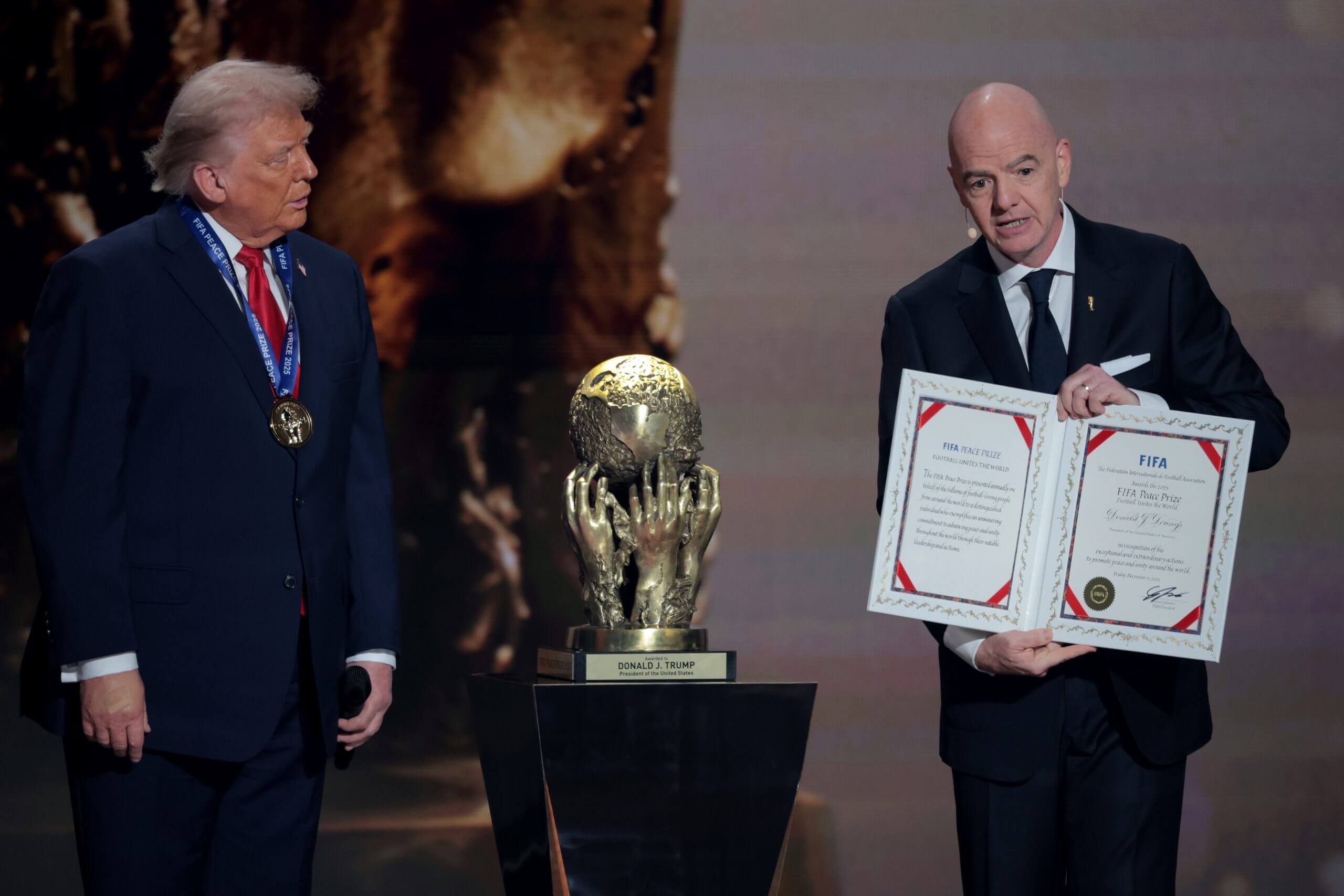
When FIFA leader Gianni Infantino gifted Donald Trump a specially created Peace Prize at December’s World Cup draw, he did not expect to see, three months later, the U.S. president warning a World Cup team of fatal consequences if it dared to venture to the tournament this summer.
This, however, was the predicament facing FIFA’s president on Thursday morning, as Trump posted on Truth Social to say it would not be “appropriate” for Iran to play at the World Cup “for their own lives and safety.”
This, to be clear, appeared to be the most important political figure of a World Cup host nation implying a threat to the security of a soccer team, which, for FIFA, surely constitutes diplomatic armageddon. By Thursday evening, the Iranian soccer federation had responded, saying the only team whose position should be at risk is the nation “who lacks the ability to provide security for teams participating at a global event,” by which they meant the U.S.
Not longer after, Trump was back online, this time claiming the World Cup would be “the Greatest and Safest Sporting Event in American History… All Players, Officials, and Fans will be treated like the ‘STARS’ that they are.” A climbdown of sorts, perhaps, but with no direct mention of Iran.
The Iranians tagged Infantino in their Instagram story, dragging him further into the quagmire of geopolitics. This, of course, is after Infantino praised Trump as his chosen winner of a prize that rewards “the outstanding contribution of those who work hard to end conflicts and bring people together in a spirit of peace.”
For Infantino, it poses obvious questions, most notably about how, or if, Iran can play in this summer’s tournament. More broadly, it calls into question Infantino’s entire judgment and strategy in handling Trump.
Infantino’s approach has been a procession of knee-bending public gestures, which, when taken together, lay bare the extent to which he has been prepared to degrade both his and FIFA’s reputation at the altar of Trump’s good graces.

Infantino presents Trump with the inaugural FIFA Peace Prize (Kevin Dietsch / Getty Images)
To many, the abiding memory will be the World Cup draw, when Infantino gave Trump a trophy, a medal and a certificate, as well as a FIFA-produced video that promoted Trump’s (contested) claims about his supposed role in ending multiple conflicts across the world. Infantino even organized for Trump’s favorite singer, Andrea Bocelli, to open the show, and for Village People to sing Y.M.C.A., which has become a Trump anthem, to close it.
These examples, however, only scratch the surface.
There was the World Economic Forum in Davos in 2020. Infantino, who came to know Trump through the North American bid to host the 2026 World Cup, introduced him to make a speech to leading CEOs.
“President Trump is definitely a sportsman,” Infantino gushed. “I am lucky enough in my life to come across some of the most talented athletes in soccer. And President Trump is made of the same sort of fiber. He is a competitor.
“He says actually what many think, but more importantly, he does, then, what he says. And this brings the American Dream to reality.”
Little wonder, therefore, that Infantino clung to Trump’s coattails upon his return to the White House in 2025. In December 2024, shortly after Trump’s election victory, Infantino invited Trump’s daughter, Ivanka, his son-in-law, Jared Kushner, and grandson, Theodore, to attend the FIFA Club World Cup draw in Miami, with Theodore even making the ceremonial first pick. Since then, Infantino has allowed Trump to keep a replica of the Tiffany & Co. gold-plated Club World Cup trophy in the Oval Office, as well as a replica of the World Cup trophy itself, each provided by FIFA.
Infantino also attended Trump’s pre-inauguration rally, wearing a red tie, having visited the president’s Mar-a-Lago resort just a few days earlier. He then attended the inauguration itself, filmed giddily laughing along as Trump said the Gulf of Mexico should be renamed the Gulf of America. This, as you can imagine, did not go down particularly well with politicians or soccer officials in Mexico, one of the World Cup cohosts. Not that Infantino has ever appeared sensitive to the optics of appearing too close to his ally, even as trade wars ignited with Canada (the other World Cup cohost) and Trump mused over making Canada the U.S.’s 51st state.

Infantino introducing Trump at an event at Davos in 2020. (Jim Watson / AFP / Getty Images)
Since then, Infantino has taken every step imaginable — and unimaginable — to please and appease Trump. He opened an office for FIFA in New York City’s Trump Tower and abandoned FIFA’s plans and extensive negotiations to hold the World Cup draw in Las Vegas, instead switching to the Kennedy Center on Trump’s recommendation. (The Joe Biden-appointed board members of the Kennedy Center were thrown out at the start of Trump’s second term, with Trump installed as the new chairman.) Infantino recently returned to the venue to attend a premiere of Melania, the documentary about Trump’s wife.
Along the way, Infantino has effectively become an extended member of Trump’s traveling entourage, joining him on trips to Qatar and Saudi Arabia last May, which caused him to turn up several hours late to FIFA’s own congress in Paraguay. This triggered a walkout by European executives, who accused Infantino of accommodating “private political interests” ahead of the sport he is supposed to represent. Infantino claimed he was in the Gulf region acting in FIFA’s best interests.
We then witnessed the surrealism of Infantino’s news briefings alongside Trump in the White House. We can refer to the time Trump warned that host cities, including Seattle and Los Angeles, may be in danger of having their games relocated due to “safety” concerns, where Infantino blankly nodded along, on the same day Trump said he would be prepared to launch “strikes” in 2026 World Cup cohosts Mexico due to concerns about drug trafficking.
Or as Infantino stood by, presenting Trump with a No. 47 FIFA jersey (Trump is the 47th U.S. president), during a news conference alongside Italian team Juventus on the day of a Club World Cup game in June. In the same meeting, Trump attempted to goad Juventus staff into a row about transgender representation in women’s sports, and floated regime change in Iran in front of baffled U.S. players Tim Weah and Weston McKennie.

Infantino and Trump with Juventus players in the Oval Office (Brendan Smialowski / AFP / Getty Images)
Let us not forget, either, the peculiarity of Infantino joining Trump for the White House’s first “Crypto Summit.” Infantino said: “FIFA is very interested under my presidency to develop the FIFA coin to do it from America and conquer the five billion soccer fans in the world.” FIFA has since not provided further information.
Infantino has now made more appearances in Trump’s Oval Office than any world leader during Trump’s second term. Infantino last month joined a meeting of Trump’s newly-formed Board of Peace, an organization so far shunned by America’s NATO allies, partially because many were fed up of his repeated threats to annex Greenland.
That did not stop Infantino though, who was photographed at the event, with a toothy grin, while wearing a Trump baseball cap. Trump claimed FIFA had agreed to raise $75 million to help rebuild Gaza, with FIFA revealing a three-step plan which it claimed a 20,000-seat national stadium would be built within three years of work commencing. An AI video shown at the event appeared to show a stadium constructed besides rows of tents. Trump said that FIFA would get “the greatest stars in the world to go there.”
This became a problem for Infantino because, very quickly, the leader of the Board of Peace appeared to be bored of peace, and U.S. forces followed up the arrest of Venezuelan leader Nicolas Maduro by taking out the Iranian Ayatollah. Now the Iranians want a response from Infantino. And Infantino, so desperate for so long to rub shoulders with the world’s rich and powerful, is discovering there is more to political involvement than photo opportunities and glib soundbites.
The question, for much of Infantino’s behavior, must be why. Why is FIFA’s president appearing so often alongside Trump and appearing to support his policies? FIFA, after all, is supposed to be a politically neutral organization, according to its statutes, and while cooperation is required in host nations, this level of obsequiousness feels without precedent from a sports leader. This even pales into comparison to Infantino’s cozying up to authoritarian leaders in Russia, Qatar and Saudi Arabia, where he has often appeared a servile partner.
The fawning he seems to reserve for Trump is at another level. It has even triggered an official complaint to FIFA’s Ethics Committee, in an eight-page letter alleging “repeated breaches” of FIFA’s duty of political neutrality submitted by FairSquare, a non-profit organization and advocacy group that focuses mainly on global labour migration rights, political repression and sport.
According to some Infantino allies, his years-long charm offensive of Trump has been born of realpolitik. They say Infantino has the president’s ear — perhaps this is what led to Trump’s post reassuring the world that the tournament would be “safe” as FIFA’s crisis escalated on Thursday – yet balancing Trump’s impulses and priorities with FIFA’s own interests is a high-wire act.
There has also been anxiety within FIFA, most notably because of Trump’s hardline immigration policy and how this may impact visa access for participants and fans. On this, FIFA has secured concessions of sorts — FIFA PASS, which ensures prioritized appointments for World Cup ticket holders, but does not guarantee a visa, with applicants still required to go through the usual vetting.
Four competing nations — Iran, Senegal, Ivory Coast and Haiti — also remain under travel bans, with exemptions for participants but not fans. This falls short not only of FIFA’s own expectations but Trump’s own apparent commitments. In a letter dated May 2, 2018, and first reported by The New York Times, Trump wrote to Infantino and said he was confident that “all eligible athletes, officials and fans from all countries around the world would be able to enter the United States without discrimination.”
FIFA also may point to the support they provided for World Cup host cities in lobbying the federal government to provide $625 million in security funding for the competition, which passed through Congress last summer. Funding for security of major international events is also a matter of obvious national security, though, and it would appear peculiar, to say the least, for any administration to not provide such assistance.
Some may also say that by keeping Trump onside, Infantino reduces the risk of domestic U.S. politics interfering in the World Cup itself. For example, Trump’s threats to relocate games from Democrat-run cities have dissipated, yet there were long-standing contractually agreed events between host cities and FIFA, and the risk of relocation always appeared negligible.
Others who know Infantino take a different view, saying he has become genuinely fond and admiring of Trump’s approach to leadership, and it is not difficult to see parallels between the pair’s vanity or centralized decision-making processes. Infantino, for example, did not consult his own version of a cabinet, the FIFA Council, before dreaming up both the Peace Prize and its recipient.
Recently, Infantino celebrated his 10th anniversary as FIFA president. There were parties at FIFA’s headquarters in Switzerland and Miami. Infantino plastered his self-proclaimed achievements across social media, dreaming up the caption Infantin10. When The Athletic asked one FIFA staff member how they felt about Infantino’s party, the employee wearily replied: “Every day at this organization feels like a celebration of the president.”

Infantino has repeatedly expressed public admiration for Trump’s leadership (Andrew Caballero-Reynolds / AFP / Getty Images)
It is not always easy to see where Infantino ends and FIFA starts, such is the way in which one man’s personality and ego has come to symbolize and dominate the organization’s messaging — in a manner that does evoke comparisons to Trump and his White House.
In Infantino, whether out of pragmatism or ideology, Trump appears to have a genuine advocate. At the American Business Forum in Miami in November, Infantino hailed Trump as a man who “says what many people think” and said he could not understand “negative comments.”
“I am not American, but as far as I understand, President Trump was elected in the United States of America and was quite clearly elected. When you are in such a great democracy as the United States of America, you should first of all respect the results of the election, right?”
The moderator of the discussion did not pause here to ask Infantino’s view on Trump’s questioning of the 2020 U.S. presidential election results, which he lost to Biden.
“He is just implementing what he said he would do,” Infantino continued. “So I think we should all support what he’s doing because I think it’s looking pretty good.”
Now, Infantino finds his tournament trapped in the Trump whirlwind. Will he be of the same view by the time the World Cup begins in June?