WASHINGTON—President Trump sought to reassure skeptical Americans that the war in Iran is in the national interest, arguing that the operation was necessary to decimate a regime threatening the U.S. and insisting that economic pain would be short-lived.

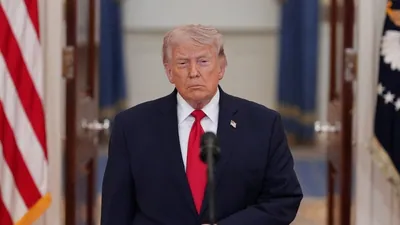
In a 20-minute address from the White House, his most direct sales pitch to the nation since the war began a month ago, Trump said the U.S. had succeeded on the battlefield and declared that U.S. military objectives would be completed “very shortly.”
”Never in the history of warfare has an enemy suffered such clear and devastating large-scale losses in a matter of weeks,” he said.
Trump said he still aims for a diplomatic agreement to end the war. But in the meantime, he vowed to hit Iran “extremely hard” in the coming weeks and pummel the country “back to the Stone Ages, where they belong.”
The Strait of Hormuz, the war’s most notable flashpoint, would “open up naturally” once the war ended, Trump claimed. “They’re going to want to be able to sell oil,” Trump said of Iran, “and the gas prices will rapidly come back down, stock prices will rapidly go back up.”
He encouraged other countries to “build up some delayed courage” and wrest control of the strait from Iran. “Go to the strait and just take it,” he said. “Protect it, use it for yourselves.”
Trump’s decision to deliver the prime-time speech reflected a desire by his advisers to explain the war’s objectives and tamp down concerns that the conflict would become one of the “forever wars” that the president campaigned against.
Trump ticked off the length of time the U.S. had been involved in past conflicts, from World War I to the Vietnam War. Drawing a contrast with those lengthy conflicts, Trump said, “It’s very important that we keep this conflict in perspective.”
Analysts say the U.S. and Israel have achieved tactical military success in Iran, striking more than 12,300 targets, sinking more than 155 vessels and killing senior figures such as Supreme Leader Ayatollah Ali Khamenei. But the monthlong conflict has also led to strategic setbacks: Iran has tightened its hold over the Strait of Hormuz, Tehran’s already hard-line regime has turned more firmly against Washington and the country’s nuclear ambitions have yet to be completely snuffed out.
The president used the address to explain why he launched the war. Iran had posed a threat to the U.S. for nearly 50 years, Trump said, and only grew more dangerous as it advanced in its nuclear work, expanded its ballistic missile arsenal and supported proxies that killed American forces in the Middle East.
“For these terrorists to have nuclear weapons would be an intolerable threat,” Trump said. “The most violent and thuggish regime on Earth would be free to carry out their campaigns of terror, coercion, conquest and mass murder from behind a nuclear shield. I will never let that happen.”
Any effort by Iran to recover highly enriched uranium—what Trump calls “nuclear dust”—buried under rubble after strikes on three nuclear sites last June could take months, Trump said. Should Tehran “make a move” for it, the president warned, “we’ll hit them with missiles very hard again.”
Trump added that Tehran killed 45,000 Iranians during antiregime protests in January, a higher total than the administration previously estimated.
Standing in the same entrance hall where he spoke in 2020 following the killing of Qassem Soleimani, a commander in Iran’s Islamic Revolutionary Guard Corps, Trump said recent attacks have wiped out the country’s leadership, making way for discussions with a “less radical” and “more reasonable” new group of leaders. But if Iran doesn’t reach a deal with the U.S., Trump pledged to launch strikes on the country’s power plants.
If the Strait of Hormuz fully reopens soon, experts estimate that it could take weeks or months for oil and gas prices to return to prewar levels. Since the start of the war, 13 U.S. servicemembers have died and nearly 350 troops have been injured. Trump, in his speech, said the country must honor those who lost their lives, and “finish the job” in their memory.
Iran made missteps of its own, according to U.S. officials and analysts. The country’s decision to target Gulf nations and other neighboring countries has further isolated it, setting back Tehran’s yearslong efforts to build stronger relations in the Middle East. Now, Iran has become a weakened international pariah.
What Iran hasn’t done, despite weeks of fierce attacks from the U.S. and Israel, is surrender to Trump’s demands. “The question at the heart of this war was never whether Iran could be wounded. It was whether coercion would produce capitulation,” said Ali Vaez, project director for Iran at the International Crisis Group consulting firm. “It hasn’t.”
In recent days, Trump asked Vice President JD Vance to deliver a message to Iran: The U.S. was open to a cease-fire as long as certain conditions were met, including the full reopening of the Strait of Hormuz, according to a person familiar with the situation. But Vance also conveyed that Trump’s patience could run out. Trump wrote on social media earlier Wednesday that Iran asked the U.S. for a cease-fire, but Iranian officials said they hadn’t done so.
The president has lashed out at North Atlantic Treaty Organization allies for not doing more to help reopen the Strait of Hormuz and for declining to join the initial wave of strikes alongside the U.S. and Israel. Earlier Wednesday, Trump spoke with one of his closest European allies, Finnish President Alexander Stubb, about NATO and Ukraine after he told aides he was considering pulling out of the trans-Atlantic alliance over its lack of support for the war. Trump made no mention of NATO in his Wednesday evening remarks.
The president’s address came hours after he went to the Supreme Court to hear arguments—a first for a sitting president—that could determine the fate of his executive order to limit birthright citizenship, a pillar of his immigration policy.
Perceptions of the war are mixed and fall largely along party lines, according to polls. In a recent Fox News survey, 80% of voters said they are concerned about the rising cost of gasoline, which has surged as the war affects global energy prices and threatens to muddle Trump’s messaging about the economy going into midterm elections.
Write to Alexander Ward at alex.ward@wsj.com and Meridith McGraw at Meridith.McGraw@WSJ.com