Published on
December 20, 2025
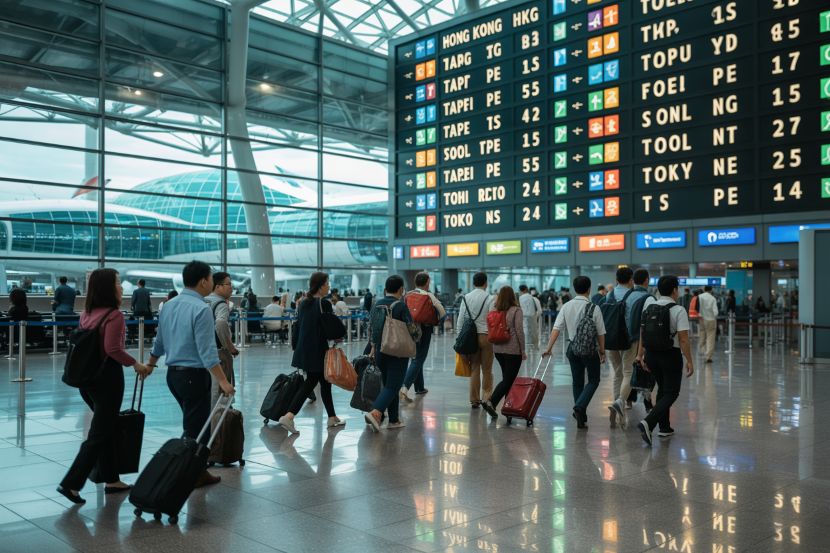
In 2025, Asia once again dominates global air traffic, with several of its routes continuing to hold the top spots for the busiest air sectors worldwide. The Hong Kong–Taipei route remains unchallenged as the world’s busiest international air corridor, marking its second consecutive year at the top. Meanwhile, other major routes across the Asia-Pacific region also witnessed significant activity, underscoring the region’s continued importance in global air travel.
Hong Kong-Taipei: The World’s Busiest International Route
With a total of 6.83 million two-way seats, the Hong Kong-Taipei route has grown slightly from the previous year’s 6.78 million seats. This represents an increase in demand, although it still lags behind its 2019 peak of 7.97 million. The route remains crucial for both business and tourism, facilitated by major carriers such as Cathay Pacific Airways, EVA Airways, and China Airlines, with Cathay leading the market with a 39% share of capacity.
Despite the strong figures, the Hong Kong-Taipei air traffic remains far below pre-pandemic levels, as the sector continues to recover from the COVID-19 disruptions. This dip in overall capacity has sparked concerns over the long-term sustainability of such high-traffic routes.
Other Asia-Pacific Routes Secure Strong Positions
Other routes from Asia have also seen impressive results, dominating the rankings for the busiest international sectors in 2025. Cairo-Jeddah, with 5.7 million seats, continues to serve as the second-most trafficked international route, supported by religious and labor migration flows between Egypt and Saudi Arabia. Meanwhile, Kuala Lumpur-Singapore rose to third place, driven by a 3.2% increase in capacity from the previous year, reflecting the ongoing strength of Southeast Asia’s aviation market.
Notably, Seoul Incheon-Tokyo Narita saw a slight drop in capacity, moving from third to fourth place, due to a 6% reduction in flight availability. Despite this, Seoul-Osaka Kansai held firm in fifth place, boasting 4.97 million available seats.
New York-London: The Sole Non-Asian Contender
New York JFK-London Heathrow continues to be the only non-Asia-Pacific route in the top 10, ranked tenth with 3.97 million seats, a slight decrease from the previous year. The decline in capacity on this critical transatlantic route suggests shifting patterns in travel demand and growing competition from other international corridors.
Asia-Pacific’s Domestic Markets Lead the Way
While international routes are dominated by Asia-Pacific, domestic travel within South Korea has continued to outperform other regions. The Seoul Gimpo-Jeju route remains the busiest globally, with a staggering 14.7 million seats offered in 2025, representing a 3.3% increase from the prior year. The Jeju Island market remains vital for tourism and business travel within South Korea.
Following closely are Japan’s major domestic routes, with Chitose-Tokyo Haneda ranking second globally with 12.1 million seats, followed by Fukuoka-Tokyo Haneda with 11.5 million seats. These statistics showcase Japan’s high demand for domestic travel, spurred by its vibrant tourism and business sectors.
Domestic Growth in the Middle East and Southeast Asia
Beyond South Korea and Japan, other countries in the Asia-Pacific region are also witnessing rapid growth in domestic air travel. Vietnam’s Hanoi-Ho Chi Minh City route saw a rise to fourth place, with 11.2 million seats, while Saudi Arabia’s Jeddah-Riyadh sector jumped to fifth with 9.9 million seats.
In China, the domestic route between Shanghai Hongqiao and Shenzhen Bao’an made a notable entry into the global top 10, surpassing Guangzhou Baiyun-Shanghai Hongqiao in terms of available capacity.
Significant Growth on Domestic Routes Across Asia
While Asia-Pacific routes dominate the busiest lists, there have been significant increases in flight capacity on certain key routes. The Jeddah-Riyadh route in Saudi Arabia saw the largest year-on-year increase, adding over 1.1 million seats. Similarly, the Shanghai Pudong-Osaka Kansai route, despite political tensions between China and Japan, also recorded a notable increase in capacity by 1.13 million seats.
The Cukurova-Istanbul Sabiha Gokcen domestic route in Turkey also showed strong growth, with an increase of about 1.08 million seats, highlighting the robust expansion of aviation capacity in the Middle East and Central Asia.
What This Means for Travelers and Airlines
For travelers, these top routes represent some of the most sought-after corridors for both business and leisure travel. With capacity increasing on many of these routes, it means more opportunities for tourists and business travelers to explore key cities and regions in Asia-Pacific, the Middle East, and beyond. Airlines operating on these routes are also seeing increased demand, with many adding more flights to meet the growing need for air travel.
Travelers can look forward to more flight options, though they should remain mindful of any potential disruptions that could arise due to geopolitical tensions or unpredictable market shifts.
Travel Tips for Navigating Busy Routes
- Book Early: Given the popularity of these routes, travelers should book flights well in advance to secure the best prices and availability.
- Stay Flexible: With frequent capacity changes, particularly in the case of domestic routes, having flexible flight options can help travelers avoid inconveniences.
- Check Alternative Routes: In case of full flights on major routes, consider alternative airports or connecting flights that might offer more flexibility.
Key Statistics Recap:
- Hong Kong-Taipei remains the busiest international route with 6.83 million seats.
- South Korea’s Seoul Gimpo-Jeju is the busiest domestic route with 14.7 million seats.
- Other prominent routes include Cairo-Jeddah, Kuala Lumpur-Singapore, and New York JFK-London Heathrow.