If the good people of Hampshire, England’s sixth most populous county of 1.8 million, want the answer to a burning question about pride, they’ll find it above the urinals at Carshalton AFC in what was formerly the neighbouring county of Surrey.
The citizens of Southampton or Portsmouth may disagree, but there, on a Carshalton cistern, is a statement presented as fact. There’s the name of Aldershot Town, 1992, the year the club was founded after Aldershot FC went bust, and then that declaration: “Pride of Hampshire”.
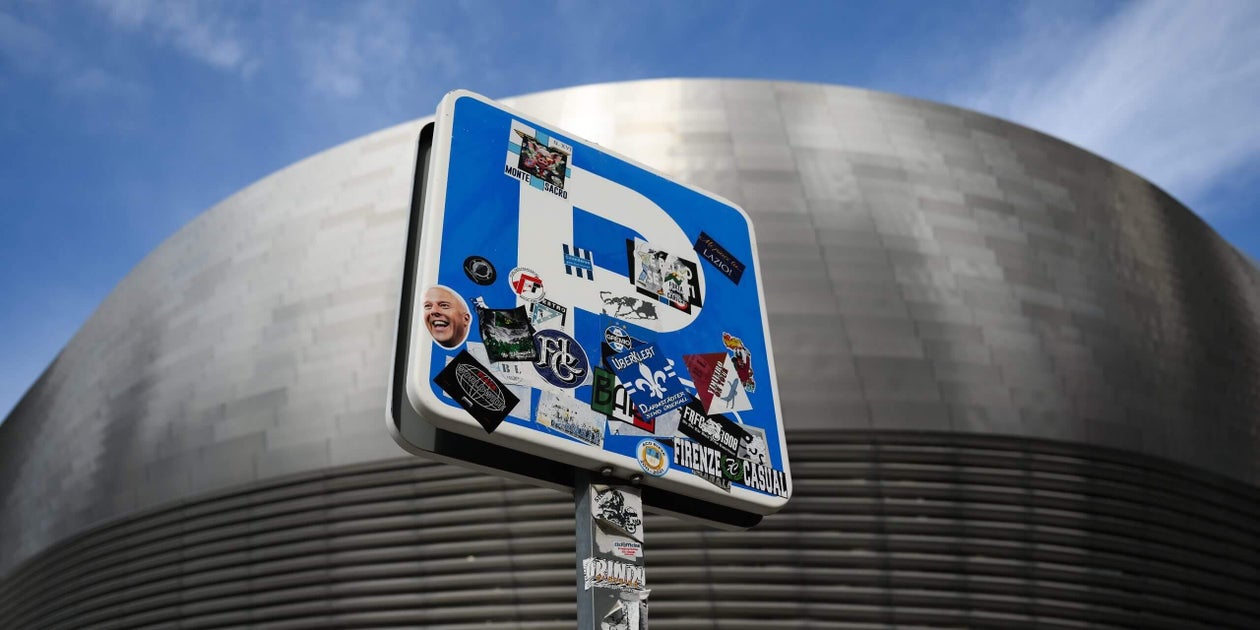
Granted, the statement, printed on a sticker, must jostle for attention with other graphically enticing examples. There’s one from FC Union Berlin, with Union Jack flags denoting the Germans’ English support. There’s also an image of a balaclava-wearing ultra holding a flag. Beneath this is “Bracknell”, hardly a hardcore football-mad city, more a middle-class town in Berkshire with a sixth-tier football club.
Others are more offensive: “Have six fingers” asks one without a question mark but a flow chart arrow kindly pointing towards the next instruction, should you indeed have six fingers: “shag your sister”, followed up with “support Sutton”. That’s Sutton United, a rival team to Carshalton based three miles away. Another is emblazoned with the letters “FIFC” to invoke Folkestone Invicta F.C., juxtaposed with a fist with the word “NOYZ”, the calling card of fan group “the Noyz Boyz”, as well as an old British Rail sign. There’s also a horse sitting on said sign. It’s like AI on magic mushrooms.
Stickers adorn a toilet cistern at Carshalton AFC (Andy Mitten/The Athletic)
You’ll find similar stickers at most British football grounds, and even more in Italy or Germany, where stickers came out of the ’90s ultras scene and spread across northern Europe.
And where Europeans mix – as on the Mediterranean island of Mallorca – you get hit by a plethora of football stickers just leaving Palma airport. From Kaiserslautern to Saint-Etienne, Benfica to Hertha Berlin, they’re all there, slapped on whiteboards or stuck on the side of rental car offices.
Some dogs mark their territory by pissing against a lamp-post and some football fans probably do that as well, but others prefer leaving a small piece of inscribed adhesive paper.
When Manchester United played a January Europa League game in Bucharest, the toilets of several bars in the old town of Romania’s capital were ‘stickered’. There was one with “115 Charges”, a dig at Manchester City and a play on the old odometer that hung from Old Trafford’s Stretford End to mock how many years it had been since City had won a trophy. Others, on a background of red, white and black tricolours, said: “Different Place – Same Old Faces. MUFC. Home, Away Abroad”, “One Love, Forever & Ever” or “Unknown Pleasures MUFC”. The latter, if you are not au fait with Manchester music, is the title of a Joy Division album.
You see similar on flags that hang in bars or away ends, but it’s easier to carry a 10cm sticker than a two-metre flag. You can’t surreptitiously stick a large banner on someone’s back either for a meme-friendly shot of putting West Ham on an unsuspecting Millwall mate’s back, or vice versa.

Stickers cover a car rental sign at Palma de Mallorca Airport (Andy Mitten/The Athletic)
You see them in the toilets at Barnet or Barcelona, Borussia Dortmund or Boca Juniors. There’s a “Just Stop Ollie” sticker on a traffic light on Manchester’s Oxford Road, parodying the style of the former environmentalist protest group Just Stop Oil. That’s Ollie Pearce, centre-forward for high-flying fifth-tier York City. York also boast fellow striker Lenell John-Lewis, and there’s a sticker with “His Name Is A Shop” printed beneath.
Esoteric, in-the-know humour is part of the charm of football fan stickers. How many people stopping at that busy Manchester intersection will have a clue who “Ollie” is? Granted, more may be familiar with “The Pride of Glasgow Town — 1872” above it. Rangers had just been in the city.
And there’s a meritocracy to stickers. It matters not that your team may never play at Anfield or the Bernabeu: you can still put a sticker near the ground for Madrid or Liverpool fans to see, or wherever you may wander.

A York City sticker on a pedestrian call button in Manchester (Andy Mitten/The Athletic)
Matt Ford, who writes about German football, recently spent a few days in New York and was struck by the number of stickers he saw from German football clubs all around Manhattan and the variety of clubs from all levels of German football: Stuttgart, 1860 Munich and SSV Jahn Regensburg were the most cited.
“Congratulations to Regensburg,” wrote Ford. “Consistently punching above their weight in the global German sticker scene against the usual suspects from Dresden & Rostock.” Regensburg may be near the bottom of the third tier of German football, but they can hold their heads high since they have more stickers bearing their name in New York than any rival.
Manchester City stickers have a decidedly anti-UEFA tilt, while Stone Island-style logos proliferate, indicating a penchant for casual culture or hooligan firms associated with the label. Other City stickers are more conventional. “City on Tour”, “Manchester La La La” or an image of Sergio Aguero scoring after 93:20 next to the words “Citeh” in an Oasis-style font. Others feature CP Company-esque lenses with “CITY AGGRO” written above. CP are now official partners of City, showing how counterculture can become monetised.
Digs at rivals are commonplace. One City sticker, on the back of the Germany kit from the 1990 World Cup, spells the words “Uwe’s Grandad bombed the Stretford End” in German. That’s City’s former German striker Uwe Rosler, who City fans have long joked had a grandfather who bombed Old Trafford in the Second World War. It was Old Trafford’s main stand rather than the Stretford End which was hit, but why let a fact get in the way of a sticker joke?

Portsmouth fan stickers pictured in September at Southampton’s St Mary’s Stadium (Charlotte Wilson/Offside/Offside via Getty Images)
And you couldn’t walk around Old Trafford a couple of years ago without seeing “Love United, Hate Glazer” stickers.
These weren’t around during the original protests against the club’s majority owners in 2005, and the sticker scene, if we can call it that, is relatively new, but what is it really and who makes and distributes them? Is it a business or something more homespun?
You can buy 100 various Liverpool stickers for £20 online. Sample selection: “We Are Liverpool — Up the Reds” or the word “Liverpool” in the font of former shirt sponsor Carlsberg. The Adidas trefoil has been appropriated to feature a Liverbird with the words “LIVERPOOL ORIGINALS” on one yellow and red sticker.
These are no mistake-strewn, scruffy musings stuck under a railway bridge, but well thought-out, well-designed mini artworks representing fan culture.
There are many other questions. Are there sticker collectors like badge and programme collectors? Does one graduate from Panini stickers to more adult themes?
Are there any particularly rare cuts, or is it all more haphazard, the work of lone wolves armed with a passport, washbag and 100 stickers when they go to see their team play in a far foreign land?
“It’s born out of nothing more mischievous than humour reflecting terrace culture,” a member of the Ralphie Milne Ultras, who produce and sell stickers, tells The Athletic. The what Ultras?
“We started in 2011 with a red, white and black flag with ‘RALPHIE MILNE ULTRAS’ on it and we had stickers made of that flag,” explains one of the founders who wishes to remain anonymous, not because he’s not authorised to speak publicly on stickers or to protect relationships, but because he’s a middle-aged and responsible man who doesn’t want to be publicly outed as talking about stickers.

A Stockport County sticker referencing Manchester rock band The Smiths on a railing near the club’s Edgeley Park home (James Gill – Danehouse/Getty Images)
“As kids, we watched players like Ralph Milne,” he continues. “It started as a bit of a joke between maybe eight of us. Then we got in touch with him. He thought it was a piss-take (Milne was a top winger at Dundee United but later widely seen as Sir Alex Ferguson’s worst signing at Manchester United) and we assured him that it wasn’t.
“He asked what we wanted from him and we said nothing, bar accepting an invite to a barbecue in Manchester we were hosting in his name. We offered to buy him a ticket and a hotel room, and he accepted.
“He asked if he needed to give a speech and we said his presence was enough. Ralph was superb company and stayed until 1am. What we didn’t know was that he was ill and was doing stuff like this while he still could. We invited him to come again and he said, “We’ll see about that.” There never was a next time. Ralph died.”
At least his final experience with Man United fans was a positive one. And the stickers?
“We might have a little dig, show humour and self-expression,” says this anonymous sticker man. “We don’t set out to upset anybody. The most vicious we’ve been is the 115 charges and the images of the Liverbird being stabbed by the devil, and we also must put a disclaimer onto all our stickers to say that they’re for your own personal domain — i.e. not for defacing public property.
“We have the advantage of having graphic designers. They’re match-going fans who understand the culture”.
In the UK, posting stickers on public property can be considered “fly-posting”, a criminal offence that can be prosecuted under the Town and Country Planning Act 1990, yet it remains a widespread phenomenon.
Aside from any legal ramifications, are there any critics of the practice?
“A couple of older heads would say: ‘Pack it in with your stickers, it’s nonsense’ and we got a kicking in France off Saint-Etienne’s firm in 2017 because the Ralph Milne flag gave away our identity, but that was wrong place at the wrong time, and not because of stickers.”
But there’s clearly a demand.
“We were getting so many orders that the Post Office told us that they’d need to send a van to do the collection. We let it cool down and become more organic. The margins on them are terrible. They’re £9 for 100 stickers, including postage. It’s not a get-rich-quick scheme. It’s a way of fighting back at an increasingly sterile football landscape.
“There are about a dozen packets under the stairs at my house. You can’t go to a motorway services and not see stickers from teams, little and large.”
Is there a favourite?
“My favourite is one that says: ‘I’d rather walk alone’ as I’d grown up with that United-Liverpool rivalry,” says the man from the RMU.
Although those in charge of the cleaning department at local councils may have a different view, it looks like football stickers are here to stay — a less harmful method than spray-paint tagging and a more creative means to show your colours and support your team.