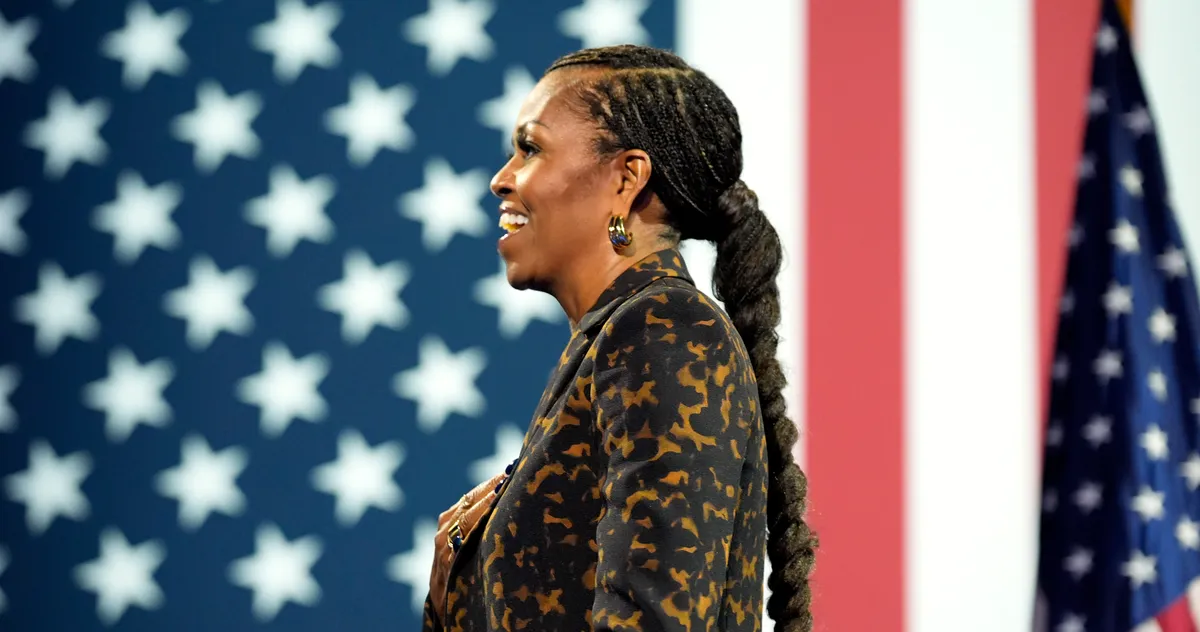
Photo: Jacquelyn Martin/AP
I’ve been thinking a lot about a painting that used to hang outside the Oval Office for a few months when our family was in the White House. A little girl in a sparkling white dress, pigtails and a bow in her hair, is walking to school escorted by four federal marshals in sharp suits. The wall behind her is marred by scrawled slurs and a smashed tomato. It’s Norman Rockwell’s depiction of Ruby Bridges’s march into her first day at a new school — the first day someone who looked like her was allowed inside to learn.
Rockwell took some artistic liberties; when you look at photos, Ruby wore a white sweater over a smart, dark dress and black flats. But the power of the image is the same: This dignified little girl, head held high, her shining appearance reflecting her extraordinary inherent worth. Her image proclaims to the world not simply that she belongs, but that there’s no stopping what she can become. She says all that simply by dressing for school.
It’s an arresting portrait — a testament to perseverance in the face of discrimination and a reminder of how essential government support for civil rights once was and still is. It’s also a statement about the implicit and explicit power in how we show up. Ruby’s outfit is dignified, bright, poised, confident — just like her. The shimmering white sweater and bow hold a truth that no policy can create or take away: No matter what people say about us or hurl at us, they can’t stop us from reflecting our best selves out into the world. When we do that, we have the chance to shine our light a little farther. Lord knows we all need that right now.
I know it’s easy to dismiss what we wear and how we look as frivolous. But that would brush aside a truth we all know: Our appearance sends messages, whether we intend it or not. The way we present ourselves to the world instantly communicates who we are, where we come from, and what we believe. And if we make use of that opportunity, our look can become a warm embrace, an invitation to come closer, to connect with one another.
When I was first campaigning in the early days of my husband’s presidential campaign, I was shocked by the number of articles that led with what I was wearing or some commentary about how I looked. Not the substance of my argument or my law degree or the two darling little girls I was raising, but my “lacy black skirt” or the heels I was wearing. When you’re a woman in the public eye, you’re often reduced to your physical appearance. And when you’re a Black woman, they’ll try to reduce you even further.
Rather than stewing over this reality, I decided that style would become a strategy for me. I would use my visibility to shine a light on our values. If people wanted to see what I was wearing, I wanted them to also see the courageous military mom I was standing next to or the group of kids hula-hooping on the South Lawn for my work to support healthy families. If they looked at the cover of Vogue, I wanted them to see America’s first Black First Lady, because when I was growing up, women who looked like me were hardly ever on the covers of those magazines. If they liked my gowns at an inauguration or state dinner, I wanted them to learn about the up-and-coming designers from nontraditional backgrounds who created them.
Our communities depend on the care and hard work of talented artisans — including many immigrants supporting their families — who use their expert hands and creative gifts to make us feel our best. These industries contribute billions to our economy and support jobs in manufacturing, retail, distribution, and design. So I hoped our work would shine a light on their contributions, too.
Of course, what style means to us evolves over our lifetimes. These days, I’ve become more accustomed to the public gaze and frankly less concerned with the haters. People have begun remarking that I look content. They’re right. I am so deeply grateful for the honor of serving as First Lady. And I’m also grateful for the opportunity to focus more on Michelle Obama, the person. I wear what I want. I do my hair how I want. A couple of years ago, I wore braids to my White House portrait unveiling, a hairstyle that felt like a bridge too far as First Lady. (I was once ridiculed for wearing shorts in preparation for a hike; I didn’t feel like risking the reaction to braids on a Black woman.) But now, I don’t care. I’m having more fun, feeling both wiser and freer.
So the time felt right to finally share my journey of finding my voice through my style. Because while most of us aren’t choosing ball gowns, we are all rifling through our closets and drawers every morning. We’re asking ourselves those often trivialized, sometimes denigrated questions about the way we look. What makes us feel good? What does this say about me? What can I say about my place in the world?
Our answers to these questions matter. Perhaps they don’t affect the arc of history as directly as deciding to get involved in our community or show up at the polls. But at a time when things feel more and more uncertain and unsafe, our look can be a reminder of the truth we all know, the truth we’ve all seen not all that long ago: The strength and beauty in this country is that we don’t all look, speak, think, or vote the same way.
So in the face of those who are trying to flatten the diversity of this country, erase the contributions of those who fall outside a narrow idea of who belongs and who doesn’t, and force us to forget who we are, we can start by embracing our power as individuals. When we show off the breadth of our beauty, we can tap into our collective strength. We can refuse those blink-of-an-eye snap judgments that others will make — and remind them that we’re still here. We’re still beautiful. And we’re still holding our heads high.
That’s the power of a look. Sixty-five years ago, it was a smart dress on the first day of school or your Sunday best at a sit-in. Today, it’s a slogan on a T-shirt during a basketball warm-up or a pair of jeans that you just know you look damn good in when you know you need to be at your best. Every day, with the choices we make, we remind ourselves — and the world — who holds the power over our lives.
Michelle Obama’s The Look, a collection of photographs and stories about Mrs. Obama’s time and wardrobe in the White House, will be published Tuesday, November 4.