Revolutionary futuristic warplanes were developed in the Second World War.
To prevent the enemy from learning the secrets of these new combat aircraft, they were developed and test flown in strict secrecy. Maintaining the secrecy of a loud flying machine is not easy, and demanded ingenious, and sometimes bizarre, to the point of comical, acts of deception or misdirection. Here are the 10 Most Secret Aircraft of the Second World War:
10: Northrop XP-56 ‘Black Bullet’

Northrop XP-56 ‘Black Bullet’
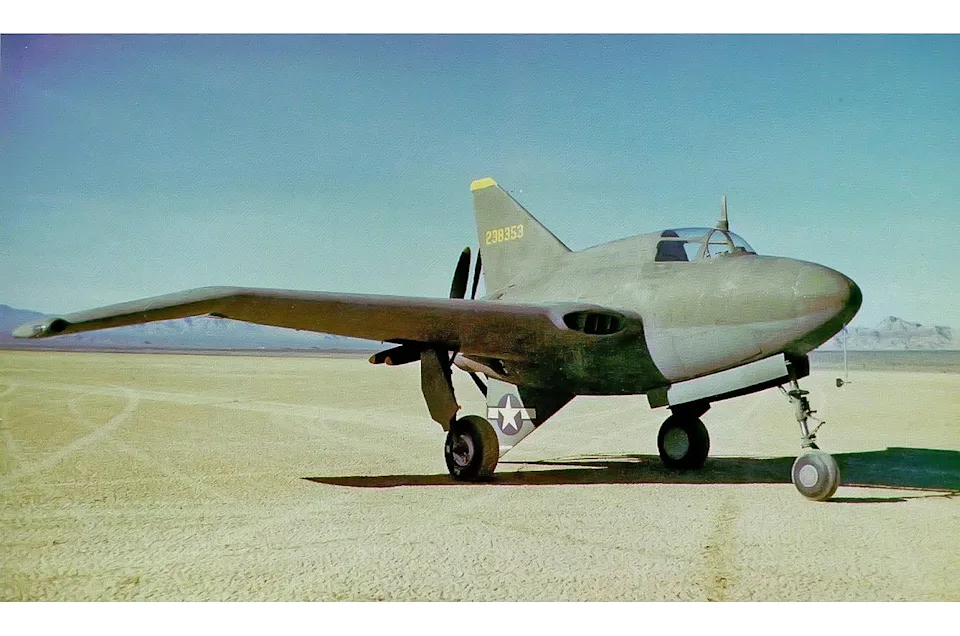
When the batlike Northrop XP-56 ‘Black Bullet’ first flew on 30 September 1943, it was undoubtedly one of the most radical and unorthodox fighters in existence. It combined a pusher configuration (with the propeller at the back of the aircraft) with a swept wing, no horizontal stabilisers, and extensive magnesium alloy construction.
It was a highly experimental aircraft developed under wartime secrecy. While not fully classified, its unconventional design and use of magnesium limited knowledge largely to Northrop engineers and test pilots. Magnesium was selected for its light weight and to reduce reliance on aluminium, which was in danger of becoming in short supply during the war.
10: Northrop XP-56 ‘Black Bullet’

Northrop XP-56 ‘Black Bullet’
The project was beset by problems from the start. When the intended engine, the Pratt & Whitney X-1800, was cancelled, the replacement, the Pratt & Whitney R-2800, required a major redesign, increased weight, and reduced the aircraft’s projected top speed.
Engine tests began in March 1943 but failed due to excessive propeller shaft flex, delaying progress by five months. Taxi and flight tests revealed severe yaw instability, prompting major tail redesigns. The first prototype was destroyed in October 1943. A revised second prototype flew briefly in 1944, but continuing problems led to the project’s abandonment. It was not fully revealed to the public until 1945.
9: Gloster Meteor

Gloster Meteor
The Gloster Meteor, Britain’s first operational jet fighter, was developed under strict secrecy during the Second World War. The project’s secrecy was critical to maintaining air superiority and preventing Germany from discovering British jet technology. Every stage, from design to flight testing, was carefully controlled and highly classified.
Early work on the Meteor was referred to internally by codes such as F.9/40. These codenames were used in official records and correspondence to avoid drawing attention. Only essential engineers, designers, and project managers had full knowledge of the aircraft’s purpose, and even within Gloster Aircraft Company, information was compartmentalised to reduce the risk of leaks to enemy intelligence.
9: Gloster Meteor

Gloster Meteor
Flight testing took place at restricted locations such as RAF Cranwell and later Boscombe Down. These airfields were off-limits to the public and heavily guarded. Components were transported in crates labelled as spare parts or experimental engines to disguise their purpose. Hangars were enclosed, and outsiders were strictly forbidden, ensuring that no one could observe the jet’s innovative turbojet engines.
Even operational deployment was carefully controlled. Squadrons training on the Meteor, including No. 616 RAF, were instructed on strict secrecy protocols. Public acknowledgement of the aircraft only occurred after combat deployment in 1944. The measures protected Britain’s technological advantage and ensured the Meteor could surprise the Luftwaffe.
8: Bell XP-59 Airacomet

Bell XP-59 Airacomet
Why was a strange propellerless aircraft piloted by a gorilla seen above the desert? During 1942–43, bizarre, unbelievable rumours circulated around Muroc Army Air Field in the Mojave Desert of a strange aeroplane. These sightings were no accident, but part of deliberate wartime secrecy.
The aircraft was the Bell XP-59 Airacomet, America’s first jet. Fearing espionage, the US Army Air Forces disguised it as a conventional propeller aircraft. A wooden dummy propeller was sometimes attached on the ground, and official explanations carefully avoided any mention of jet propulsion.
8: Bell XP-59 Airacomet

Bell XP-59 Airacomet
To deepen the deception, a test pilot wore a gorilla or monkey mask while taxiing the XP-59 in full view of onlookers. The intention was simple: if anyone later reported a propellerless aircraft piloted by a monkey, their account could be dismissed as unreliable.
The episode also reflected the dark humour of test pilots facing unknown dangers. Early jets were unreliable and hazardous, and humour helped relieve tension. Although the XP-59 itself was a disappointment, the gorilla-mask story remains an enduring symbol of inventive deception during the earliest days of jet aviation.
7: Yokosuka MXY-7 Ohka

Yokosuka MXY-7 Ohka
Secrecy surrounded the Yokosuka MXY-7 Ohka. The Imperial Japanese Navy concealed both its radical design and its grim operational plans. A 20-foot, stub-winged rocket aircraft, it carried a 2645 lb (1200 kg) high‑explosive warhead—larger than that of most contemporary aerial bombs—and a 4,500 lb thrust motor. Armour protected the doomed pilot’s rear quarter, a rare feature in a kamikaze aircraft, reflecting the expectation of intense defensive fire during the final attack run.
Built by Yokosuka Arsenal, the Ohka was rocket-powered and piloted, designed for suicide attacks against Allied ships. The pilot sat between the massive warhead and the rocket motor, guiding the missile at extreme speed. With terminal velocities exceeding 450 knots, the size of the warhead promised catastrophic damage to even large warships, but practical effectiveness was limited. Previous kamikaze missions had already demonstrated serious risks, and the Ohka’s operational shortcomings soon became apparent.
7: Yokosuka MXY-7

Yokosuka MXY-7
Its main weakness was range. The Ohka had to be carried close to the target by a converted G4M “Betty” bomber. Laden with the heavy missile and its large warhead, the G4M lost speed and altitude, dropping to just 16,400 feet.
Secrecy covered both design and missions. The unusually large warhead and rocket-powered suicide concept demanded protection from espionage, while the slow, vulnerable carrier bombers required operational concealment. By hiding both the weapon and the carriers’ approach, Japan hoped to preserve surprise and give the Ohka—even with its severe limitations—a slim chance of delivering its devastating payload against Allied ships.
6: Arado Ar 234 Blitz

Arado Ar 234 Blitz
Amazingly, the fastest pure bomber of the war was over 100mph faster than the speediest operational fighters of 1939. Initially too ambitious, the Ar 234 combined jet propulsion with a jettisonable trolley undercarriage (massive fuselage fuel tanks left no room for undercarriage), rocket-assisted take-off, cabin pressurisation and an ejection seat. It first flew on 22 August 1943.
Somewhat simplified, with a conventional undercarriage fitted in a larger fuselage, the first B-series aircraft first flew on 10 March 1944. The Ar 234 was used for both reconnaissance and bombing. Though fast, it was not invulnerable and suffered from poor rearward visibility and relatively poor manoeuvrability at lower speeds.
6: Arado Ar 234 Blitz

Arado Ar 234 Blitz
The world’s first jet bomber attack took place on Christmas Eve 1944. III./KG 76, under the command of Hauptmann Dieter Lukesch, dispatched nine Arado 234B-2s each armed with a single 500-kg (1100 lb) bomb to attack rail yards at Liege during the Ardennes offensive. The mission was a success with all bombers returning safely.
Secrecy surrounded the Arado Ar 234 because it was the world’s first operational jet bomber and reconnaissance aircraft. Its Jumo 004 engines, high speed, and high‑altitude performance were classified, with restricted access, dispersed production, and limited pilot training to prevent Allied intelligence from learning too much of its technological advantages. Arado’s factories, like many in Nazi Germany, relied on coerced labour, often under brutal conditions.
5: Messerschmitt Me 262

Messerschmitt Me 262
The Messerschmitt Me 262 was a technological marvel of the Second World War, Germany’s first operational jet fighter. Its sleek sharklike design and twin Jumo 004 jet engines enabled astonishing speeds exceeding 540 mph, leaving Allied piston-engined fighters unable to keep up. Armed with four 30 mm cannon, it could obliterate bomber formations with devastating precision. Its secrecy meant that when Allied pilots first encountered it in combat, the sudden appearance of an almost impossibly fast jet came as a genuine shock.
Secrecy was paramount. Factories were dispersed and camouflaged, hidden in forests, industrial complexes, or even partially underground, shielding production from Allied reconnaissance and bombing. Components were coded, documents restricted, and engineers compartmentalised, ensuring no one outside a small circle fully understood the project. Knowledge was fragmented to prevent espionage from compromising the programme.
5: Messerschmitt Me 262

Messerschmitt Me 262
Test flights took place at remote airfields, often at night or in poor weather, with only a handful of personnel present. Guards patrolled facilities, photographs were strictly forbidden, and prototype deliveries were staggered to minimise exposure. Within the Luftwaffe, operational knowledge was tightly controlled, shared only with selected pilots and ground crews who experienced firsthand the jet’s astonishing performance and handling.
Although 1430 Me 262s were completed during the war, but a lack of fuel and general Allied air superiority limited its impact. Its speed and armament could have wreaked havoc on Allied bombing campaigns, but its scarcity, late introduction, and Germany’s collapsing war effort meant it remained more a symbol of ambition than a turning point, sparing countless lives.
4: Horten Ho 229

Horten Ho 229
The Horten Ho 229 was a jet-powered flying wing aircraft designed by brothers Reimar and Walter Horten. Its construction made much use of wood and other non-strategic materials due to wartime shortages, while its shape resulted from the Hortens’ long interest in tailless flying wing designs.
Several prototypes were built, beginning with gliders and followed by powered versions fitted with Junkers Jumo 004 turbojet engines, but development was cut short by the end of the war. However, unlike most late-war German projects, the Ho 229 did make it to the flight-test stage, making its first flight on 2 February 1945.
4: Horten Ho 229

Horten Ho 229
On its third flight, an engine fire led to the loss of the aircraft and the death of test pilot Erwin Ziller. Work continued however, as Goering was keen on the design and had already ordered a production series of 40 production aircraft from Gotha before the prototype had even flown.
No further aircraft were completed before the end of the war, but today, one nearly complete prototype that was captured and shipped to the US for evaluation is preserved as part of the Smithsonian collection. This is the only genuine German WWII prototype jet to survive the war.
3: Lockheed P-38 Lightning

Lockheed P-38 Lightning
This American twin-boom fighter was fast and full of a host of innovations including fowler flaps (also carried by the Westland Whirlwind), General Electric turbochargers recessed into the tailbooms, and a (then novel) tricycle landing gear. It was first flown in 1939, and blew minds with its performance. The early design phase was conducted under considerable secrecy, with Lockheed closely guarding technical drawings and test results to prevent competitors and foreign powers from learning about its unconventional twin-boom layout.
The concept of twin-booms itself wasn’t secret (Fokker had the twin-boom G.1). What was sensitive was how Lockheed executed it. The secrecy around the P-38 focused on its exceptionally low-drag twin-boom configuration, tightly integrated engine nacelles, and carefully refined aerodynamics, which together delivered high speed and altitude performance that rivals had not yet achieved.
3: Lockheed P-38 Lightning

Lockheed P-38 Lightning
On February 11, 1939, the prototype Lockheed XP-38 Lightning flew from California to New York in seven hours and two minutes, setting a speed record (it took two refuelling stops). The flight was part of a record-breaking transcontinental flight to publicise the aircraft, breaking the secrecy to some extent.
But even during subsequent trials in the United Kingdom, secrecy was maintained: British and French evaluators were given limited access to technical specifications, and only selected personnel observed test flights, ensuring that the innovative design remained largely unknown to most other nations.
2: Focke-Wulf Ta 183

Focke-Wulf Ta 183
The Focke-Wulf Ta 183 Huckebein was envisaged as the Luftwaffe’s jet successor to the Me 262, but never developed beyond model form before the Reich’s collapse. Designed by Kurt Tank and Hans Multhopp, it was nicknamed “Huckebein” after a mischievous raven from a popular children’s book and, post-war, influenced Argentina’s Pulqui II project under Tank’s direction.
The Ta 183 combined boldly swept wings, a compact fuselage, and Heinkel’s HeS 011 turbojet, though prototypes were to rely initially on the Jumo 004B. A rocket boost option was mooted, intended to deliver an exceptional rate of climb for the aircraft’s primary role as a bomber interceptor.
2: Focke-Wulf Ta 183

Focke-Wulf Ta 183
Aerodynamically daring, the design placed its wings unusually far forward and was built largely of wood to conserve aluminium. The wing was fitted with elevons for both pitch and roll control, though stability fears lingered. Four MK 108 cannons formed the main armament, with provision for bombs or guided missiles mounted semi-internally beneath the fuselage.
By mid-1944, Germany’s Emergency Fighter Programme initially favoured Junkers’ EF 128 but then decided the Ta 183 was the better design after all and sixteen prototypes were ordered, with first flight due in May 1945. But Focke-Wulf’s factory was captured by British forces before the prototypes could be completed.
1: Boeing B-29 Superfortress

Boeing B-29 Superfortress
The Boeing B-29 Superfortress first flew in 1942 and was the most advanced bomber of the Second World War. It incorporated pressurised crew compartments for high-altitude operations, centralised analogue fire-control systems for remote gun turrets, reversible-pitch propellers, an advanced autopilot, and radar navigation equipment, enabling precision bombing over vast distances in the Pacific theatre.
Its Wright R-3350 radial engines provided exceptional power, though early models suffered overheating. The airframe combined large fuel capacity, long range, and heavy payload capability, allowing up to 20,000 pounds (9091 kg) of bombs. The aircraft’s complexity required extensive crew training and sophisticated maintenance, reflecting a major technological leap from earlier heavy bombers such as the B-17 and B-24.
1: Boeing B-29 Superfortress

Boeing B-29 Superfortress
The B-29 programme cost over $3 billion, including purpose-built factories, runways, and logistics systems. Costing $60 billion in today’s money, it was the most expensive single defence project of the second world war. For comparison, the Manhattan Project that produced the first nuclear bombs cost around $2 billion then (around $38 billion today). Entering combat in June 1944, the B-29 flew for roughly 14 months during the war, and a B-29 named Enola Gay (pictured) would be the delivery vehicle for the world’s first nuclear bomb attack, on Hiroshima in August 1945.
Its secrecy gave the Allies a decisive advantage, while its association with a still-classified strategic mission demanded strict security throughout development and deployment. Although the hush-hush origins of the B-29 were to prevent Japan and Germany from countering its capabilities, the later Soviet copying of the aircraft showed how quickly a rival power could exploit exposed technology. The Tu-4 programme proved that once secrecy failed, even an ally (albeit a distrustful one) could replicate advanced designs, fully justifying the B-29’s strict wartime security.
Follow Joe Coles on Substack, Twitter X or Blue Sky. His superb Hush-Kit Book of Warplanes is available here.
If you enjoyed this story, please click the Follow button above to see more like it from Autocar
Photo Licence: https://creativecommons.org/licenses/by/4.0/deed.en
]]>