Mach 2 (twice the local speed of sound) is incredibly fast, and few modern aircraft fly much faster. Operating at higher speeds is rare in real-world warfare and entails huge compromises.
Despite this, some astonishingly fast planes flying today comfortably exceed Mach 2. A handful of designs prove that extreme speed still matters, surviving decades of changing doctrine. You may be surprised to learn that work on the youngest aircraft in this list started in the 1980s, and that most were designed in the 1960s.
One of the aircraft is rarely mentioned or ranked so highly, but our new research revealed it deserves a place. Meet the Top 10 Fastest Warplanes in Service Today.
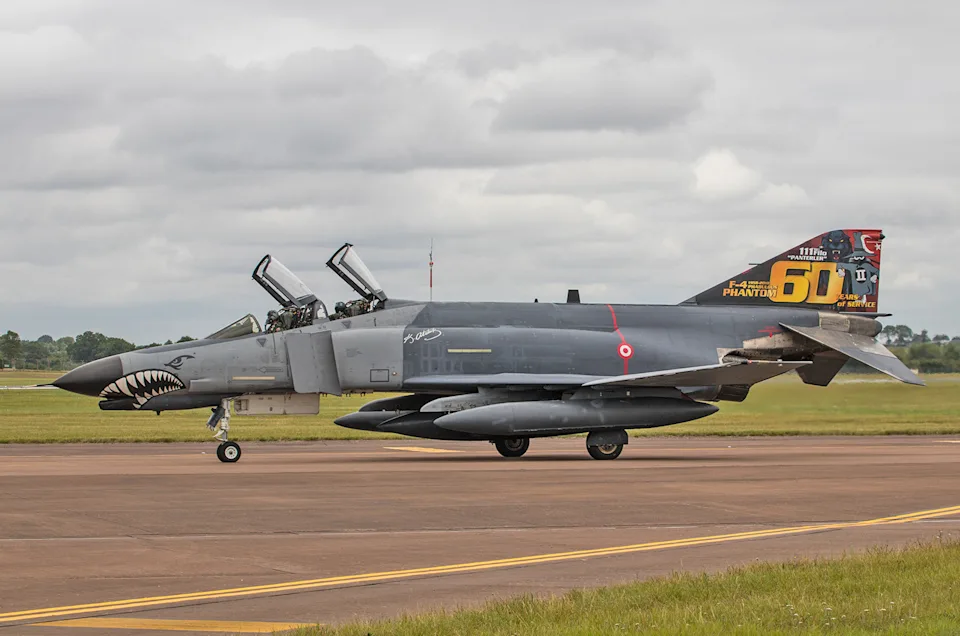
10: McDonnell Douglas F 4 Phantom II – Mach 2.2

McDonnell Douglas F 4 Phantom II – Mach 2.2
The McDonnell Douglas F-4 Phantom II is a twin-engine, two-seat, long-range supersonic fighter and attack aircraft developed in the late 1950s. Originally designed for the US Navy, it proved exceptionally adaptable, serving in air-to-air, strike and reconnaissance roles with air forces across the world for more than half a century.
The Phantom is highly regarded for its versatility, robustness and combat record. It served simultaneously with the US Navy, Air Force and Marine Corps, an unusual achievement, and was widely exported. Its powerful radar, speed, heavy weapons load and ability to operate from carriers or relatively austere bases made it a formidable and flexible combat aircraft.
10: McDonnell Douglas F 4 Phantom II – Mach 2.2

McDonnell Douglas F 4 Phantom II – Mach 2.2
The F-4 is capable of speeds around Mach 2.2 in service, enabled by two powerful turbojet engines, large variable-geometry intakes and a very strong airframe. Specially modified examples set world speed and climb records in the early 1960s, with one reaching approximately Mach 2.6. Persistent rumours also claim Israel operated a secret water-cooled, high-speed reconnaissance Phantom capable of around Mach 2.8, though no firm evidence confirms this aircraft ever flew.
Although largely retired, the Phantom remains in limited service today despite it first flying in 1958, making it older than many of the fathers of the pilots who fly it today! Iran operates the largest remaining fleet, using the type operationally, while smaller numbers have been retained elsewhere demonstrating the Phantom’s astonishing longevity.
9: Dassault Mirage 2000 – Mach 2.2

Dassault Mirage 2000 – Mach 2.2
The Mirage 2000 is a French delta (or triangular) wing multirole fighter built by Dassault Aviation. It was one of the first fly-by-wire fighters, allowing designers to tame the limitations of a traditional delta wing. The FBW system provides pilots with precise control, mitigating inherent handling quirks and enabling effortless manoeuvres.
The Mirage 2000 is highly regarded for its combination of agility, reliability and fine handling. Many of its systems were advanced for their time, and it performs well in both air‑defence and ground strike missions. It has also been tasked with the nuclear strike role as the 2000N.
9: Dassault Mirage 2000 – Mach 2.2

Dassault Mirage 2000 – Mach 2.2
The Mirage 2000 can reach Mach 2.2, supported by its powerful SNECMA M53 engine, efficient aerodynamics and low drag. Earlier French aircraft like the Mirage 4000 promised even greater speed but never entered production, while the experimental Mirage G8 remains the fastest European aircraft ever flown reaching Mach 2.34.
Today the Mirage 2000 remains in service with several air forces, including France, India, Egypt, Greece, Qatar and Ukraine. Ukraine has received French Mirage 2000‑5Fs and uses them to help defend its airspace, including intercepting Russian missiles and drones alongside F‑16s.
8: Lockheed Martin F 22 Raptor – Mach 2.25

Lockheed Martin F 22 Raptor – Mach 2.25
The F 22 Raptor is the United States Air Force’s air superiority fighter and a leading example of a fifth-generation combat aircraft. It was designed to dominate contested airspace by detecting and engaging adversaries long before the Raptor itself is detected, giving it a decisive tactical advantage in modern warfare.
The Raptor is highly regarded because it combines stealth, agility, and advanced avionics with sensor fusion. It also delivers incredible sustained high-speed performance. Its stealth design reduces detection by radar, while sensor fusion provides the pilot with superior situational awareness, making it exceptionally capable in both beyond-visual-range and close engagements.
8: Lockheed Martin F 22 Raptor – Mach 2.25

Lockheed Martin F 22 Raptor – Mach 2.25
The aircraft is exceptionally fast for a stealth design, with a top speed at altitude of around Mach 2.25 and a supercruise capability of roughly Mach 1.8 (cruising supersonically without afterburner). These high speeds are primarily achieved by its powerful Pratt & Whitney F119 engines and a relatively clean aerodynamic design. As security considerations relaxed, public references shifted from the generic Mach 2 figure to the more accurate Mach 2.25 quoted today.
Its fixed, carefully shaped supersonic intakes efficiently slow incoming air to subsonic speeds (the role of all supersonic jet intakes) before it enters the engines while maintaining a low radar signature. This allows the Raptor to balance maximum speed and stealth, whereas other stealth aircraft often use more restrictive intake designs that limit top speed.
7: McDonnell Douglas F 15C Eagle – Mach 2.25–2.3

McDonnell Douglas F 15C Eagle – Mach 2.25–2.3
The F‑15C Eagle is a single-seat, all-weather air-superiority fighter developed by McDonnell Douglas for the United States Air Force. The F‑15 family has served since the late 1970s, with the F‑15C entering service around 1979. It combines speed, agility, and a large, effective radar with long range, remaining a key component of American air superiority.
It was the most potent fighter in the world for much of its early career. Though its lower-speed manoeuvrability was surpassed in some aspects by the Soviet MiG-29 and Su-27 in the 1980s, overall, it remained an extremely capable fighter. It achieved numerous air-to-air victories in early service, demonstrating the effectiveness of its twin engines, aerodynamic design, and advanced flight controls for its era.
7: McDonnell Douglas F 15C Eagle – Mach 2.25–2.3

McDonnell Douglas F 15C Eagle – Mach 2.25–2.3
The Eagle can reach very high supersonic speeds thanks to its twin Pratt & Whitney F100 engines, lightweight airframe, and aerodynamic efficiency. Its wing is designed primarily for subsonic manoeuvrability rather than supersonic optimisation, but the aircraft can still reach speeds of around Mach 2.25–2.3 in a clean configuration without external stores. Its thrust-to-weight ratio being greater than one (in certain configurations) allows excellent acceleration and climb performance.
Despite claims of Mach 2.54, pilots report that the fastest speeds achieved in practice are Mach 2.25–2.3 in brand-new aircraft with no pylons or weapons. The higher figure is probably unattainable under operational conditions and reflects design limits rather than real-world experience.
6: IAI Kfir – Mach 2.3

IAI Kfir – Mach 2.3
The Kfir evolved from Israel’s Nesher, an unlicensed copy of the French Mirage 5 built after a French arms embargo stopped deliveries. The Nesher retained the Mirage 5’s layout but was produced entirely in Israel. It formed the basis for the more powerful and refined Kfir design.
For the Kfir, Israel replaced the Mirage’s SNECMA Atar engine with the General Electric J79 turbojet, the same engine used in the F‑4 Phantom. This gave the aircraft significantly more thrust, enabling faster acceleration, higher climb rates, and improved supersonic performance. The engine upgrade made the Kfir faster than both the Nesher and the original Mirage 5, with a top speed of around Mach 2.3.
6: IAI Kfir – Mach 2.3

IAI Kfir – Mach 2.3
The airframe was reinforced to cope with the J79’s power, and intake ducts were optimised for high-speed airflow. These modifications allowed the Kfir to carry heavier payloads while maintaining stability and control at supersonic speeds. Combined, the engine and airframe improvements gave the Kfir superior performance compared to its Mirage predecessors, making it a highly capable strike and interceptor aircraft.
Kfirs were operated extensively by the Israeli Air Force and later exported. Today, small numbers remain in service with the Colombian Aerospace Force and Sri Lanka Air Force, while several are flown by contractors for U.S. training. In the 1980s, some were leased as the F‑21A Lion for U.S. Navy and Marine Corps adversary training.
5: Mikoyan MiG-29 ‘Fulcrum’ – Mach 2.3+

Mikoyan MiG-29 ‘Fulcrum’ – Mach 2.3+
Along with the ‘Flanker’ and the ‘Foxhound’, intelligence reports of the MiG-29 tactical fighter sent ripples of panic through Western defence planners. The MiG-29 combined high performance, mind-bending manoeuvrability, a new radar, and new missiles (including a new ultra-agile missile aimed by a helmet-mounted sight).
Designed to counter the US F-15 and F-16, and replace older tactical fighters, the MiG-29 entered service in 1983. It combined an excellent aerodynamic configuration, very similar to the larger Su-27, with two powerful engines, and unlike the early F-16s, could fire medium-range air-to-air missiles.
5: Mikoyan MiG-29 ‘Fulcrum’ – Mach 2.3+

Mikoyan MiG-29 ‘Fulcrum’ – Mach 2.3+
Whereas the F-16 enjoyed a healthy manoeuvrability advantage over the MiG-23, the MiG-29 levelled the playing field. The excellent manoeuvrability was fortified with the helmet-cued thrust-vectoring R-73 ‘Archer’ missile, the first of its kind, gifting the Fulcrum with a terrifying potency in close-in air combat. Though fast, its very limited range makes time at high Mach extremely limited.
Though in many respects superb, the Cold War-era MiG-29 had smoky engines, making it easy to spot from a distance, a limited range, and a human-machine interface far inferior to that of the F-16 and F/A-18. However, it was a hot tactical fighter, with a phenomenal power-to-weight ratio, able to deploy from rough and ready austere airfields, and represented a serious threat. The MiG-29 remains in service with several operators, notably the Ukrainian Air Force.
4: Sukhoi Su-27 ‘Flanker’ – Mach 2.3+

Sukhoi Su-27 ‘Flanker’ – Mach 2.3+
The most feared Soviet fighter for the final years of the Cold War was the Su-27. It boasted everything in spades: spectacular turn rate, astonishing high alpha performance, world record-setting climb rate weapons persistence (it could carry more air-to-air missiles than any other Cold War fighter) and, importantly, a long range.
The Sukhoi T-10 (the company designation for the series) had a troubled early development, and the actual production aircraft looked somewhat different from the initial prototype. It entered service in 1985 and, once mature, challenged the F-15C Eagle for the unofficial title of the world’s best fighter.
4: Sukhoi Su-27 ‘Flanker’ – Mach 2.3+

Sukhoi Su-27 ‘Flanker’ – Mach 2.3+
Though similar to the MiG-29 in configuration, the Su-27 is far larger. The Su-27 is around 22 metres long (over 72 feet), while the MiG-29 is about 17 metres (over 55 feet). The Flanker series proved highly adaptable, but the story of these derivatives lies after the Cold War.
The ‘Flanker’ combines a clever aerodynamic configuration with a large amount of the aircraft’s fuselage contributing to lift, with a high power-to-weight ratio (at lighter fuel loads). Shortly after the Cold War, the Flanker’s jaw-dropping air displays astonished Western audiences with extremely high alpha and wild controlled manoeuvres at extremely low speeds.
3: Boeing F 15EX Eagle II – Mach 2.5

Boeing F 15EX Eagle II – Mach 2.5
The Boeing F‑15EX Eagle II is the latest evolution of the proven F‑15 fighter family, derived from the advanced F‑15QA development of the F‑15E Strike Eagle. It combines modern avionics, long‑range radar, planned drone command roles, long range and a huge weapon load. Something of a media stir was made when Boeing claimed the aircraft was capable of close to Mach 3, vastly faster than almost all fighters, which generally top out at around Mach 2.
The F‑15EX’s often‑quoted Mach 2.9 top speed is a theoretical maximum in an ideal, clean configuration without weapons, sensors, or weapons pylons. In actual flight tests, the highest recorded speeds reached just under Mach 2.5, confirming that operational performance is below the theoretical ceiling, with Mach 2.9 representing an unattainable limit under normal conditions.
3: Boeing F 15EX Eagle II – Mach 2.5

Boeing F 15EX Eagle II – Mach 2.5
It is highly regarded because it brings together significant payload capacity, endurance and modern systems while retaining classic F‑15 handling. Its ability to carry large numbers of air‑to‑air and air‑to‑ground weapons, extended patrol range and networked situational awareness make it useful in high‑intensity scenarios, including potential future conflicts across the Pacific.
The F‑15EX uses conventional intakes optimised for smooth airflow at supersonic speeds. Without stealth constraints, the design allows it to maintain efficiency and power at high speed while carrying weapons. Its radar cross-section is lower than the older F‑15C and modestly reduced compared with the F‑15QA due to radar‑absorbing coatings and shaping, although it is not a stealth aircraft.
2: Mikoyan-Gurevich MiG-23 ‘Flogger’ – Mach 2.6+

Mikoyan-Gurevich MiG-23 ‘Flogger’ – Mach 2.6+
Outrageously fast and made in colossal numbers, the Mikoyan-Gurevich MiG-23 ‘Flogger’ was a single-engined variable geometry (‘swing’) wing tactical fighter that served the Warsaw Pact nations from 1970 until the end of the Cold War. Though something of a handful to fly, the Flogger force was a huge combat mass of high-performance fighters.
We spoke to Mihai Vălceleanu about the Flogger’s astonishing speed, “..maximum Mach number stated in most sources is 2.35. And that’s correct, for reasons of temperature and directional static stability, the MiG-23 is indeed limited to Mach 2.35. But that’s not its true limit. According to the MiG-23M/ML flight manuals, the maximum Mach at high altitude is 2.55 or 2.6, and that’s not even clean…that’s when carrying two R-23 missiles!”
2: Mikoyan-Gurevich MiG-23 ‘Flogger’ – Mach 2.6+

Mikoyan-Gurevich MiG-23 ‘Flogger’ – Mach 2.6+
Capabilities varied hugely between the variants, from the rather basic MiG-23MS to the formidable MiG-23MLD. It also spawned dedicated ground attack variants in the form of the radarless ‘duck-nosed’ MiG-23BN and slower, heavily armed and armoured MiG-27, complete with a 30-mm ‘Gatling-style’ rotary cannon.
A total of 5,047 MiG-23s were made, representing well over 40% of all variable geometry wing aircraft ever produced. This Soviet fighter was relatively cheap and straightforward to make and spoke of the Soviet doctrine of superior numbers over high technology and the ability to operate from austere airstrips.
1: Mikoyan MiG-31 ‘Foxhound’ – Mach 2.83

Mikoyan MiG-31 ‘Foxhound’ – Mach 2.83
Building on the earlier MiG-25, the MiG-31 was designed as a dedicated long-range interceptor. Its exceptional speed capability derives from a combination of very powerful turbofan engines, a highly optimised intake and airframe designed for sustained supersonic flight, and a mission profile focused on high-altitude interception rather than manoeuvring combat.
It is capable of higher sustained speeds than any other operational combat aircraft, and remains the fastest air-breathing, crewed military aircraft in full service. Such extreme speeds are rarely used in routine operations due to fuel consumption and engine life considerations, but the performance envelope remains available when required. Although its mission set has expanded over time, the aircraft remains highly specialised compared to modern multirole fighters.
1: Mikoyan MiG-31 ‘Foxhound’ – Mach 2.83

Mikoyan MiG-31 ‘Foxhound’ – Mach 2.83
Like the US Navy’s F-14 Tomcat, the MiG-31was designed to carry very large, long-range air-to-air missiles. During Russia’s invasion of Ukraine that started in 2022, modified MiG-31K aircraft have been used to launch the Kh-47M2 Kinzhal, an air-to-ground ballistic missile. These missiles have been employed against targets including hardened infrastructure, airbases, energy facilities, and ammunition depots, with the MiG-31’s speed and high launch altitude used to extend missile range and impact energy.
During the Soviet period, the aircraft was tasked with defending vast areas of national airspace, operating in coordinated formations and sharing radar data via datalink. With a maximum speed of Mach 2.83 and a take-off weight comparable to that of a Second World War heavy bomber, the MiG-31 remains in limited service in Russia, continuing to fulfil a niche high-speed role. Interestingly, while the similarly fast MiG-25 was long believed to be fully retired, its appearance at a 2025 Algerian military parade means the MiG-31 may now share the top speed slot.
Follow Joe Coles on Substack, Twitter X or Blue Sky. His superb Hush-Kit Book of Warplanes is available here.
If you enjoyed this story, please click the Follow button above to see more like it from Autocar
Photo Licence: https://creativecommons.org/licenses/by/4.0/deed.en
]]>