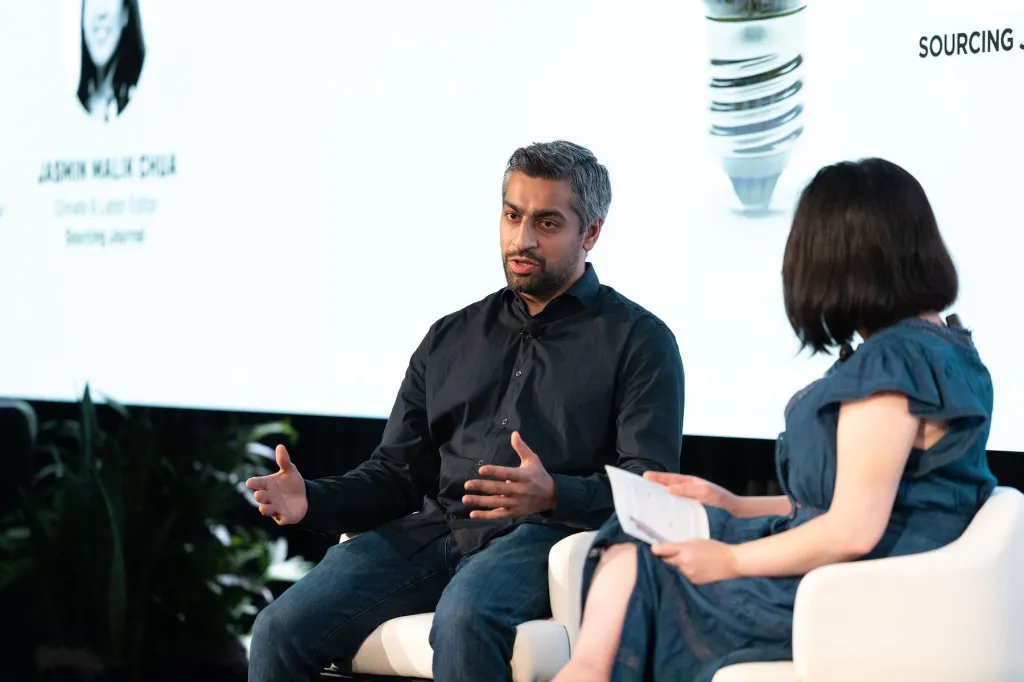
In a world choking on textile waste, Ambercycle is performing industrial choreography for the fashion industry, orchestrating a new ecosystem of capital and manufacturing with brands and retailers to make circularity a commercial reality with Cycora.
The Los Angeles-based innovator discussed the importance of next-gen collaborations—and how its three-year offtake agreement with REI Co-op is more than meets the eye—at the Sourcing Journal LA Sustainability Summit.
“We’ve been doing this for 10 years; one of the things that we’ve really taken to heart is doing anything new,” said Shay Sethi, chief executive officer of Ambercycle. “It’s not necessarily a straight path and it’s more like a journey, so the things that have worked for us, the partners that have been cohesive with us [are] the partners that understand, at the high level, that it is a journey.”
For context, Cycora is a regenerated polyester made through a molecular regeneration process that turns end-of-life textiles into “new,” decarbonized ones. What started as two students at the University of California at Davis is now a next-gen leader pumping out some two tons of Cycora at a demonstration facility in Wisconsin while working to get its first commercial-scale plant up-and-running and, critically, inking offtake (or otherwise) agreements with global players like Ganni and Reformation and, most recently, REI.
“It’s not just an owned products manufacturer, but it’s a marketplace, a wholesale customer for a lot of the brands that we know and love; This gets us one step closer to the customer—the end-person that we’re are trying to sell to and trying to educate,” Sethi said of the self-described phased integration. “For us, especially growing up in California, REI is one of the perfect places to educate. It’s a really good alignment with our brand values and we think this is a better place to build thought leadership in circularity.”
That said, building a global supply chain for a novel material is a monumental task only made more complex by an increasingly “diverging” world—one where, “at the end of the day, over 100 billion garments end up going to landfill,” Sethi said. For Ambercycle, the consumption challenges make scaling the startup’s North Star, in pursuit of a “worldview that embraces the best of both worlds.”
“There’s going to be roadblocks and there’s going to be bumps; we’re going to try and do our best to mitigate those roadblocks, but that’s a process to create something real that changes the world,” Sethi said. “Finding alignment on ‘Hey, this is a journey,’ we are going to be committed to the journey.”
It’s one of the reasons why Ambercycle’s vision is collaborative and not competitive. The polyester market is a 100-million-ton-per-year business; the immediate challenge is displacing virgin materials, not fighting other innovators for market share.
“Now is not the time to think about how do we compete with each other,” Sethi said. “The market is super big and there’s a huge opportunity; we really enjoy collaborating and sharing best practices with our partners and peers in the industry.”
That ethos extends to policy, where Ambercycle—and its peers—are actively working together to provide recommendations to bodies like the European Union in an effort to help shape a supportive regulatory landscape for the long journey ahead.
“I think the biggest challenge right now is the divergence in the world,” Sethi said. “Understanding that equity story, the existence of the production regions in Southeast Asia—also the emerging production regions in Southeast Asia and trying to keep the glue together—it’s important that we work together as different countries to create change that actually works at scale.”
He highlited the growing friction, between Western consumption regions and Asian production hubs, as a significant challenge in creating the cohesive ecosystem that the circular economy requires. But despite such headwinds, Ambercycle still sees some powerful “hope spots” on the horizon. The commitment from brands to circularity has proven durable, driven by tangible market forces like regulation in Europe and the pursuit of differentiation in America and Asia.
“We’re not going to change our feelings about the high-level end goal, but we’re going to get into the weeds and figure it out,” Sethi said. “It might take five years, it might take 10 years, it might take 30 years—but that’s our commitment and we have to get this done.”
And that is the spirit Ambercycle seeks out in the companies—and the people—it connects and collaborates with; with the right fit, everything else tends to fall in place.