After months of ideating, sketching and stitching, Cal Poly student designers brought their visions to life in front of a packed audience on Sunday.
The annual spring fashion show, hosted by Cal Poly’s Fashion, Innovation, Trendsetting, and Styling (FITS) Club in collaboration with the Sustainable Fashion Club, returned to campus, highlighting student creativity and design.
This year, 31 student designers showcased their interpretations of the theme, “Roots,” exploring concepts like heritage, personal growth, and sustainability.
Back to her fairytale roots: The swan, the rose and the mirror
Growing up, Victoria Garcia told her parents she wanted to be a fashion designer.
The architecture sophomore first got involved with FITS during her first year through the Valentine’s Tea Party drag race. The rest of her freshman year, she participated as a model, stylist and set designer for the club.
As this year’s fashion show approached, she knew it was time to commit to her childhood dream.
Her inspiration is based on the fairytales of her childhood, Garcia said. The first thing she thought of when she heard the theme was to connect it to herself beyond her culture, focusing on how she grew up.
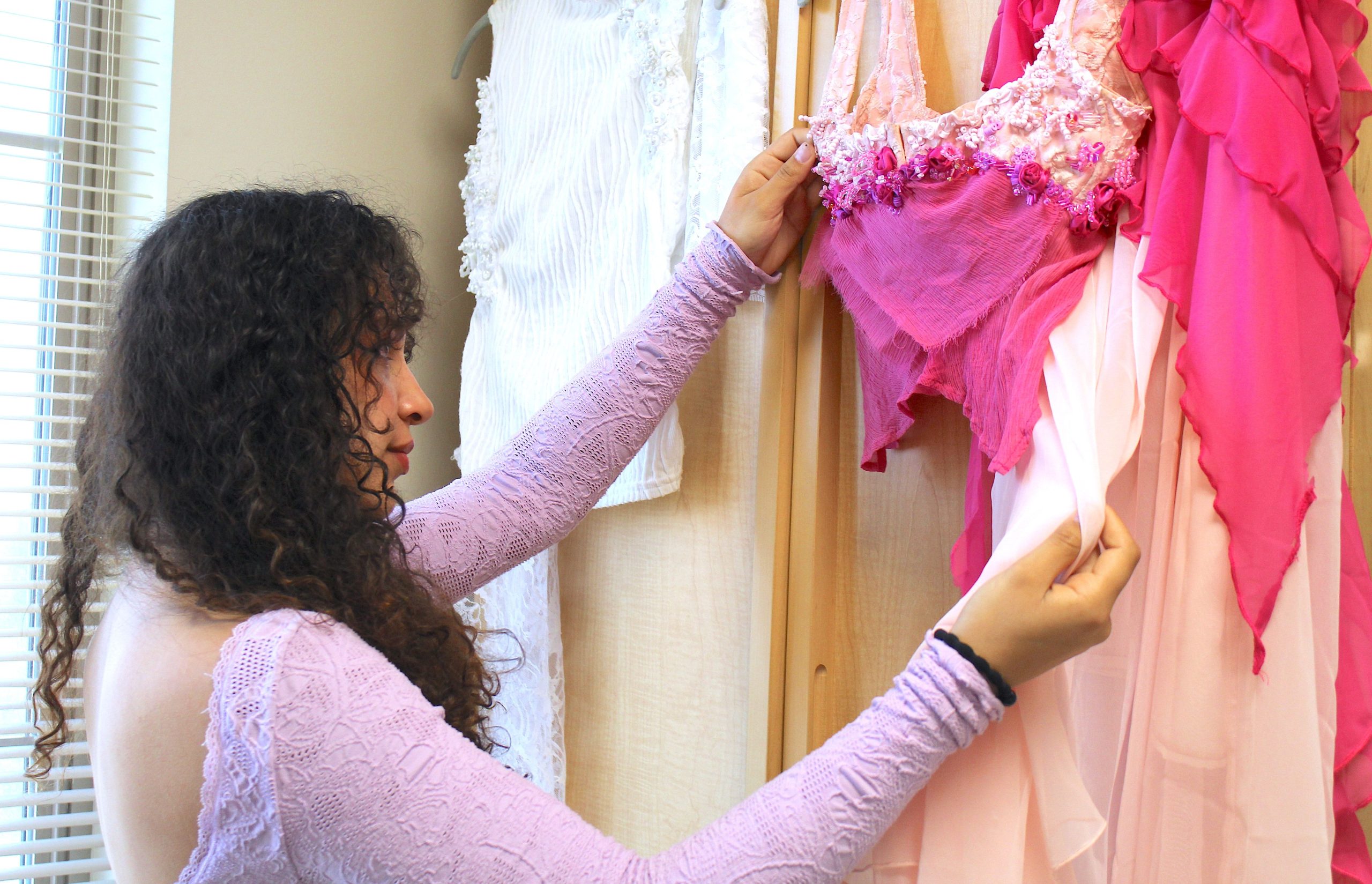
“The most important thing, especially for a college fashion show, is to make sure that the models are comfortable walking, since it’s really nerve-wracking,” Garcia said, drawing on her own experience modeling last year.
All of her looks are mostly second hand, she said, incorporating thrifted items, recycled materials and clothing from her own closet in her designs. All three looks in the collection incorporate beading and embroidery.
“I have the swan, which symbolizes purity and innocence. I have the rose, which symbolizes romance, and I have the mirror, which represents, like, the reflection at the end of the story,” Garcia said. Each look is catered towards a specific model.
The swan’s design combines white lace, frills, and pearls. Her favorite aspect of the look is the open back. Gold beading outlines the cut-out, representative of where the swan’s wings would be, Garcia said. She constructed the design using an old white turtleneck, ripping open the middle and incorporating embroidery around it.
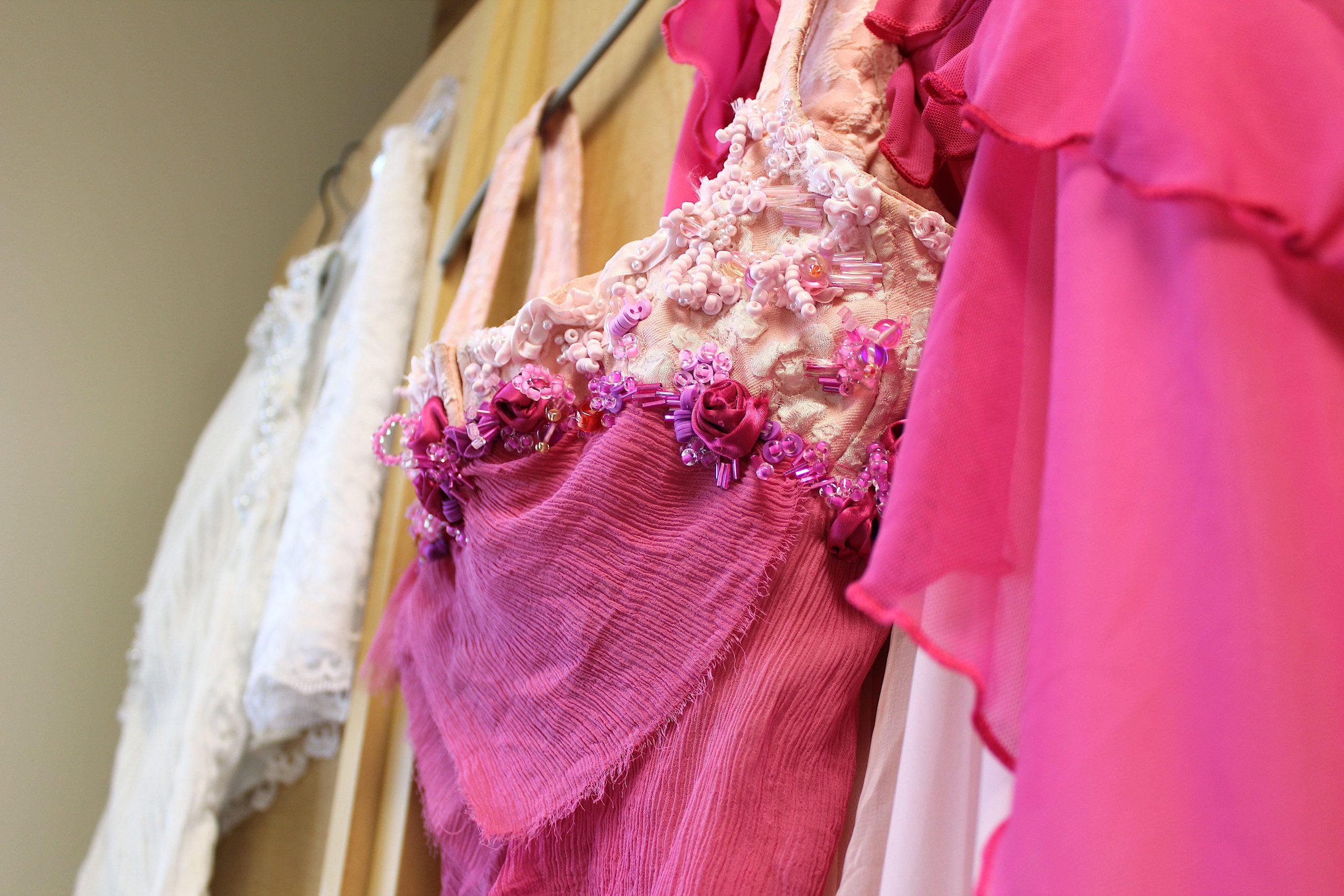
For the rose, Garcia said she went back and forth between a central rose on the front and dispersed petals, eventually settling on a rose ruffle texture on a flowy, pink-ombre skirt.
The aim of the design was to encapsulate innocent romance and a “cutesy vibe”, Garcia said. Her goal was to give the model a fairy-like appearance in a rose-themed outfit.
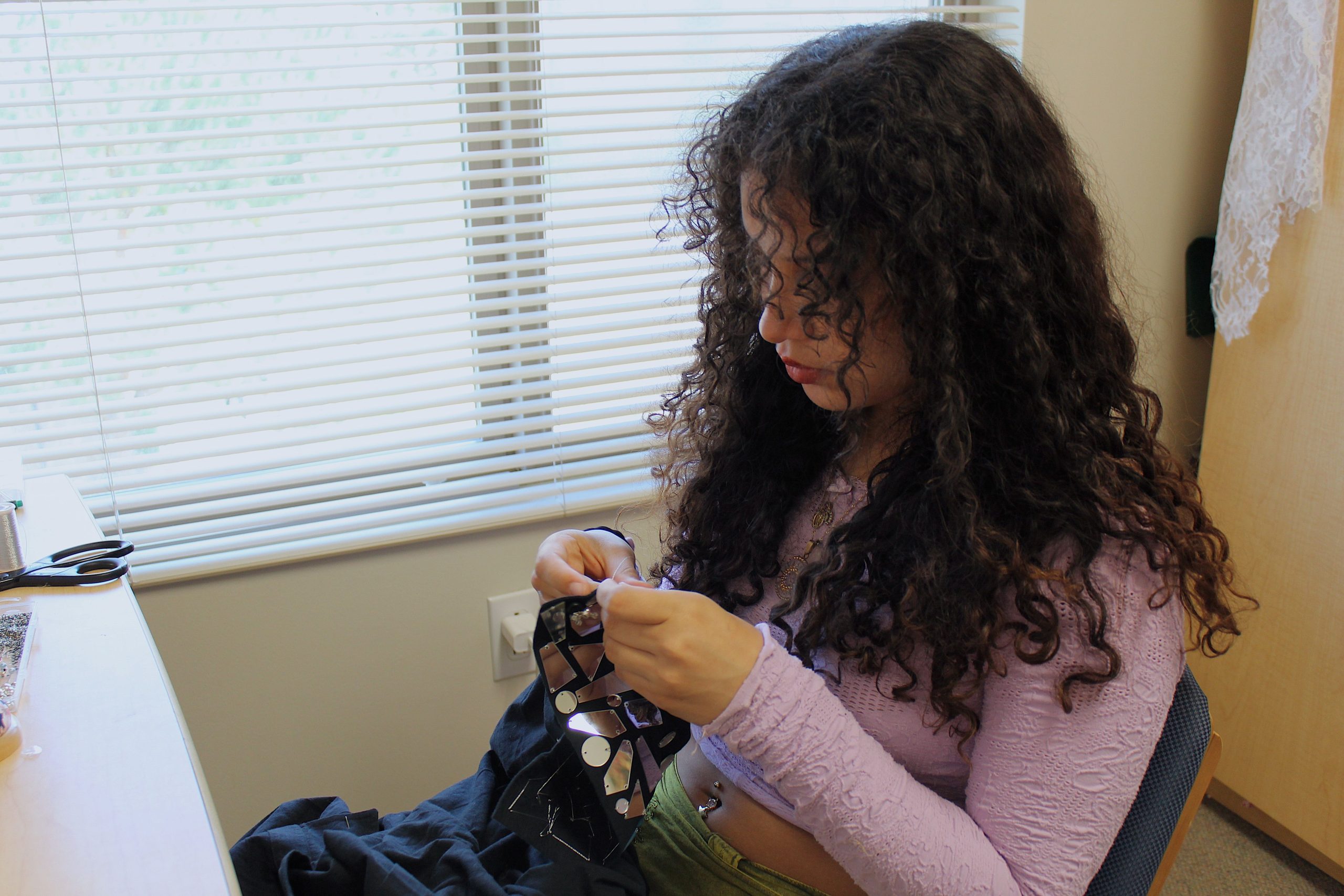
Garcia’s last design, the mirror, is connected to the reflection at the end of a fairytale, she said. She is proud of her creative use of a large black button-up, turning the shirt into an off-the-shoulder dress. Silver beading lines the back of the dress, complementing the black clothing.
“The most fulfilling part was just seeing my models have that confidence in a walk, and really own it,” Garcia said after the official dress rehearsal.
The excitement of last year’s fashion show drove Garcia to participate again this year, she said.
“Having all that excitement was probably my favorite memory because it really made me feel that I was a part of something,” Garcia said.
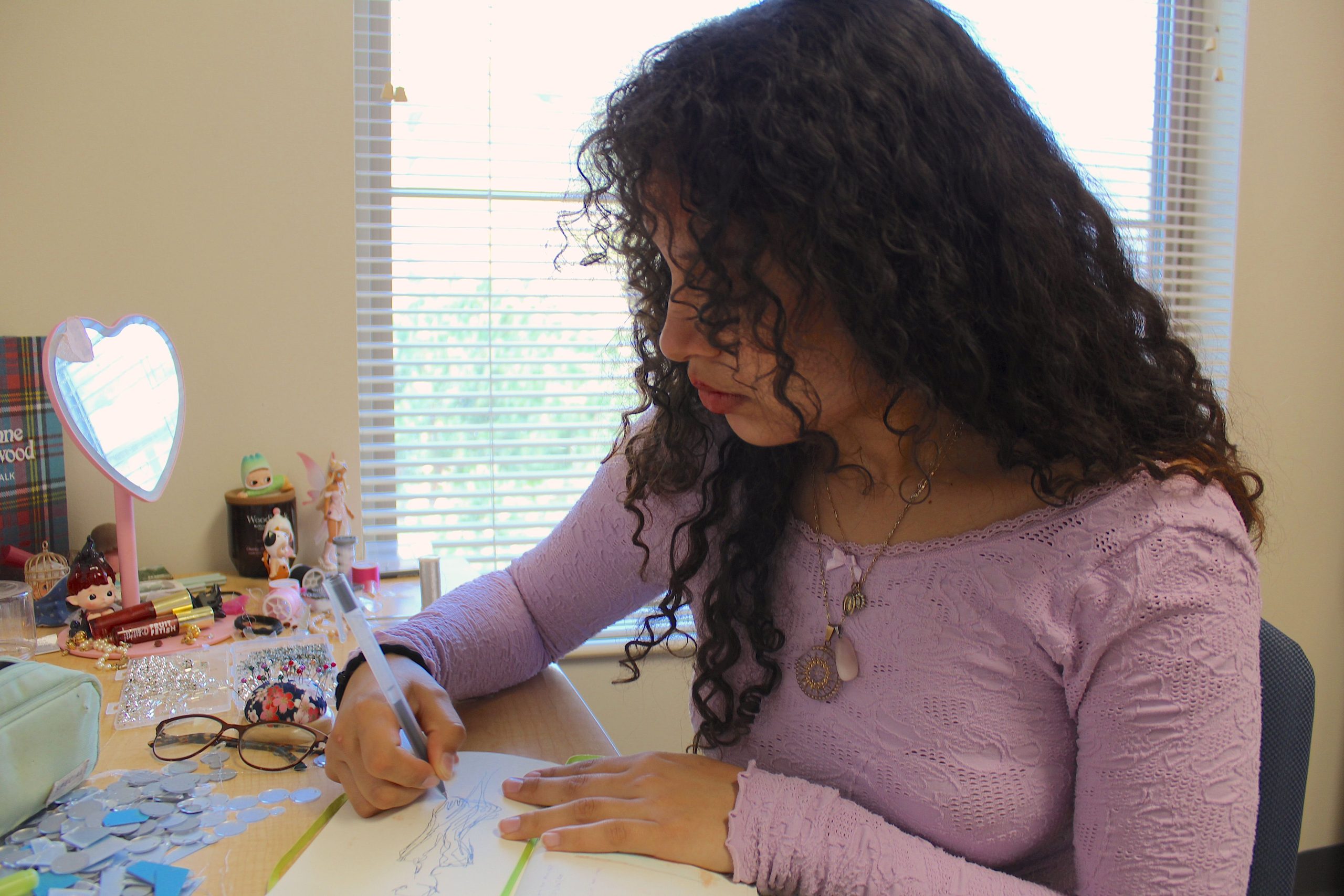
Garcia keeps at least one sketchbook with her at all times. When an idea for her Roots designs came into her head, she took to sketching it out, examining if it had a shot at working out.
Finding time to work on her designs proved to be the most difficult aspect, she said.
But to Garcia, being part of the student-led club is worth it.
“It’s just so amazing to see everyone do their own separate things and come together and be a unit,” Garcia said.
Tin Van and Avery Loll: One chainmail link at a time
Deciding to work in a team was a spontaneous decision for Tin Van, an electrical engineering junior, and Avery Loll, an architecture junior. They were walking back from a party, talking about the upcoming fashion show, and they found a strikingly similar correlation between their ideas.
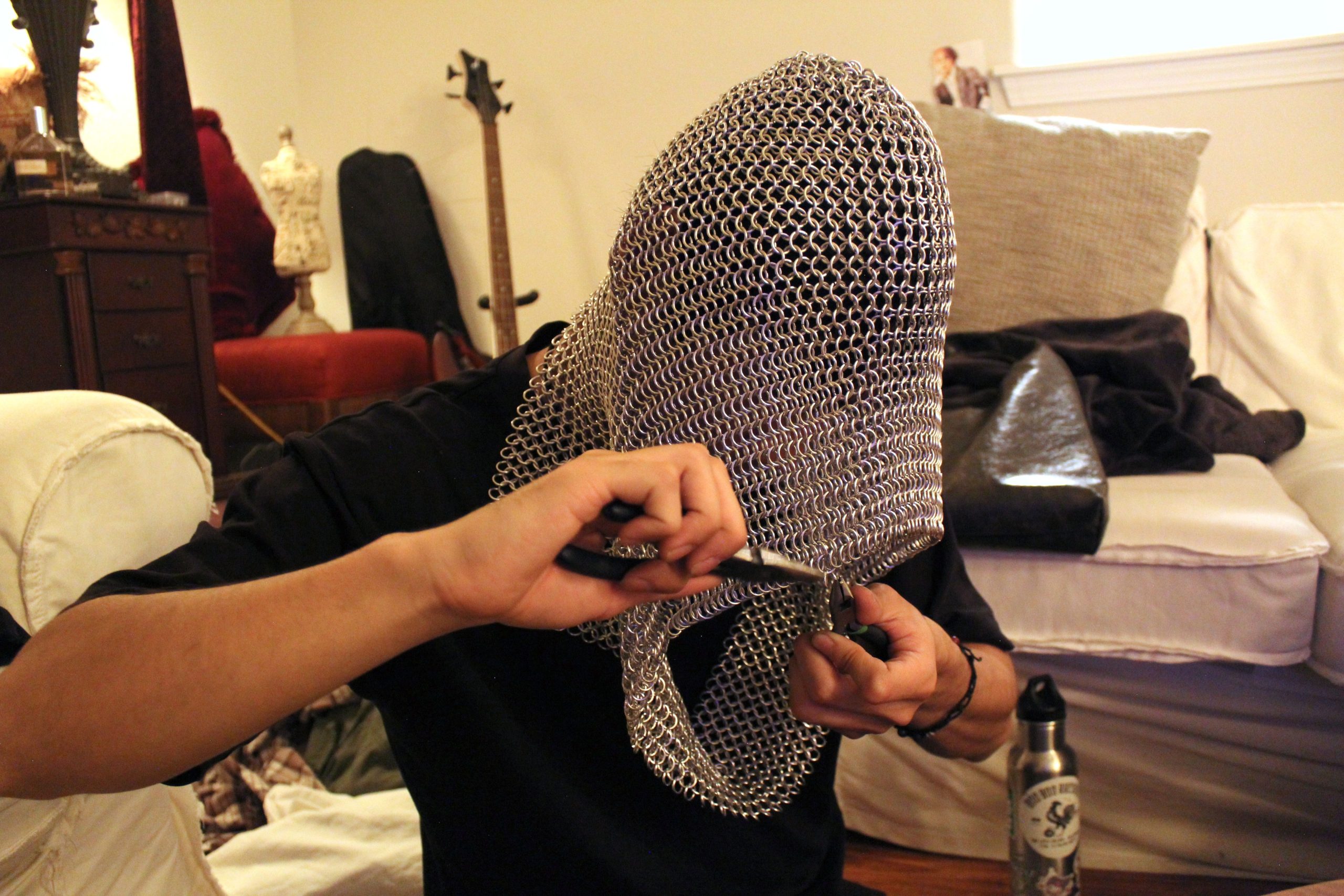
The duo’s main focus for the collection is chainmail as a material study, Van said. They examine how chainmail moves and drapes in the models.
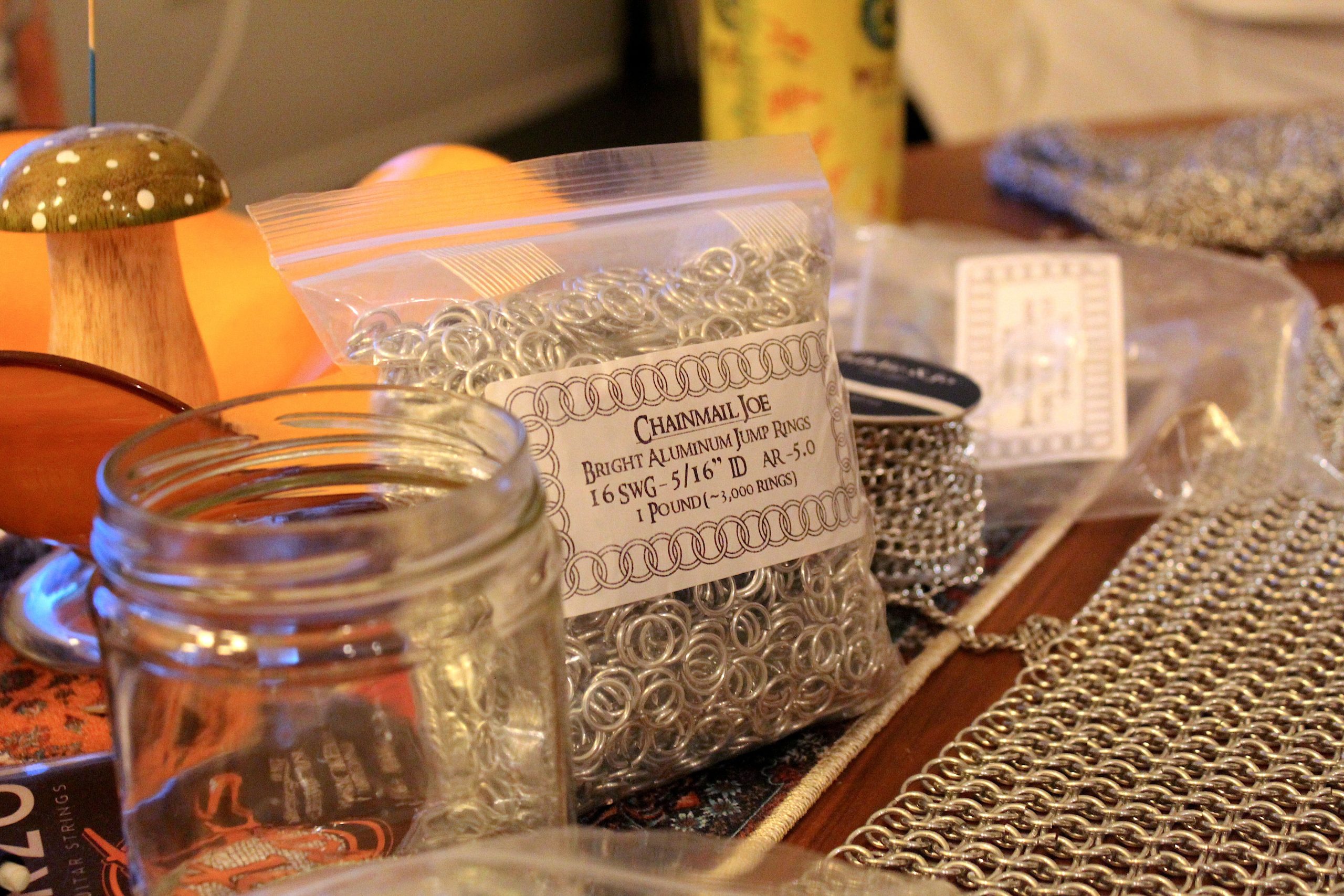
Chainmail proved to be a time-consuming medium for fashion, with the duo estimating to have individually unlinked and connected 20,000 jump rings, according to Van. The other main feature of their designs is brocade, which is similar to the material a grandma’s couch would be upholstered in, Loll said.
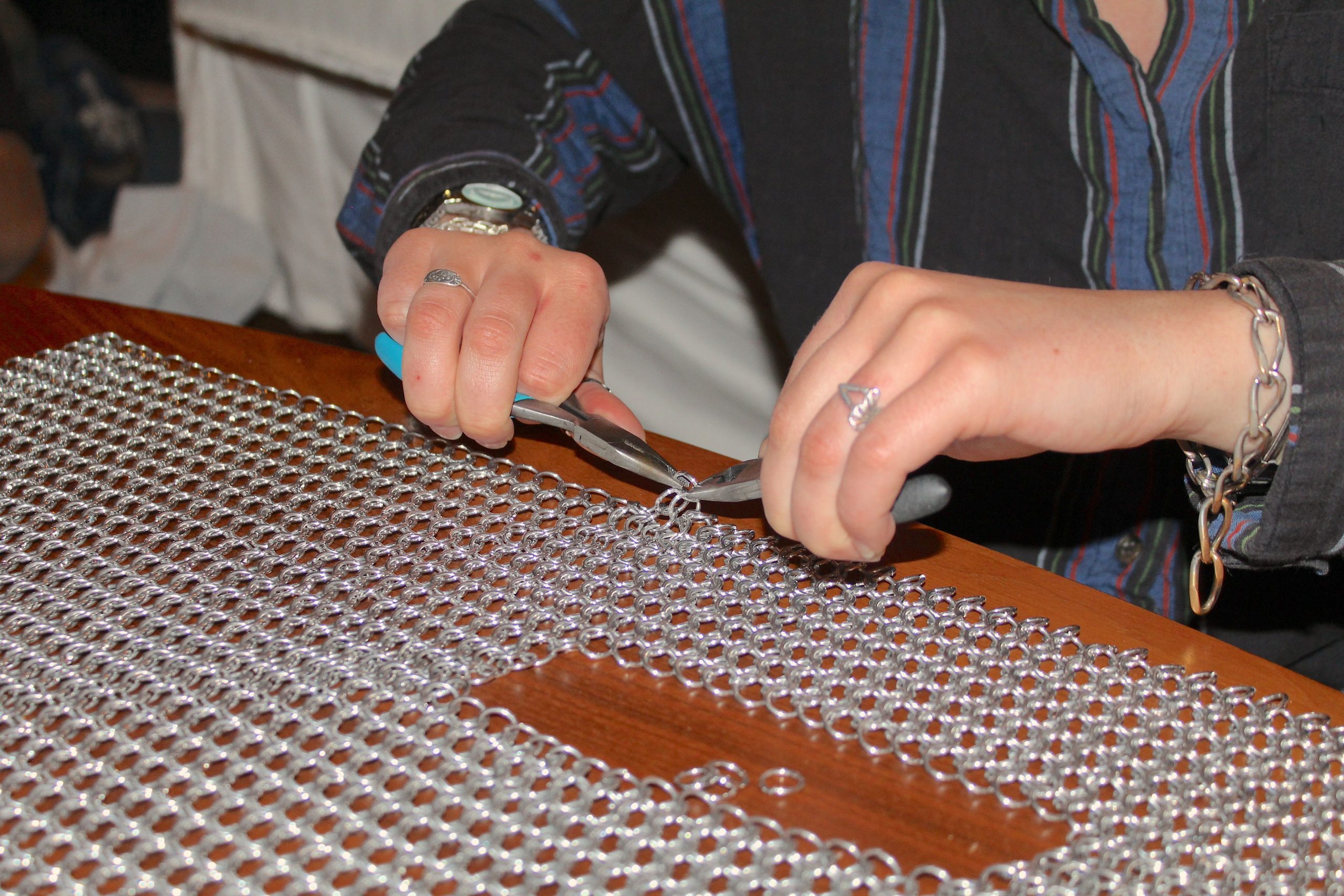
Loll shared how this would be their last opportunity working together since she would be studying abroad next year.
Though they had clear common ground, Van said the team came into the project with very different visions. It took months of pitching ideas before they came to a middle point.
Van said he hoped the collection would be feminine and dramatic, while Loll was planning for androgynous, baggy looks.
“You can really extract different origins from all of these looks. You can trace it back to me, and you can trace it back to Avery, which is fascinating to me,” Van said.
“The designs–they’re brain children,” Loll said.
Van explained that their first design, “Serentresse”, is a play on words between “serenity” and “tresse”, meaning long, luscious hair. The outfit is centered around a muted gold chain mail headpiece that reaches the knees and represents hair.
The connection to the theme applies literally to the “roots” of the chain mail hair, Van said. On a deeper layer, the duo noted it symbolizes a form of protection, connecting back to humanity’s instinct of survival. The intertwining texture of the headpiece also relates to the twisted nature of plant roots, Loll said.
In the collaboration process, they discovered more ways to connect their designs to the themes than if they had worked alone, Loll said.
Finding a model for “Serentresse” happened by chance, said Van. In his fiction writing class, a girl instantly stood out to him, suiting the vibe of the design. He asked her if she would model for the show, and she agreed.
“She literally looked exactly like my sketches,” Van said, bewildered. “She embodied the looks so perfectly. And when I finished the chain mail head piece and put it on her, it was like seeing my baby come to life.”
The second look, “Braeveil”, incorporates chainmail into an eye-covering hood. The headwear drapes down to the waist and is paired with a brocade kilt, sporting hints of royal blue.
Brae is the Scottish word for a mountain, meaning a “high point”. The look connects to the concept of being high in stature to virtue, Van said, and to an old-world Scottish energy, grounded in historical roots, Loll said.
“You’re like the king of the hill,” Van said, referencing the mountain symbolism embedded in “Braeveil”.
Lastly, their piece “Madelle” – French for tall tower. A conical princess hat is the basis of the look, decorated in ornate brocade. The top is square cut with big bell sleeves, partnered with baggy, skirt-like brocade pants.
This princess-inspired look also sports a ski mask, leaving only the eyes and mouth visible. It connects to the idea of status and power, leaning into the concept of being high in stature, Van said.
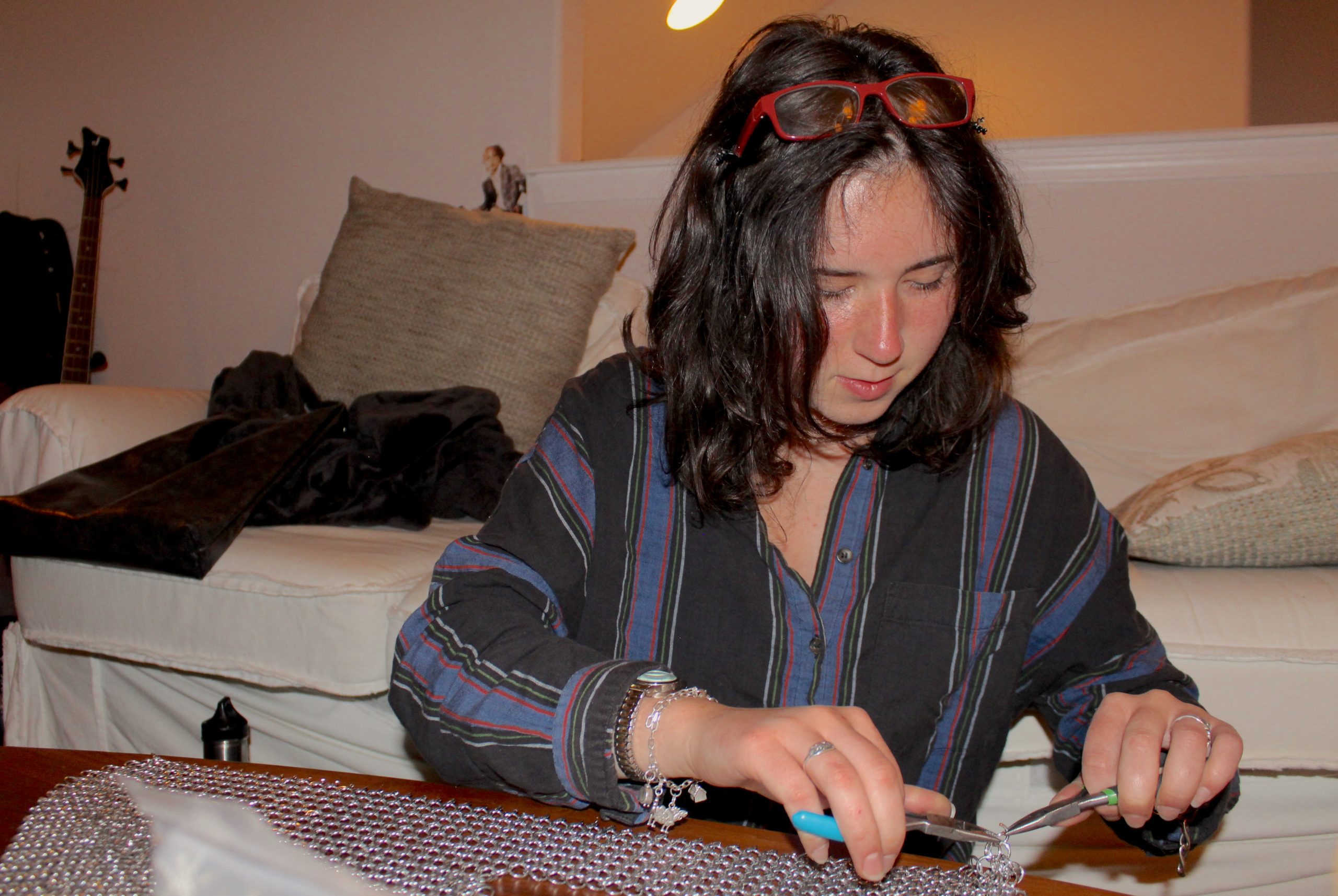

Loll has loved the opportunity to see her sketches come to life and merge with Van’s ideas. Fashion and design are essential creative outlets to her, within and outside of FITS.
“Sometimes you get lost in your major, and kind of forget about all these things that you used to kind of, really take fulfillment from,” she said. Fashion designing has been an essential creative outlet for her since joining FITS.
While Van and Loll don’t anticipate a future in fashion professionally, they have loved the opportunity to participate as designers in their time at Cal Poly.
Rooted in Resilience: How Natalie Kha honors women in business
As a teenager, Natalie Kha remembers browsing her favorite clothing stores and feeling like the price tags were too far out of reach. So, she decided to try making the pieces herself. Her first outfit that she created—a two-piece set modeled after a Princess Polly design—made her realize that she could recreate the clothes she admired.
Kha remembers thinking, “I feel like I could make that… and I made an exact duplicate.” The moment of creativity sparked a passion that eventually led her to the FITS runway.
Now, in her second year as a FITS designer, Kha is debuting a new collection inspired by this year’s theme, “Roots.”
The concept led her to reflect on the “powerful women” she is surrounded by, the business administration junior said.
“The angle I’m taking on this theme is towards women’s roots, specifically women in business, and women in the corporate workplace,” Kha said.
As a woman about to enter the corporate workplace, Kha said it felt important to “honor the legacy of women breaking barriers, specifically in male-dominated areas.”
Her collection consists of four outfits that reimagine traditional workwear through a feminine and contemporary lens, she said. One outfit transforms a trench coat into a voluminous dress mid-runway, while another features a halter top made almost entirely from men’s ties.
“I want people to see this as a reimagined, fresh, contemporary, but unapologetically feminine collection,” Kha said. “It reflects how women today are redefining their roots while staying true to their identities and thriving in traditionally male-dominated spaces.”
Kha’s designs incorporate structured silhouettes and cinched waists, paired with modern elements like exposed shoulders and above-the-knee hemlines, she said.
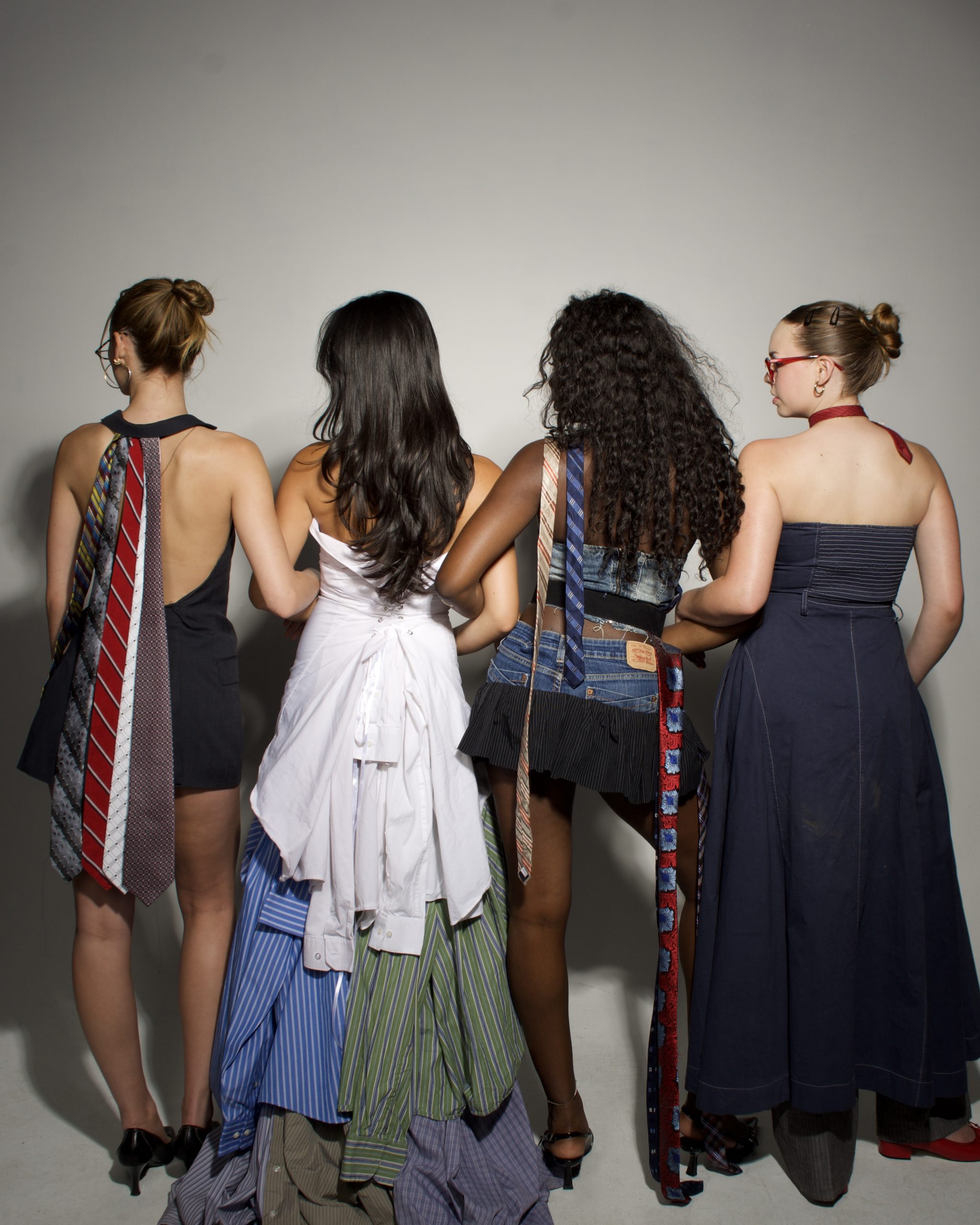
Sourcing nearly all her materials from second-hand clothing from the San Luis Obispo Goodwill Bins, Kha’s choice aligned with the values of FITS and the Sustainable Fashion Club.
“It’s a fun experience because you never really know what you’re going to get,” Kha said.
At the same time, Kha explained that the process wasn’t without its challenges.
“When you’re working on something for so long, you kind of grow tired of it, and then the vision that you thought was so cool in the beginning doesn’t seem as cool anymore,” Kha said.
Yet Kha said she understood that those feelings were a part of the process, which eventually helped move past them. Kha made a deliberate effort to build on her past experience.
“Something that I didn’t think about last year was photos,” Kha said. “I never really got to take photos of my collection after spending so much time on it.” This year, Kha began working on her designs earlier and organized a photoshoot with a student photographer to document the finished looks.
While Kha isn’t sure whether fashion will remain a part of her career, she’s proud of what she’s created—and what it represents.
“I’m really proud that I was able to take something that I genuinely enjoy doing and turn it into something that my whole community can enjoy,” Kha said.
Jaclyn Brodersen: Experimental designs blur engineering and art
From a young age, Jaclyn Brodersen knew she wanted to invent things.
“I was one of those weird kids that really knew what they wanted to do, like right from the get-go,” Brodersen said.
Growing up in Ventura County, Brodersen was exposed to a “big culture of engineering” at an early age.
To her, engineering and creativity were always linked—until they weren’t. “In my mind, engineering was very creative,” she said. But in high school and college, she
“realized how rigid the curriculum actually is.”
That realization pushed her to carve out her own space between disciplines. Now, Brodersen, a mechanical engineering and art and design senior, focuses on sustainable textiles and material innovation—something that comes alive in her work for this year’s FITS fashion show.
The theme of this year’s show, “Roots,” opened the door to a wide range of interpretations. Brodersen and her co-designer, Brady Nakamura, a mechanical engineering junior, didn’t want to box themselves into just one concept. Instead, they pulled from many directions to build a collection that branches out rather than narrows down.
The collection features a mix of techniques like Nuno felting—a process that merges wool fibers with lightweight fabrics—and unconventional materials sourced from science labs and even a local bike shop. Algae-based yarns, chainmail, dried seaweed, and deconstructed bike inner tubes from Foothill Cyclery are just some of what ended up on the runway.
Sourcing materials second-hand was important to Brodersen, she said, but recognized that wasn’t possible for everything in the collection. Many of the materials she used were lab-grown or developed through experimental processes. This, however, made them difficult or impossible to find used, she said.
Some of these materials—like the agar and glycerin-based composites—can’t be machine sewn because they’re so fragile, according to Brodersen. This meant nearly everything had to be done by hand.
For Brodersen, the design process has never been linear. She started with rough sketches and chaotic lists of ideas, but doesn’t rely on step-by-step planning, she said.
“I don’t have a specific intermediary process,” she said. She appreciates the flexibility to change her designs when things don’t go as planned.
Even the theme itself evolved through the design process. While other designers may cite specific inspirations, Brodersen resists that.
“Inspiration really comes from everything around you and your experiences and your feelings and really just so much and it feels almost reductive to cite specific things,” she said.
This fashion show offered not just a creative outlet, but a challenge, Brodersen explained. She described the fashion show as “less of a means to an end for my playing with materials, but more of an opportunity to encourage myself to get over being afraid of it not turning out right.”