Emergency alert warnings can save lives if a flood, fire, tornado or active shooter threatens your neighborhood.
NBC 5 Investigates has learned hundreds of Texas cities and counties cannot use one of the nation’s most powerful warning tools, FEMA’s Integrated Public Alert and Warning System (IPAWS).
About 13 years ago, the federal government launched IPAWS so local officials could send emergency alerts that could reach all cell phones in a particular area.
It’s the system often used to send AMBER Alerts, but NBC 5 Investigates has learned many cities and counties still can’t use IPAWS to send warnings because those communities never signed up.
“It’s shocking. It’s shocking. I mean, it’s disheartening, because … you think that there would be some sort of consistency at least within the same state that you’re in,” said Christen Leaf, a parent in Richardson.
Edward Ayala, NBC 5 Investigates
Edward Ayala, NBC 5 Investigates Christen Leaf, left, and Elaina Leaf, right.
Leaf is now hyper-aware of the importance of emergency warnings. Her daughter, Elaina, was among the campers at Camp Mystic when fast-rising floodwaters overtook part of the camp on July 4, killing 27 children. Elaina survived the flood because her cabin was located on higher ground.
After the storm, they wondered why all cities and counties were not ready to use IPAWS to provide the most widespread cell phone alerts.
“It would be good to standardize it. I think that should be a priority,” said Elaina Leaf.
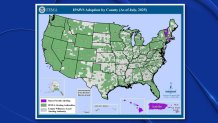
However, FEMA data analyzed by NBC 5 Investigates suggests that it has not been a priority in many communities. Texas has 254 counties, but a map showing FEMA IPAWS adoption by county shows that about 120 Texas counties, fewer than half, have no county or city agency authorized to send IPAWS alerts.
FEMA
FEMA This FEMA map shows IPAWS adoption nationwide by county. Counties in grey have no local agency able to send an IPAWS alert. Counties marked in green have at least one agency able to send alerts. However, NBC5 Investigates found even in some counties marked green the county government itself or large cities within the county cannot use IPAWS to reach cell phones.
Texas has more than 1,200 cities, but FEMA data reviewed by NBC 5 Investigates shows only 48 Texas cities are IPAWS “alerting authorities,” meaning they completed a FEMA application process authorizing them to send alerts directly.
Even some of the largest cities in North Texas can’t send IPAWS alerts. Arlington, with a population of more than 400,000 and an Entertainment District hosting hundreds of thousands of visitors next summer during the FIFA World Cup, can’t send emergency alerts.
“We have several other tools we can employ if we need to alert the citizens,” said Irish Hancock, Arlington’s emergency management administrator.
Hancock told NBC 5 Investigates the city currently relies on outdoor warning sirens, social media messaging and a subscriber system where people can sign up for cell phone alerts. However, for more than a decade, the city has not been able to send more far-reaching IPAWS alerts directly.

Edward Ayala, NBC 5 Investigates
Edward Ayala, NBC 5 Investigates NBC 5’s Scott Friedman, left, talks with Irish Hancock, right, with the city of Arlington.
While Hancock acknowledged the city cannot reach everyone through its current system, he explained that even IPAWS has limitations, including people who may not have a phone, those who don’t have their phone on them when an alert is sent or those who have disabled emergency alerts altogether.
Hancock said that following the devastating flooding in Central Texas, the city recently decided to apply for IPAWS access. City officials hoped FEMA could expedite its IPAWS application in time for the World Cup because IPAWS has the most widespread ability to reach visitors.
“We realize that that’s a tool to our toolbox that we need to add to ensure that we are as complete as possible, so we don’t have a gap. We want to fill any gaps that we might have,” said Hancock.
NBC 5 Investigates also found warning gaps in Collin County, one of the fastest-growing counties in the United States, with more than 1.2 million residents. However, the county government does not have direct access to send an IPAWS alert in an emergency.
In a statement, a county spokesperson said, “Our jurisdiction consists of 31 municipalities, and each has its own established alerting systems and protocols for their residents. For weather-related emergencies, the National Weather Service (NWS) issues alerts for our area. For other emergencies, the appropriate municipality or responding agency with jurisdiction will issue any necessary alerts through their systems. This structure allows alerts to be managed at the most local level, where agencies can provide information that is specific, timely, and relevant to their community.”
But here’s the thing: Only three Collin County cities can access IPAWS: Allen and the portions of Richardson and Dallas. Frisco told NBC 5 Investigates that it is researching the possibility of joining IPAWS, and the city of Plano said it recently decided to apply.
“Just gives us another tool, and in advance of the World Cup. I think it’s a good tool for us to have, especially as we consider international visitors coming to our area,” said Carrie Little, Plano’s director of emergency management.
Little said the city held off joining IPAWS because she feared the risk of false alerts. Each city needs software to connect to IPAWS, and Little said that until recently, the version of software Plano had installed did not allow her to manage which staffers could send alerts.

Edward Ayala, NBC 5 Investigates
Edward Ayala, NBC 5 Investigates Carrie Little, with the city of Plano.
“There was not a limitation within the software that I could block them out from having that type of access. And I was not comfortable giving over 100 people access,” said Little.
Plano, the ninth-largest city in the state, recently upgraded its software and is now applying to become an alerting authority after more than a decade of holding out.
Little said they did have a backup plan: The National Weather Service could send an IPAWS message to their city on their behalf. The NWS uses IPAWS to send out weather warnings.
However, researchers who study the effectiveness of emergency alerts told NBC 5 Investigates that local communities need to have direct IPAWS access to avoid delays in sending alerts and so that cities can follow weather service warnings with more specific instructions on what actions to take.
“The best organizations that are capable of issuing a message to the local population are those who know the local area. So those who are familiar with geography. The populations that are most vulnerable, the areas that are at highest risk,” said Jeannette Sutton, an emergency alert researcher with the University at Albany.
Sutton helped FEMA create a national tool for communities to craft more effective IPAWS messages. She pointed out that only local authorities can issue evacuation or shelter-in-place orders, and when they need to send those instructions fast, Sutton said IPAWS is often the most powerful tool.

NBC 5 Investigates
NBC 5 Investigates Jeannette Sutton talks with NBC 5 about power messaging tools like IPAWS.
“Thinking about visitors to your area, how are you going to reach them if you don’t have a system that allows you to communicate with them directly through their cell phone?” said Sutton.
Sutton said some communities have been slow to join IPAWS because of concerns about software costs, how to manage the system locally and even a lack of awareness of available training tools. Still, Sutton said more communities may be more inclined to sign up after seeing the sudden impact of the flooding in Central Texas.
“People are really paying attention. They recognize that what happened in Texas can happen anywhere. And it’s time to get prepared and to make sure their systems are ready to go, and their people are prepared to issue good messages,” said Sutton.
NBC 5 Investigates asked FEMA what it’s doing to get more cities to join.
In a statement, the agency said it “strongly encourages all jurisdictions to join IPAWS and sign up as an Alerting Authority so that lifesaving alerts can be widely disseminated.”
The agency said it’s helping speed the application process and offers free community training.
Elaina Leaf and her mom hope every community will join.

Edward Ayala, NBC 5 Investigates
Edward Ayala, NBC 5 Investigates
In Kerr County, where the July 4 flooding killed more than 130 people, the county had access to IPAWS but didn’t use it to send alerts on the day of the storm. County officials have said they decided not to send alerts because the National Weather Service had already issued flood warnings.
A reminder, IPAWS is not perfect, even though many believe it may be the best tool. The NWS warnings could not reach some young campers who were prohibited from having phones or other people who were camping in areas with poor cellular coverage.
“I mean, you know, you want to keep people safe. You want to keep Texans safe. You know, it’s just something that we need to do,” said Christen Leaf.
Other local cities, including Grand Prairie, DeSoto and Cedar Hill, recently joined IPAWS. In Dallas County, some cities still cannot send IPAWS messages directly. Still, Dallas County emergency management told NBC 5 Investigates that it has a 24-hour duty officer who will help a local city issue an IPAWS alert anytime, day or night.
NBC 5 Investigates found several hurricane-prone counties along the Texas Gulf Coast aren’t IPAWS alerting authorities.
In 2017, Hurricane Harvey heavily damaged much of Aransas County and other coastal communities, making it the state’s most expensive natural disaster.
Today, Aransas County is still not a FEMA alerting authority.
Aransas County emergency management coordinator Mike Greer told NBC 5 Investigates that the county communicates evacuation orders using a reverse alert system to deliver phone calls, text messages and emails to residents.
“As a tertiary measure, police/sheriff, volunteer fire departments, and other civic partners use public address systems throughout neighborhoods and undeveloped parts of the community”, Greer said.
In coastal Nueces County, Corpus Christi officials told NBC 5 Investigates they are in the final stages of meeting the FEMA IPAWS requirements and expect to complete the certification by the end of September. Corpus Christi emergency management coordinator Jace Johnson said the city also uses a reverse notification system to warn residents of hazards.
Reverse notification systems are typically designed to reach landlines, but can also get the cell phones of people who opt in.