When Martin Scorsese saw Fellini’s 8½ for the first time he was a student at New York University. Upon returning home, he tried to sketch his favourite scenes from memory and then set about thinking what the film was about.
“Then you realise you don’t have to because it’s very simple really,” Scorsese explained. Dreams. Memory. “It’s total fantasy.” There’s nothing to get. Don’t try to understand. Let it wash over you in all its beauty and absurdity.
Following Serie A is similar. The main plot points — who will win the scudetto, qualify for the Champions League, suffer relegation — often feel secondary to the elaborate, often mind-blowing set pieces that happen simultaneously.
Take this summer, for example. Lazio were placed under transfer embargo for failing the liquidity index. This is Serie A’s PSR, its FFP and it came after Lazio owner Claudio Lotito insisted: “We don’t have debts. It’s all been paid for and that’s a big deal because there aren’t any of those things like mortgages or leasing or… bond… James Bond.”
The embargo only came to light after Lotito re-hired Maurizio Sarri, who had been in the dark about it all. It led to rumours about him immediately considering his position. When asked what he thought about the prospect of not being able to sign anyone this summer, Sarri smiled and said: “I thought he screwed me.” Lotito was sat next to him at the time.
Sarri, the former Chelsea head coach, has returned for another spell at Lazio (Marco Luzzani/Getty Images)
The only move Lazio have made, apart from the sale of Loum Tchaouna to Burnley, was to move out their falconer. He had been squatting at the club’s Formello training ground since his dismissal for posting on Instagram about his penis enhancement surgery.
This off-season, every off-season is one long blinking-in-astonishment-WTF-meme. Sampdoria were relegated to Serie C on May 14 then un-relegated less than a month later after Brescia were wound up and kicked out of football altogether for failing to pay their players and the tax man.
Their lifeline was a two-legged survival series against Salernitana, who went 2-0 down at Marassi and literally began to feel sick. Passengers on the flight back to Salerno were blowing in bags, as a bout of food poisoning apparently struck hard. Twenty-one players and staff were hospitalised, training the next day was cancelled and a request was lodged with Serie B to postpone the second leg. Serie B refused.
It was the middle of June. The season could not go on any longer. When Samp went 2-0 up at the Arechi, Salernitana fans ripped up their seats and threw them onto the pitch below, forcing an abandonment. It was madness. Italian football deals in madness.
More followed. DAZN’s lead co-commentator, Andrea Stramaccioni, (think Italy’s Gary Neville) a fleeting Julian Nagelsmann-style figure in the Italian game whose last coaching jobs weren’t in Italy but in Iran and Qatar, managed to save a couple of swimmers from drowning while at the seaside in Puglia. “I’m no hero,” he said. “I realised the lifeguard wouldn’t be able to save both on his own.”
Speaking of saves, the national team captain Gigi Donnarumma doesn’t know where he will make his next one after contract talks collapsed and Luis Enrique made it clear that the only Italian on the Ballon d’Or shortlist has no future with Paris Saint-Germain.
Donnarumma’s old home, San Siro, may, in the meantime have been saved by an urban planning scandal in Milan. An investigation into other building projects in the city risks further holding up plans for a new San Siro or San Siro-adjacent stadium. Having stripped San Siro of the right to host the 2027 Champions League final, Udine was chosen for the European Super Cup perhaps so UEFA president Aleksandar Ceferin could once again make a point about all other Italian stadia, apart from the Allianz Stadium in Turin, being terrible and unfit for Euro 2032, which it is still, for now, set to co-host with Turkey.
San Siro will be out of action in January as Milan and Cortina share the Winter Olympics with the International Olympic Committee handing Serie A the excuse and the opportunity to be the first of the top five leagues to take a regular season game — Milan versus Como — abroad. Subject to final approvals, it will be held in Perth, Australia. For now there has been no uproar. It isn’t yet carved in stone and still feels a long way off, as does the World Cup, although the tournament in the U.S., Mexico and Canada is far far closer to the front of everyone’s minds.
The glare of media scrutiny is on Milan’s Christian Pulisic after his decision to rule himself out of selection for the USMNT at the Gold Cup. It flashes hotter still on Italy’s national team as the panic of prospectively missing out on a third World Cup in a row, even an expanded one, gripped the nation after a 3-0 defeat in Norway in June.
Luciano Spalletti then announced his own sacking before his final game in charge, a 2-0 victory against Moldova. Claudio Ranieri changed his mind about succeeding Spalletti and decided to remain an executive at Roma. Andrea Pirlo went to work in the Dubai second division after the Italian Football Federation settled on Gennaro Gattuso as the underwhelming answer to a qualifying campaign now overwhelmed by a sense of dread.
The dissonance with performances at European Championships in the last 15 years (Euro 2024 excepted) and various successes at under-17, under-19 and under-20 level mean it is never not shocking. By now a trend, it still feels like freak occurrence. And yet enthusiasm for football has not dampened, amid the engagement caused by four different champions in six years in Serie A, a mini-renaissance in club football in Europe and the Azzurre making the nation proud.
Italy’s women were only a minute away from qualifying for the Euros final this summer. Cristiana Girelli moved a nation with her goals, tears, anguish and heartfelt address before the president, Sergio Mattarella, at the Quirinale. Andrea Soncin’s team were saints and yet Italians are Sinners now.

Girelli starred at the Euros (Sebastien Bozon/AFP via Getty Images)
With respect to Adriano Panatta and Nicola Pietrangeli, tennis has never swept over Italy with the force of a 24-year-old red-head Tyrolean. After becoming the first Italian to win a slam since Panatta in 1976, Jannik Sinner could have won them all by now had Carlos Alcaraz not saved three championship points against him at Roland Garros.
Italy has always produced great era-defining athletes: Fausto Coppi and Gino Bartali, Francesco Moser, Pietro Mennea, Alberto Tomba, Marco Pantani, Valentino Rossi, Federica Pellegrini and more recently Sofia Goggia. But all of them have had to share the limelight with the great Italian footballers of the age. Not Sinner. At the Club World Cup, Roberto Baggio no less followed every one of his matches at Wimbledon, as he became the first Italian to win the singles tournament in SW19. But calcio is still alive and kicking.
The first weekend of the Premier League season offered a reminder of the talent Italy can supply. From Federico Chiesa’s welcome volley at Anfield and Riccardo Calafiori’s point-blank header at Old Trafford to the instant impact of last year’s midfielder of the year in Serie A, Tijjani Reijnders.
The gravitational pull of the Premier League, the only place outside the Saudi Pro League capable of affording Donnarumma, is laid bare in the spending gap this summer. English clubs have invested close to €3billion gross in recruitment. Their Italian counterparts only a third of that amount.
And yet, aside from Reijnders and the league’s Capocannoniere, Mateo Retegui, who left Atalanta for Al Qadsiah in a €68m move, no one of importance has left. Last season’s Goalkeeper of the Year, Roma’s Mile Svilar, signed a new deal. The Young Player of the Year, Nico Paz, is staying at Como for another season. Juventus have not made the same mistake of last year when they cashed in prematurely on Dean Huijsen. That means Kenan Yildiz, another of the league’s outstanding talents, is hanging around.
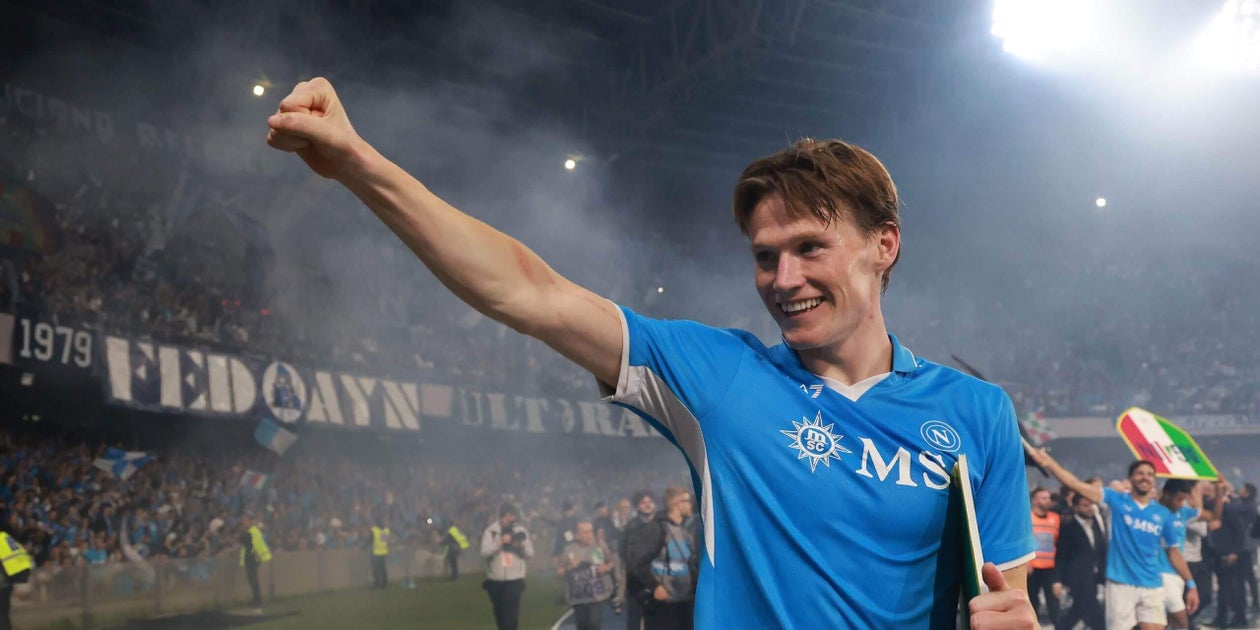
MVP Scott McTominay has no hankering to return to England after emerging as a Neapolitan folk hero. The retention is perhaps a reflection of a tipping point in ownership as more than half the teams in Serie A are now foreign-owned. There is stability of capital amid the volatility of the actual football.

McTominay was superb in Napoli’s title win (Elianton/Mondadori Portfolio via Getty Images)
Only three clubs that finished in the top 10 (Como, Bologna and Napoli) are starting this season with the same coach with whom they began last season. Gian Piero Gasperini left Atalanta for Roma after nearly a decade in Bergamo.
Milan’s owner Gerry Cardinale’s promise to be Silvio Berlusconi 2.0 has manifested in the appointment of Berlusconi’s last scudetto-winning coach, Massimiliano Allegri, and signing a Ballon d’Or winner who’ll turn 40 next month. Luka Modric follows Kevin De Bruyne (Napoli), Edin Dzeko (Fiorentina), Ciro Immobile, Federico Bernardeschi (Bologna) and Papu Gomez (Padova!) in reinforcing not only their new teams but stereotypes about Serie A, retirement homes and its status as a twilight league.
Look beyond the headline names, though, and the data tells a very different story. The majority of signings have been in the 20-24 bracket and as much as Champions League finalists Inter have been frustrated in their attempts to sign Atalanta’s Ademola Lookman, who has performed the role of Serie A’s Alexander Isak this summer in holding out for a move, they have rejuvenated. Como may have brought in Alvaro Morata on loan, but the €100m the league’s biggest spenders have splurged is mainly on up-and-coming players like teenager Jesus Rodriguez from Real Betis and Jayden Addai from AZ.
The return of league-winning coaches Allegri, Stefano Pioli (Fiorentina) and Sarri contrasts with the Cesc Fabregas effect. Such was the impression the 38-year-old made at Como last season, Parma have tried something of their own. Remember they offered Enzo Maresca his first senior coaching role after his work with Manchester City’s development squad. Maresca was fired in Serie B but has since rebounded and become a world champion… Parma hope Carlos Cuesta, 30, has similar potential after serving as Mikel Arteta’s assistant at Arsenal.
The jeopardy in the league should be the envy of its peers. A team hasn’t retained the title in Italy since Juventus in 2020. Anyone sure of Napoli’s chances of bucking that trend has been rocked by the news of Romelu Lukaku’s quad injury and the lengthy spell he now faces on the sidelines.
Italian football is compelling in its sheer unpredictability, the sweep of its beauty and preposterousness on so many levels. Take Rimini, a third-division club from Fellini’s hometown. They have changed presidents three times, had a change of owner, gone through three different coaches and are at risk of a points penalty. All in the space of 10 August days. It’s hard to understand and makes little obvious sense. It feels like a Fellini-esque fantasy. But that’s Italian football. Your jaw drops. Your pupils dilate. Your gast flabbers if that’s even a thing.
Is it a dream? Is this reality? We’ll be back tomorrow with more questions about the contenders, the players to watch and more.
(Top photo: McTominay after helping Napoli clinch the title. Cesare Purini/Mondadori Portfolio via Getty Images)