In the First World War, fighter aircraft typically had only two light machine guns.
By the Second World War, the firepower available to combat aircraft had increased dramatically. An arsenal of massive cannons firing explosive shells, combined with multiple heavy machine guns and a vast supply of ammunition, made some combat aircraft high-speed flying ‘battleships’. Here are 10 aircraft with insane firepower:
10: Messerschmitt Me 262

Messerschmitt Me 262
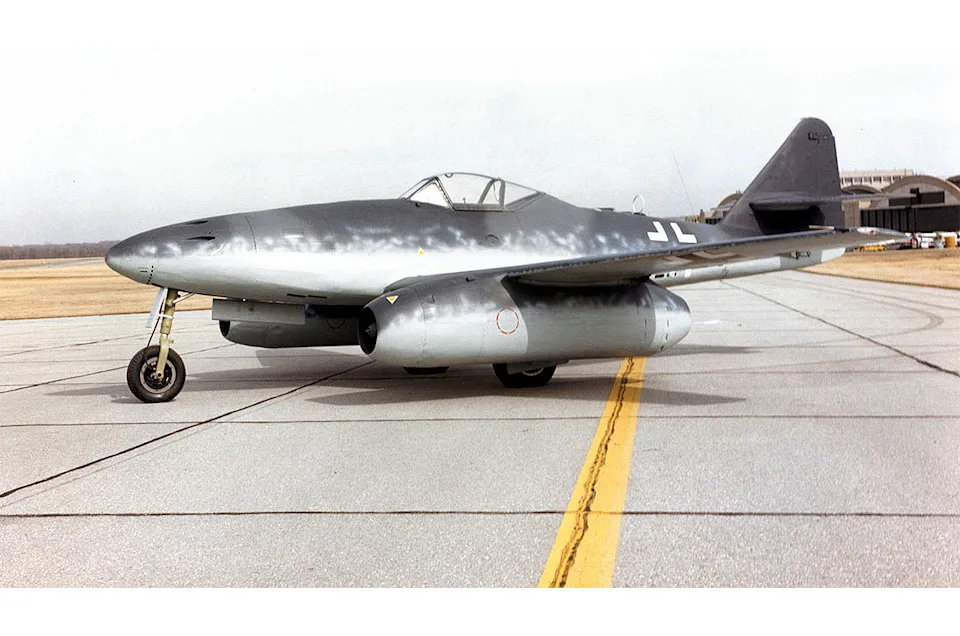
Though famous for being the first jet-powered aircraft to see combat, it wasn’t just the engines and speed that made the Messerschmitt 262 so formidable; its firepower, optimised for bomber destruction, was hefty, consisting of four 30-mm cannon firing explosive rounds at an extremely high rate.
A conventionally armed 262 with its four 30-mm cannon might have found an honorary mention in the flying artillery hall of fame. Still, a 50-mm gun in that shark-like nose guarantees a place. The Mauser MK 214A was a 50 mm (1.969 in) calibre autocannon designed for use on Messerschmitt Me 262 and Me 410s.
Fortunately for Allied bomber crews, the entire 262 programme, including two versions earmarked for either a Mauser or Rheinmetall 50-mm autocannon, was hamstrung by administrative stupidity, technical headaches, and Hitler’s absurd notion that it should be a bomber, not a fighter. Had the gun seen widespread operational use, it could have been disastrous for Allied bombers.
One to three 50-mm rounds were calculated to be enough to destroy a B-24 or B-17. Extra points are awarded for its intimidating appearance. With a top speed of 578 mph, the Me 262 was astonishingly fast and a serious threat to Allied aircraft.
9: Boeing YB-40

Boeing YB-40
This aircraft is a fighter of sorts, but, as you have no doubt spotted, it is also a B-17. In 1942, the US Eighth Air Force considered creating an effective escort by mounting a massive number of guns on a bomb-free Flying Fortress.
No aircraft has ever flown with such a formidable machine-gun-based defensive armament. Unfortunately, this made the aircraft so draggy and heavy that it couldn’t keep up with the bombers it was supposed to protect. Making the whole exercise rather pointless.
In a totally irrelevant but oddly satisfying aside, the YB-40 appeared in an Oscar-winning film – two of them appear in William Wyler’s The Best Years of Our Lives, which won nine Academy awards in 1947. The YB-40’s film career was notably more successful than its operational one, but did not save it from the scrapman’s torch.
The YB-40 could be equipped with up to thirty defensive guns, though it normally carried between fourteen and sixteen. Armament was mostly the .50-calibre M2 Browning machine guns in various configurations, though 40-mm cannons were also tested.
8: Northrop P-61 Black Widow

Northrop P-61 Black Widow
The massive and sinister Northrop P-61 Black Widow was a ferocious machine. It was the first purpose-designed night interceptor to enter operational service. The forward-looking requirement that led to the aircraft was issued as early as October 1940. The P-61 was of the twin-boom configuration.
Pioneering British efforts with radar-equipped fighters had impressed US military planners. Using a first-generation airborne radar effectively required a large aircraft with a dedicated second crew member for its operation. The Black Widow started as 10,000kg beast when loaded; by the end of its career, it was a bulky 18,000kg…
To put this in perspective, it was around the same weight as seven fully loaded Spitfire Mk1s! Finding the target with a radar was one thing, but destroying it effectively required firepower; the P-61 boasted four fixed 20-mm cannons in the belly.
But this was not all. The first 37 P-61As, the final 250 P-61Bs and all the P-61Cs also had an electric dorsal turret with four heavy machine guns. In addition to being heavily armed, the P-61 had its armament concentrated on its centreline, rather than in the wings, making it more accurate and destructive.
7: North American B-25G/H Mitchell

North American B-25G/H Mitchell
In the Second World War, the 75mm gun armed many US ground vehicles, including M4 Sherman tanks. Rather more remarkably, it was also fitted to the B-25 medium bomber. Intended for the strike and anti-shipping roles, these upgunned B-25s were offered to the RAF, USN and the USSR but only adopted by the USAAF.
The short nose and squarish fuselage of the proven B-25 allowed for easy installation and operation (the weapon was hand-loaded by the navigator). The aircraft version of the 75mm gun had a lighter, thinner-walled barrel and a different recoil mechanism than the ground variants, but used the same ammunition.
The B-25 could also carry twelve to eighteen .50 cal (12.7 mm) heavy machine guns. Considering that rockets, bombs, and torpedos could be carried on the trusty B-25, it is a wonder it didn’t win the entire Pacific war single-handed…
The aircraft was particularly effective against shipping, sinking barges, freighters and small craft. It was noted that a single well-placed hit could inflict considerable damage, even to a destroyer. The 75mm gun was also tried experimentally on the Douglas A-26 Invader.
6: Tsetse Mosquitoes

Tsetse Mosquitoes
The Ordnance 57-mm QF 6-pounder gun was a land-based anti-tank gun used by both the British and United States Army. The ‘Tsetse’ (named for an African biting fly) was created by fitting a quick-firing variant, the Molins, into a standard fighter-bomber Mosquito. This formidable weapon could fire 55 rounds per minute in fully automatic mode.
The Molins gun replaced the Mosquito’s normal primary armament of four 20-mm cannon; Two or four .303 machine guns were retained in the nose to sight the large gun (the aircraft retained the ability to carry bombs or rockets on its underwing hardpoints).
By the time the conversion flew, the 57-mm weapon was no longer competitive against armour, so it was decided to operate the new variant in the anti-shipping role instead. The results were spectacular. In 14 months, eight U-boats were destroyed wholly or in part by Mosquito Mk. XVIIs.
Decrypted Enigma information was used to send the Molins Mosquitoes to meet U-boats as they approached French ports and to coordinate anti-shipping strikes. At least one Ju 88 was destroyed by a Tsetse Mosquito in a fight during which a single 57-mm round was seen to rip one engine clean off the unfortunate Junkers.
5: Bristol Beaufighter

Bristol Beaufighter
The Beaufighter was a twin-engine bruiser that emerged from the tumultuous attempt to get the Royal Air Force a heavy fighter. Armed with four 20-mm cannon and six light machine-guns, it emerged as perhaps the best armed aircraft on its entry into service in 1940.
Though British aircraft generally carried less ammunition than US equivalents, the Beaufighter is an exception. The A-20 Havoc could carry 252 kg of ammunition, the Beaufighter Mk IF, a stonking 367 kg. Compare this to the paltry 100 kg of the Soviet Pe-2.
The Beaufighter proved capable in a variety of roles, and other armament options included two 250-pound (113kg) bombs or eight 60-pound (27kg) rockets (RP-3 from Rocket Projectile 3 inch). It served with distinction as a night fighter, strike fighter and torpedo bomber.
Its wings were as big and thick as barn doors – its wing area of 46 square metres was almost 45% greater than its Japanese rival, the Ki-45 Toryu. Its empty weight – 7000kg – was actually greater than the maximum take-off weight of the Me 110, and a fully loaded, late-war Beaufighter could top 11,500 kg gross weight, enough to make a bombed-up medium bomber blush…
4: Junker Ju 88

Junker Ju 88
With Soviet tank production factories creating armour at a startling rate, Germany was forced to consider every conceivable measure of anti-tank warfare. Every combat aircraft type was assessed for suitability for the anti-armour role, which meant fitting heavy armour to withstand low-level ground fire and adding bigger guns.
The twin-engined Junkers Ju 88, which first flew in 1936, was the most versatile of the Luftwaffe’s aircraft, serving in various roles, including bomber, heavy fighter, night fighter, torpedo bomber and reconnaissance. It was even adapted into an explosive-packed drone. With a glut of available Ju 88 airframes, it was considered convenient if they could be drafted into the anti-tank role.
Many gun types were tried with the Ju 88, including the huge 75mm PAK 40, capable of penetrating thirteen centimetres of tank armour at one kilometre. However, even the smaller 30mm Mk 101 was highly effective and could remove a tank if attacked in its relatively vulnerable rear.
The Ju 88 P variant was developed for the anti-armour role with a single Bordkanone series 75 mm, 50 mm (1.97 in), or twin 37 mm (1.46 in) calibre cannon in a ventral gun pod position. Produced in small numbers, this large, somewhat lumbering Ju 88s were not a success.
3: Hawker Hurricane

Hawker Hurricane
To take on tanks requires serious firepower, and with this (and other ground attack roles in mind), a Hawker Hurricane was tested with a wing-mounted 40-mm cannon in 1941. The Rolls-Royce 40mm cannon was tried but dismissed for a lack of reliability and smaller ammunition capacity in its drum magazine, and the Vickers S was selected instead.
The Hurricane Mk.IID, armed with 40mm cannons, went to fight tanks in the desert as part of the No.6 Squadron of the Royal Air Force, earning the nickname ‘The Can Openers’ for their ability to destroy armoured vehicles. Hurricanes armed with the hefty Vickers S gun claimed 47 tanks plus 198 other enemy vehicles.
With its water-cooled engine, the Hurricane IID was not ideal for the low-level ground attack role and suffered heavy losses, mainly from enemy anti-aircraft fire. The improved MkIV, operational from 1943 – had beefed up armour around the fuel tanks, engine and cockpit areas.
In June 1943, Hurricanes of No. 137 Squadron started flying Hurricanes with the option of a 40mm cannon or unguided rockets, initially known as Unrotating Projectiles (UP) and later Rocket Projectiles (RP). The rockets were more effective, but the unit was initially banned from using this ‘secret’ weapon over enemy-occupied territory.
2: Yakovlev Yak-9

Yakovlev Yak-9
Though given different designations, the wartime Yak fighter family is the same series, with significantly more commonality than the Spitfire family can claim. Around 8700 Yak-1s were made, 6399 Yak-7s, and 4848 Yaks for a tremendous total of around 36,716, making it the most numerous fighter type in history.
The Soviet Union’s fixation with tactical air power meant no fighters could completely escape the ground attack, Close Air Support or Ground Attack missions. With its 37-mm cannon on excellent low-level performance, it is often thought that the Bell P-39 was a prime Soviet anti-tank aircraft, but it was primarily tasked with the low-level fighter role.
The Yak-9 performed more anti-tank missions, in particular, the Yak-9T variant with a 37-mm cannon, in this case the Nudelman-Suranov NS-37 (also fitted to the Ilyushin Il-2 and Lavochkin LaGG-3). This formidable cannon could penetrate up to 40 mm (1.6 in) of tank armour from 500 metres (1600 ft).
The Yak-9T carried 30 rounds of 37-mm ammunition, which fired through the propeller hub. A total of 2748 Yak-9Ts were produced. Attempts to up-gun the Yak-9 further to carry a 45-mm gun, as the Yak-9K, proved too much for the tiny fighter.
1: Henschel Hs 129

Henschel Hs 129
The Henschel Hs 129 is unique in this list in being purpose-designed for the Schlachtflieger (Close Air Support) mission, which included anti-armour; in this and several other respects, it was the A-10 of its time. In the 1960s, the USAF experience in Vietnam led to a desire for greater armour protection for ground attack aircraft; in the 1930s, the German Spanish Civil War experience had the same effect on the Luftwaffe.
The requirement was issued in 1937, and soon, two contractors were down-selected: Focke-Wulf and Henschel. The new aircraft was required to have an armoured ‘bathtub’ and carry 20-mm cannon. Focke-Wulf proposed a converted existing design, and Henschel a new one. Henschel won the contest, and the machine flew in 1939.
It proved troublesome, with the chronic lack of power and the poor pilot view (through the thick armoured glass) being among the worst problems. Considering the size and power of the aircraft, there were limitations on the size of gun it could effectively use. A lightened Pak 40, the massive BK 7.5 cm Panzerabwehrkanone was fitted to the Henschel Hs 129B-3, but was too much gun for the aircraft.
Though insufficient numbers of Hs 129s were made, they proved excellent at destroying tanks. Rudolf-Heinz Ruffer (1920-1944) was a German Luftwaffe ground-attack pilot who destroyed 80 tanks, most with the Henschel Hs 129. Though relatively slow and tricky to master, pilots felt reassured by its effective armour and armament. Had it been produced and deployed in larger numbers, like the Il-2 and Ju 87, it could have proved a significant problem for the Allies.
Follow Joe Coles and his Hush-Kit aviation world on Substack and X
If you enjoyed this story, please click the Follow button above to see more like it from Autocar
Photo Licence: https://creativecommons.org/licenses/by/4.0/deed.en
]]>