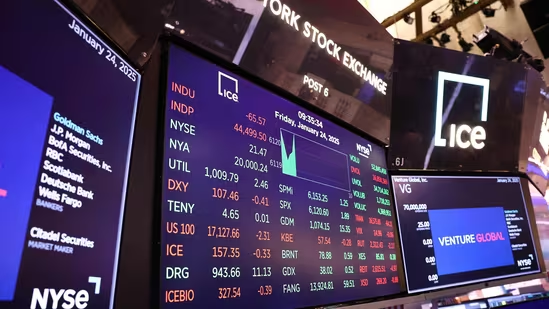
The global investment markets are fuelled by the rhythmic churning of stock exchanges on which trading broadly takes place during daylight hours ranging from 8am to 4.30pm The daily trading cycle begins in Japan and ends with the US, and goes through the world’s 10 major exchanges, accounting for up to $300 billion worth of trade and clocking anywhere between 150 million and 200 million transactions.
Those are staggering numbers, and the demand for extended trading hours has steadily grown. However, it wasn’t always like this.
Stock trading traces its origins back over four centuries to a Dutch trading company that forever altered the landscape of financial markets. On 20 March 1602, the Dutch East India Company (Vereenigde Oostindische Compagnie, or VOC) made history by launching the world’s first Initial Public Offering (IPO), a groundbreaking event that laid the foundation for modern investment practices.
Article 10 of the VOC’s charter proclaimed: “All the residents of these lands may buy shares in this Company,” opening the doors of financial participation to the masses. It marked the beginning of a new era in which capital markets could be accessed by ordinary people, not just elite investors. Prior to that, the market had existed primarily for the exchange of commodities.
The United States didn’t enter the stock market scene until the late 18th century. The origins of American stock trading began with a small group of merchants who forged the Buttonwood Tree Agreement in 1792. This group, meeting regularly to trade stocks and bonds, unknowingly laid the foundation for what would eventually become the New York Stock Exchange (NYSE).

Traders would meet beneath a buttonwood tree outside 68 Wall Street in New York City, making informal deals to buy and sell shares in various companies. These early gatherings set the stage for the establishment of the New York Stock Exchange in 1792, a physical marketplace where buyers and sellers could meet in person to trade stocks.
Over the years, the NYSE grew into one of the most important stock exchanges. The Buttonwood traders effectively became the founding members of the New York Stock Exchange, creating the infrastructure for a market that would go on to revolutionise the way people invested.
But while the Buttonwood traders are often hailed as the founders of the NYSE, Philadelphia holds the distinction of being home to the first stock exchange in the US. Founded in 1790, the Philadelphia Stock Exchange was the first of its kind in the US.
Fast-forward to 1971, when another pivotal moment in the history of American stock trading occurred: the launch of the National Association of Securities Dealers Automated Quotations (Nasdaq). Unlike the NYSE, which required in-person trading on the exchange floor, Nasdaq was an entirely electronic exchange, allowing investors to buy and sell stocks through a network of computers. This shift to automated trading marked the beginning of the transition to digital markets and changed the way people interacted with the stock market.
In 1992, Nasdaq expanded its reach globally by merging with the International Stock Exchange (ISE) based in London. This collaboration created the first-ever intercontinental securities market, allowing investors to trade stocks across international borders seamlessly.
Round-the-clock trading is becoming a reality in markets, and investors say it’s about time. The once-predictable opening and closing bells, at 9.30am and 4pm US Eastern Time, are increasingly viewed as anachronistic. After all, today’s markets have long since outgrown the traditional working day. Assets like currencies, US Treasury bonds, and cryptocurrencies already trade 24/7, leaving stocks as one of the last major asset classes tied to set hours.
For years, individual investors around the globe have been restricted to trading US stocks during standard hours at the New York Stock Exchange (NYSE) and Nasdaq (^IXIC), which are timed to suit US market participants. But this trading window, beginning when investors in Hong Kong are heading to bed and ending during lunchtime on the West Coast, has led to a push for extended hours to meet the growing global demand. If you’re in London and want to trade US stocks, your window is currently open from 2.30pm to 9pm.
Premarket and after-market sessions, which run from 4am to 8pm ET, have provided some flexibility, but they’re often marked by lower liquidity and less market participation. And while European and Asian exchanges have similar core trading hours, the gap is increasingly seen as a competitive disadvantage.
The timing of earnings reports, often scheduled after the bell or before market open, can trigger significant price swings, leaving investors vulnerable to overnight risks.
In 2022, Robinhood expanded its trading hours to accommodate early and late traders, introducing a trading window from 7am to 8pm ET. This move was part of a broader trend to provide users with more flexibility in response to growing demand for after-hours trading. The latest 24/5 initiative, which allows trading on select stocks nearly round-the-clock, represents another step toward giving retail investors greater control over their investment activities.
Since its launch in 2013, Robinhood has evolved from a no-fee trading app aimed at democratising finance into a comprehensive financial ecosystem. Originally designed to attract a younger, less-experienced demographic, the platform drew attention with its commission-free stock trading and social-first approach, where users could share stock tips and trading insights.
The company’s rise to prominence coincided with the retail trading boom of 2020 and 2021, when social media-driven stock movements like GameStop (GME) pushed Robinhood into the spotlight. As of January 2025, the platform boasted 25.5 million funded customers, with its offerings expanded beyond equities to include cryptocurrency, options, futures, and even mortgage services. Robinhood has also launched a robo-advisor and a prediction market hub.
“Robinhood is liberating information that’s locked up with professionals and giving it to the people,” said co-founder and CEO Vlad Tenev in a 2021 interview with TechCrunch. The company’s mission to “democratise finance” has been central to its growth, allowing it to reshape how retail investors approach stock trading. The firm’s no-commission model pushed major competitors, including Charles Schwab, Vanguard, and Fidelity, to follow suit and eliminate their own trading fees by 2020.
It operates in the UK under Robinhood UK.
Webull has positioned itself as a player in the commission-free brokerage space, offering a platform that caters to both novice and more experienced investors. Since its launch in 2018, Webull has gained attention for its customisable trading tools and advanced features, distinguishing itself from competitors such as Robinhood by targeting a broader range of traders.
The platform has expanded beyond the US market, with a user base that spans Asia-Pacific, Europe, and Latin America. According to the latest available figures, Webull reports 66.4 million monthly active users across its international markets, reflecting its growing global presence.
In 2023, Webull went public on the Nasdaq through a merger with SK Growth Opportunities, a special purpose acquisition company (SPAC).
While Robinhood has focused on simplifying trading for retail investors, Webull differentiates itself with a platform designed for more sophisticated traders. Webull offers a wider range of assets, including US stocks, options, ETFs, and cryptocurrencies, alongside advanced charting tools and detailed analytics. This approach appeals to users seeking more customisation and control over their trades.
A feature of Webull’s offering is its “Webull Blue Ocean” service, a partnership with Blue Ocean Technologies, which allows users to trade US stocks and ETFs during overnight hours. This service operates through the Blue Ocean Alternative Trading System (BOATS), enabling trading outside of traditional US market hours.
Webull has faced scrutiny over its ties to Chinese companies. In 2019, CEO Anthony Denier described Webull as “both a US and Chinese company,” raising concerns about the platform’s potential exposure to Chinese regulatory risks. This has sparked debate about the platform’s security and independence, particularly among US investors.
In the UK, Webull operates under the name Webull UK, offering access to the US, Chinese, and Hong Kong markets. The company’s expansion into these regions is part of its broader strategy to diversify its user base and offer access to international trading.
Charles Schwab (SCHW) expanded its extended trading offering, increasing the number of stocks and exchange-traded funds (ETFs) available to retail investors outside regular US market hours.
Schwab’s extended trading covers 1,100 securities, including stocks in the S&P 500, Nasdaq 100, and a range of ETFs.
Schwab’s strategy is to provide investors with greater flexibility in a market driven by global factors. “As the pace of interconnected global markets activity increases and market-moving news and events happen outside of regular US market hours, 24-hour trading gives investors flexibility and access that can be critical to take advantage of potential opportunities — as well as helping to manage risk,” said James Kostulias, managing director at Schwab.
Schwab has observed significant trading activity in stocks such as Tesla (TSLA), Nvidia (NVDA), and NIO (NIO), amid strong interest in both tech and international equities.
In addition to its regular market hours from 9.30am to 4pm ET, Schwab offers extended premarket and after-hours trading sessions. The company also provides 24/5 trading on its thinkorswim platform, which includes over 1,100 equities, such as those in the S&P 500, Nasdaq 100, and Dow 30, alongside more than 600 ETFs.
-
Fidelity – Premarket (4am) and after-hours (until 8pm); no overnight yet
-
E-Trade – Offers extended hours (4am to 8pm), no full overnight
-
Interactive Brokers – Offers overnight trading of US stocks
-
Firstrade – Offers 8pm – 4am ET trading Sunday night through Friday morning
Founded in 1974 by Stuart Wheeler as IG Index, the company was the first to offer spread betting on the price of gold. Over the years, IG has expanded its product range and services, transitioning from spread betting to a comprehensive offering that includes access to global stocks, indexes, forex, and commodities. In 2006, IG broadened its scope to include institutional services, and in 1998, it launched its first online dealing platform.
The broker offers access to 140 US stocks 24/5, extended hours on 150+ US stocks, and out-of-hours on indexes and forex, using CFDs.
IG said it also recognised demand from investors who did not want to be limited by standard trading hours. “We already provide extended access across a wide range of assets, from US stocks and indices to FX. We’ve also created our own markets such as weekend oil trading, and this month we’re launching 24/5 trading on more than 100 stocks,” Michael Healy, UK managing director at IG, told Yahoo Finance UK.
Launched in Denmark in 1992, it claims to serve over 1 million clients worldwide. It provides them with access to premarket and after-hours trading on US exchanges, allowing them to place limited orders outside regular trading hours. This feature enables traders to respond to news events and market developments even when the markets are closed.
The premarket session is available from 7am to 9.30am ET, while the after-hours session runs from 4pm to 5pm ET. Saxo offers these extended hours for a range of instruments, including US stocks, ETFs, and single-stock CFDs.
While primarily focused on US exchanges, the availability and specific conditions can vary based on the client’s country of residence and account type.
As David Morrison, senior market analyst at Trade Nation, told Yahoo Finance UK: “Without doubt, there can be unexpected, and arguably excessive, market moves in out-of-hours stocks, particularly around earnings releases. Typically, this is because trade volumes are lighter out of hours.
“But it can be argued that trading outside ‘normal’ hours can help take the sting out of an unexpected piece of news. It’s possible that the first reaction is the correct one, but there have been plenty of occasions when the first move gets faded over the course of an extended session, and that this leads to more orderly trading once the exchange is fully open.”
This is where brokerages are stepping in. Following the launch of overnight trading in single stocks by Robinhood and Interactive Brokers (IBKR) in 2023, other platforms have raced to extend their trading timetables. The NYSE has unveiled plans to extend trading on its all-electronic exchange to 22 hours daily.
CME Group’s (CME) equity futures and options markets are active nearly 24 hours a day. “Clients want to react to news flow immediately,” Paul Woolman, global head of equity products at CME Group, said. “Historically, they would hold on to their options risk and wait for hours before trading again. I think clients learned they just can’t afford to do that.”
Investor appetite for US stocks has been particularly robust, with the S&P 500 up 10% year to date, driven by the boom in AI and expectations for interest rate cuts.
Proponents of 24-hour trading argue that it gives investors more control over their portfolios and allows them to react faster to news outside regular trading hours, enhancing real-time risk management.
However, late night trading isn’t without its dangers. Thin volumes and low liquidity during extended hours can cause sharp price swings, and large volumes of trade may stress trading platforms. For example, in August last year Blue Ocean, a platform that powers off-hours trading for brokerages like Schwab and Webull, suffered an hours-long outage during a global market rout. The company has since upgraded its technology to address these issues.
Healy told Yahoo Finance UK: “With today’s round-the-clock news cycle, extended hours trading has become a necessity. The 24-hour nature of crypto markets is fuelling this appetite, and we’re already seeing US exchanges move towards near-continuous sessions. Traders expect to react instantly to earnings, policy decisions, or geopolitical shocks, not wait for markets to reopen.”
In an environment where news events can break at any time, investors want the flexibility to act immediately. Robinhood, for instance, has introduced 24/5 trading on select stocks, providing global investors the ability to respond to breaking news on their own timelines. As a spokesperson for Robinhood told Yahoo Finance UK: “We believe investors should not be beholden to traditional market hours but rather be able to trade when it makes sense for them.
“Market-moving news can break day or night – and few investors have the ability to react in real time. In the UK, US East Coast hours have long dictated access to US equities – leaving UK investors at risk of missing opportunities and at a disadvantage compared to both institutions and US-based retail investors.”
However, the issue of liquidity remains a concern. As Morrison pointed out: “There are definitely times when 24-hour markets can lack liquidity. We can already see this in FX, particularly during the Asian Pacific session where liquidity can be thin. And this can be dangerous should an event lead to a flood of orders, causing a big market move which is exaggerated due to a thin order book.”
To mitigate these risks, many brokerages are implementing safeguards like limit orders during extended hours. A Robinhood spokesperson said: “Limit orders are especially important for retail investors trading during extended and overnight hours. As trading volumes are typically lower than during regular market hours, spreads can widen and run the risk of unfavourable execution.” These safeguards can provide greater price certainty, reducing the risk of slippage, particularly when price movements are volatile.
As trading hours continue to expand, exchanges are also taking steps to protect investors. “Exchanges also have a role to play with safeguards such as circuit breakers, and that should continue as extended hours trading becomes more widespread,” said Healy. For instance, Robinhood’s overnight trading platform uses Alternative Trading Systems (ATS) to execute orders, with built-in risk controls to prevent stocks from trading beyond a set percentage of their price established near the end of extended hours.
While many investors welcome the extended access, institutional investors have raised concerns. Some have called for a reduction in trading hours, arguing that much of the activity now occurs around the opening and closing auctions just before the traditional market bells.
The liquidity issue is particularly problematic. Even during the regular trading day, volumes are often concentrated around the market open and close, while trading activity in between can be sparse. This can result in higher volatility during off-hours, making it difficult for investors to get good prices.
Limitations on overnight trades can mitigate some of these risks. Brokerages like Schwab and Webull restrict off-hours trading to limit orders, which allow investors to set a maximum and minimum price for their trades. This strategy, recommended by financial advisers, aims to reduce risk if markets experience sudden movements.
The trend towards extending trading hours is not limited to the US. The London Stock Exchange Group (LSEG.L) is reportedly exploring 24-hour trading to boost the competitiveness of the UK market. While still in early discussions, LSEG is looking into the technological, regulatory, and liquidity considerations involved, according to Financial Times sources.
LSEG boss David Schwimmer previously told Yahoo Finance UK that LSEG was indeed eyeing a shift to an extended trading hours model, with ongoing discussions around the commercial, policy, and regulatory implications of a move.
“We are looking at whether we should be changing our hours. We haven’t made any decisions, and anything that we would do would happen in consultation with the market, our users, and of course, we would work closely with the regulators,” he said. “Nothing has been decided at this point, but it’s something we are certainly thinking about.”
A shift to either extended trading hours or 24-hour trading would make LSEG the first UK or European trading venue to move to this model.
The NYSE has asked the US financial regulator to approve extending its trading hours beyond the traditional 9.30am to 4pm window. Its proposal includes extending the trading day to 1.30am to 11.30pm. Still, concerns about clearing trades and the potential impact on open-ended funds, which calculate their values once a day, have complicated the issue.
Meanwhile, Nasdaq is already engaging with regulators to facilitate 24-hour trading five days a week by 2026. The exchange’s push is driven by increasing interest from investors in the Asia-Pacific region, where US markets offer lucrative opportunities.
As IG’s Healy underscored: “The benefits of being able to respond in real time to breaking events far outweigh the risks, as long as traders understand the different dynamics of out-of-hours markets.”
Download the Yahoo Finance app, available for Apple and Android.