For decades only diehard royalists took Reza Pahlavi seriously. Iran’s regime, its opponents and Western diplomats dismissed the son of the last shah as the “Clown Prince”. He seemed more interested in his suntan than recovering his sun-and-lion flag. When protests erupted on December 28th he was said to be on a beach holiday. For 47 years he has championed his claim to the throne, mixing with the powerful in Washington, dc (he lives nearby). An Iranian exile there describes Mr Pahlavi and his team as “rookies”. Donald Trump considers him “a nice man” but has brushed aside his requests to meet.
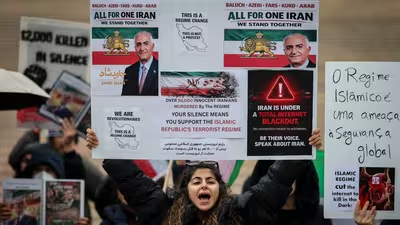
Protestors hold signs and portraits of the son of the last shah of Iran Mohammad Reza Pahlavi, Reza Pahlavi, during a demonstration in support of Iranian People in front of the Portuguese Parliament in Lisbon, on January 17, (AFP)
And yet after nearly half a century of waiting, Mr Pahlavi believes his moment has arrived. “This regime is on the verge of collapse. And what it’s doing right now is a last-gasp effort to intimidate,” he told The Economist in Washington on January 14th. Cries of “Javid Shah” (“Long live the king!”) were widespread at the protests that have consumed Iran—at least before the regime mowed down the protesters. When their numbers began to flag, Mr Pahlavi called for a return to the streets and turned a provincial rally of jobless angry men into a mass mobilisation that swept Tehran and Iran’s other cities.
Raised on the Shahnameh, Iran’s epic poem of kings and heroes, Iranians like mythical saviours. In 1979 Ruhollah Khomeini, an untested cleric, played that role; followers said they saw his face in the moon. And few alternatives remain. The regime has locked up any would-be challengers in Iran. It has filled its prisons with dissidents and their lawyers; political parties are prohibited; even environmental groups are banned.
Iranians have long since abandoned their faith in regime reformists championing gradual change. Even as presidents such as Muhammad Khatami and Hassan Rouhani were elected, the rule of Ali Khamenei, the supreme leader, grew more absolute and the economy more threadbare. Even Mostafa Tajzadeh, a former presidential adviser who was jailed for fomenting anti-regime protests, fell from favour. “Tear them apart,” runs a lyric from “Marg bar kolle nezam” (“Death to the whole regime”), a popular rap.
Clean-shaven and besuited, Mr Pahlavi sits in stark contrast to the bearded supreme leader in his robes and turban, who scorns ties as symbols of decadence. Like many a populist, including the cleric who toppled his father, Mr Pahlavi claims legitimacy from the people’s cries. But he stumbles when asked what Iranians should do in the face of the mullahs’ violence.
He stresses the importance of non-violence and civil disobedience but argues that people have the right to defend themselves when attacked. Mr Khamenei, he says, “declared war on the Iranian people a long time ago. This is not a foreign enemy, it’s a domestic enemy.” “You have to neutralise and destroy that element that represses,” he continues. He dismisses the risk of armed confrontation with security forces leading to a Syria-style civil war.
You have to “eliminate the top corrupt brass”, Mr Pahlavi argues, but leave infrastructure in place so the country can function: “The day the regime falls, somebody has to still pick up the trash, electricity and water has to be provided.” His 169-page “Emergency Phase Booklet”, his plan for Iran published in July, seems to offer change while also trying to placate potential foes. It vows to seek national reconciliation, integrate the Islamic Revolutionary Guard Corps into the army, retain police and civil servants, and warns against vengeance and purges. Yet it also proposes vetting minor civil servants in key ministries for ideological and intelligence ties and repealing laws against homosexuality.
His plan makes him a transitional leader. In our interview he stresses this, describing himself as a “neutral arbiter” who would lead a temporary government. Iran should, he says, be a democracy. His plan promises a referendum within four months on restoring the monarchy or setting up a parliamentary republic. If voters chose the former, he would be crowned two months later. He would establish diplomatic ties with Israel (his father never did). He also says he would abandon the nuclear programme for sanctions relief.
And yet Iran’s opposition movements remain wary. The country’s ethnic minorities remember his father’s suppression of their languages and heritage in the name of Persian grandeur. Kurdish nationalist movements, including armed groups among them, prefer secession. Mr Pahlavi has never united the regime’s critics in exile. Keeping a polarised Iran from fragmenting, should he ever return, would be harder still. He has promised to put the restoration of a monarchy to a referendum, but many doubt that pledge. His supporters denounce exiled Iranians who refuse to endorse a monarchy.
The man who would be king
Diplomats fear the collapse of another Middle Eastern state. Democrats aspire to a constitutional assembly and wonder why they should trade one supreme leader for another. “Death to the satemgar (tyrant),” goes another chant in Tehran, “whether Pahlavi or the rahbar (leader).” Mr Pahlavi wants a perch above others, not a place beside them, says an academic who tried but failed to include him in a coalition.
In our interview Mr Pahlavi emphasises that Iran’s fate is in the hands of Iranians: “Iran’s destiny is not sealed by what any other country does… Our fighting will not stop.” From afar, he sounds confident that this is a revolution. But what his role will be remains unclear.
Sign up to the Middle East Dispatch, a weekly newsletter that keeps you in the loop on a fascinating, complex and consequential part of the world.