Key Points
-
Apple went into the holiday quarter with improving revenue momentum.
-
Highlighting Berkshire’s confidence in Apple, the tech stock is still Berkshire’s biggest holding.
-
Berkshire’s upcoming CEO handoff to Greg Abel could lead to a shift in strategies for the equity portfolio.
- 10 stocks we like better than Berkshire Hathaway ›
Berkshire Hathaway (NYSE: BRK.A) (NYSE: BRK.B) has spent the past two years trimming its stake in Apple (NASDAQ: AAPL) — a move that caught many investors off guard. That trend becomes even more interesting heading into 2026, when Warren Buffett is scheduled to hand the chief executive role to Berkshire Vice Chairman Greg Abel.
Notably, the selling doesn’t necessarily mean Berkshire has soured on Apple’s business. The cuts to the conglomerate’s massive position in the iPhone are more likely a way to manage an oversized position. Further, Apple has been giving investors reasons to be upbeat; its latest guidance points to stronger growth during the holiday quarter.
Where to invest $1,000 right now? Our analyst team just revealed what they believe are the 10 best stocks to buy right now, when you join Stock Advisor. See the stocks »
Why should investors care? Apple remains Berkshire’s biggest listed stock holding, and Abel will inherit a company that already has enormous financial flexibility. If Abel’s looking for ways to deploy capital at Berkshire’s scale, continuing to sell down a high-quality holding may not make sense now that the position has already been right-sized.
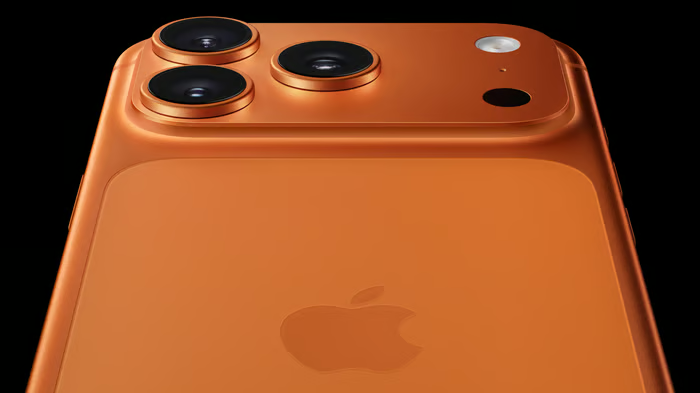
Image source: Apple.
Understanding Berkshire’s Apple position
Berkshire Hathaway reported owning 238.2 million shares of Apple as of Sept. 30. That was down from 280.0 million shares three months earlier.
At Berkshire’s latest reported share count for its Apple position, and based on the value of Apple stock today, Berkshire’s position in the iPhone maker is currently worth more than $65 billion. This is ahead of its second-largest holding, American Express, which is valued at about $57 billion. In addition, it represents about 20% of Berkshire’s total equity portfolio.
Showing just how big Berkshire’s position in Apple stock is, it’s even significant as a percent of the conglomerate’s total market capitalization. With a market capitalization of about $1.07 trillion as of this writing, Apple stock represents about 6% of Berkshire’s total market value.
Embracing tech stocks
With Apple still sitting at the top of Berkshire’s stock portfolio, it’s difficult to believe managers at Berkshire are bearish on the tech company. A more practical reason for recent selling is concentration risk after years of compounding.
Sure, it wouldn’t be surprising to see Berkshire sell more Apple shares in the fourth quarter of 2025, getting the position to an even 20% position (as a percent of Berkshire’s total equity holdings) or slightly below it for the sake of risk management. But any selling beyond this level may be unlikely.
And Berkshire hardly looks like a business desperate for more liquidity. In its latest quarterly report, Berkshire said its insurance and other businesses held $354.3 billion in cash and U.S. Treasury bills. That kind of dry powder gives Abel flexibility, but it also creates pressure to find places to deploy capital that can still move the needle.
With this backdrop (a ton of cash and a need to deploy some of it productively), Abel may choose to hold onto whatever remaining shares Buffett leaves Berkshire with when he steps down at the end of the year.
Further, under new and younger management, Berkshire may be more prone to owning a higher percentage of tech stocks. In fact, Berkshire recently revealed a new stake in Alphabet (NASDAQ: GOOG) (NASDAQ: GOOGL). This position is now valued at more than $4 billion, putting it in Berkshire’s top 10 holdings.
Apple’s business is improving
Perhaps the biggest reason Berkshire may opt to stop selling Apple stock next year is the Cupertino-based company’s improving business.
Apple’s most recent earnings report showed steady momentum before the company’s biggest seasonal quarter. Revenue for the fourth quarter of fiscal 2025 rose 8% year over year to $102.5 billion.
And management expects that growth rate to accelerate during the important holiday quarter. Apple chief financial officer Kevan Parekh said in the company’s most recentearnings callthat it expects revenue during the period to grow 10% to 12% year over year.
That outlook is also consistent with Apple CEO Tim Cook’s recent comments on demand.
“At the aggregate level, we are thrilled with how iPhone has been received, and that’s the reason that we’re expecting double-digit growth in the current quarter,” Cook said during the fiscal fourth-quarterearnings call
None of this, of course, guarantees Berkshire will stop selling. But I think, under Abel’s leadership, there’s a good chance it will.
Should you buy stock in Berkshire Hathaway right now?
Before you buy stock in Berkshire Hathaway, consider this:
The Motley Fool Stock Advisor analyst team just identified what they believe are the 10 best stocks for investors to buy now… and Berkshire Hathaway wasn’t one of them. The 10 stocks that made the cut could produce monster returns in the coming years.
Consider when Netflix made this list on December 17, 2004… if you invested $1,000 at the time of our recommendation, you’d have $509,039!* Or when Nvidia made this list on April 15, 2005… if you invested $1,000 at the time of our recommendation, you’d have $1,109,506!*
Now, it’s worth noting Stock Advisor’s total average return is 972% — a market-crushing outperformance compared to 193% for the S&P 500. Don’t miss the latest top 10 list, available with Stock Advisor, and join an investing community built by individual investors for individual investors.
*Stock Advisor returns as of December 22, 2025.
American Express is an advertising partner of Motley Fool Money. Daniel Sparks and his clients have positions in Apple and Berkshire Hathaway. The Motley Fool has positions in and recommends Alphabet, Apple, and Berkshire Hathaway. The Motley Fool has a disclosure policy.
The views and opinions expressed herein are the views and opinions of the author and do not necessarily reflect those of Nasdaq, Inc.