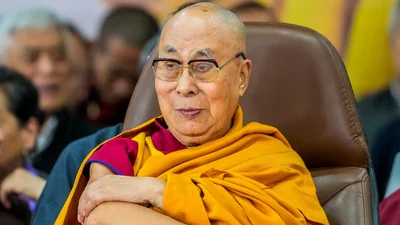
China’s Foreign Ministry spokesperson Lin Jian on Monday criticised the Tibetan Buddhist spiritual leader Dalai Lama’s first Grammy win. He described the music industry award for an audiobook, narration and storytelling as “a tool for anti-China political manipulation.”

Dalai Lama, who lives in exile in India, received the award on Sunday for his book “Meditations: The Reflections of His Holiness the Dalai Lama.”
Speaking against the recognition, the Foreign Ministry spokesperson Jian said that it is well known that the 14th Dalai Lama is “not merely a religious figure” but a “political exile engaged in anti-China separatist activities under the guise of religion,” Associated Press quoted him as saying.
He objected to the decision to confer an award to the Dalai Lama, and claimed that it is being used “as a tool for anti-China political manipulation.”
Meanwhile, Lama, in a statement, said that he saw the award “as a recognition of our shared universal responsibility.”
“I receive this recognition with gratitude and humility,” he added.
Dalai Lama won in the category of Best Audio Book, Narration, and Storytelling Recording, at the 68th Annual Grammy Awards held in the United States, on Sunday.
Other nominations in the category include Kathy Garver (Elvis, Rocky & Me: The Carol Connors Story), Trevor Noah (Into The Uncut Grass), Ketanji Brown Jackson (Lovely One: A Memoir) , and Fab Morvan (You Know It’s True: The Real Story of Milli Vanilli).
While many see the Dalai Lama as the face of Tibet’s struggle for autonomy, he has lived in exile since 1959, when Chinese troops crushed an uprising in the Tibetan capital of Lhasa.
China, which governs Tibet as an autonomous region, has been accused of trying to stamp out the Tibetan language, culture and identity.
Also read: Global resonance: Dalai Lama’s Grammy win sparks jubilation in Dharamshala | Hindustan Times
Beijing and the Dalai Lama remain at odds over the question of the Tibetan spiritual leader’s eventual successor. Tibetan Buddhists hold that the Dalai Lamas are reincarnations of a spiritual figure whose lineage dates back to 1391.
China insists that the next Dalai Lama must be born in Tibet and identified under the authority of the ruling Communist Party, while the Dalai Lama has said his successor will emerge from a free country and that Beijing has no role in the selection process.
(With inputs from AP)