LONDON — Gucci’s latest retreat in China, capped by the closing of its flagship in Shanghai’s iAPM mall last month — having shut two locations in the city a year before — is fast becoming the symbol of a market where the luxury recovery is not just uneven but starkly polarized.
The latest report from Barclays said China looks less like an emerging engine of growth and more like a mature, highly selective arena where those with clear positioning, disciplined execution and compelling local relevance are extending their lead, while laggards, Gucci most visibly among them, are struggling to re-ignite demand.

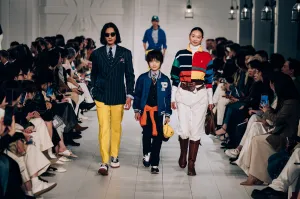
Ralph Lauren‘s spring 2025 runway show in Shanghai.
Su Shan Leong/WWD
Calling the luxury sector “an industry in churn,” Bernstein’s latest trackers across Chinese and Western social media also showed how quickly momentum can diverge.
In China, Ralph Lauren, Zegna and Chanel top the brand-momentum rankings, while in the West, Zegna, Chanel and Ferragamo lead, the tracker found.
Zegna, in particular, is the rare crossover winner, climbing to the top-two spot in China and top-one in the West, helped by a consistent, ambassador-led narrative fronted by Mads Mikkelsen and William Chan.
Chanel, meanwhile, is in the middle of a highly anticipated brand re-ignition story.
The Parisian fashion house has jumped five positions in China and 11 in the West, supported by the continued buzz around Matthieu Blazy’s spring 2026 debut, the fall 2026 runway, and the arrival of the spring 2026 collections in stores, which dominated chatter among showgoers in Paris last month.

Model on the runway at the Chanel spring 2026 fashion show.
Swan Gallet/WWD
By contrast, Gucci was at the bottom of Bernstein’s momentum rankings in both regions, and in Chinese retail, as Barclays pointed out, the brand is still posting double-digit declines although with “meaningful green shoots.”
Other major players in the sector are hardly immune.
Bernstein observed the first quarter of broad-based deceleration at both Miu Miu and Louis Vuitton on social media, with Miu Miu failing out of the top 10 in both Chinese and Western trackers for the first time.
Louis Vuitton’s monogram mania 130th anniversary push has not matched the viral energy of earlier collaborations, including the Takashi Murakami revival and “The Louis” in China. Barclays’ report also suggested a softer start for Hermès, although Louis Vuitton is broadly stable.

The Louis, a ship-shaped flagship of Louis Vuitton in Shanghai.
Future Publishing via Getty Imag
Yet pockets of strength are clear on the ground. Barclays anticipated low- to midsingle-digit growth in luxury sales in mainland China for the first quarter of 2026.
Outperformers such as Loro Piana, Brunello Cucinelli, Moncler and Burberry — as well as Miu Miu for now — according to Barclays, are offsetting brands still shrinking at a double-digit pace.
Domestic players like Laopu Gold and aspirational global brands, including Longchamp and Coach, are also benefiting from a shift toward more accessible luxury and a shifting consumer sentiment toward quality and long-term value.

Backstage at Zegna, fall 2026.
Jonathan Daniel Pryce/WWD
Zegna’s ambassador strategy; Ferragamo’s renewed focus on communication, assortment and store network, and Burberry’s Forward plan — now pivoting from brand clean-up to driving store productivity across categories — were all cited by Bernstein as examples of self-help that are starting to take off.
Both reports also highlighted Richemont and Cucinelli as emblematic of a “plain vanilla,” high-quality core — jewelry-led in Richemont’s case, quiet luxury in Cucinelli’s — that feels well-suited to China behaving more like Europe or Japan.
Barclays described China today as “structurally more selective, with growth driven less by macro expansion and more by market-share gains, execution, and brand strength.”
In such an environment, double-digit market growth is unlikely to return in the medium term. Instead, relative winners will be those able to continuously refresh desire without overextending, the bank added.

Wu Lei stars in Burberry’s anniversary campaign that focuses on the trench.
Courtesy
Looking to the second half of 2026, luxury observers in China will be watching several fault lines: whether Gucci’s reset can find a stronger footing in China before 2027, how far the current outperformance of Burberry and Moncler in China can extend, and whether revivals at Dior and Ferragamo can be translated from improved online buzz into meaningful growth.
Chanel’s next move in the market can be seen as a key barometer. The house’s Le19M program is headed to Shanghai this fall for a wide-ranging takeover at the Museum of Art Pudong, set to spotlight its network of specialist ateliers while placing them in dialogue with Chinese craftsmanship and contemporary creators from both China and France.
In a market where depth, heritage and local resonance are increasingly decisive, the initiative looks like a blueprint for how global brands can speak to China as a mature audience.