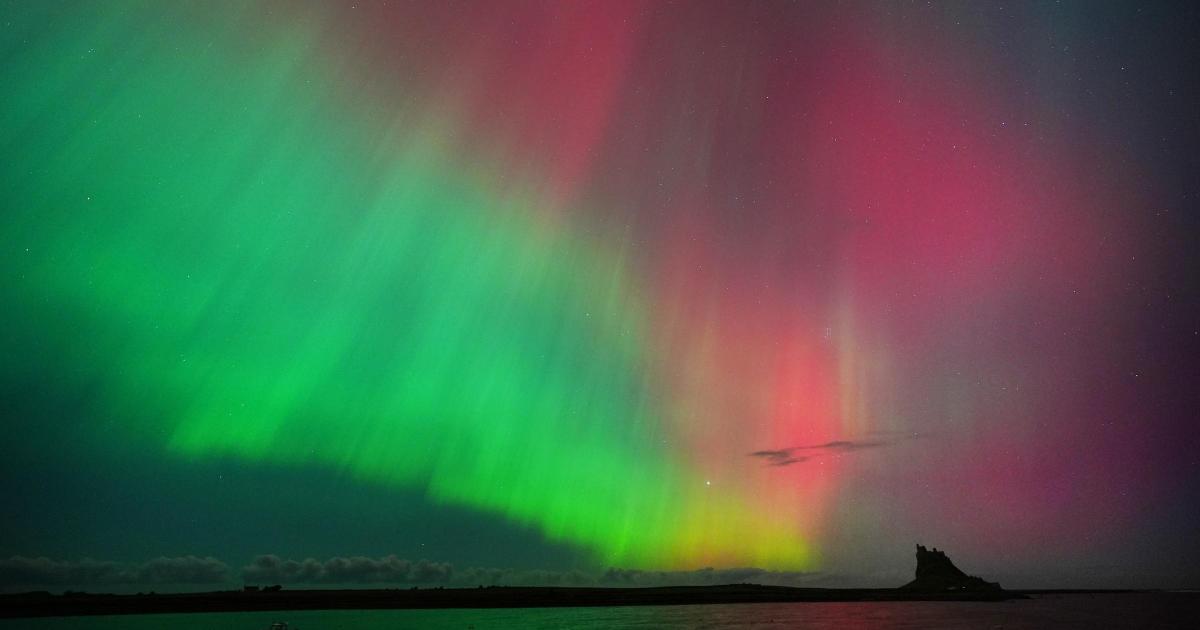
The Northern Lights, also known as the Aurora Borealis, are described as “one of the most spectacular displays in the night sky”.
The “spectacular” display was visible in the UK last week.
Members of the Facebook group UK Aurora Updates posted photos of the Northern Lights as far down as Worcestershire, Norfolk, Ceredigion, Sussex, and even Dorset.
Time-lapse of the Northern Lights
Best time and where to see the Northern Lights in the UK
The Northern Lights may be visible in the UK again this week from Monday (October 6), according to the Met Office.
The Met Office Space Weather forecast reads: “Slightly enhanced aurora activity remains possible Sunday night due to ongoing rather fast solar winds, with visible aurora possible for the north of Scotland.
“Incoming Coronal Mass Ejections (CMEs) which left the Sun on the 03/04 Oct may impact Earth from 06 October onwards.
“This may bring an enhancement with chances of visible aurora across Scotland, and possibly further south, dependent on cloud cover.”
What are the Northern Lights?
The Northern Lights are caused by charged particles from the sun hitting gases in the Earth’s atmosphere.
The colours occur due to different gases in the Earth’s atmosphere being energised by the charged particles.
Nitrogen and oxygen are the two most common gases in the atmosphere, with nitrogen emitting purple, blue and pink colours and oxygen emitting green.
Tip for night sky photos on your phone
Rare Harvest Moon and Draconid meteor shower also visible in UK this week
Not only will there be the potential to see the Northern Lights in the UK this week, but there will also be a rare Harvest Moon and the Draconid meteor shower.
Draconid meteor shower
The Draconid meteor shower will be active in the night sky above the UK from Monday (October 6) until Friday (October 10).
The meteor shower is set to reach its peak on Wednesday (October 8).
Must-see sky events in 2025
The best time to see the night sky spectacle is in the evenings, “after nightfall”, according to Royal Museums Greenwich.
The Draconid meteor shower takes its name from the constellation of Draco, where it is believed to have originated, according to BBC Countryfile .
Meteor showers are caused when the Earth travels through a cloud of debris from a comet.
The Draconid meteor shower comes from the debris of comet 21 P/Giacobini-Zinner, Royal Museums Greenwich explains.
Rare Harvest supermoon to also be visible in UK sky this week
A Harvest Moon is also set to appear in the UK sky on Tuesday (October 7) at 4.48pm.
Don’t miss the Harvest Supermoon on Oct 7 at 03:48 GMT! 🌕 It’s both the first Supermoon of 2025 and this year’s Harvest Moon — appearing ~7% bigger & 13% brighter than usual. Check the complete lunar guide for October here:
👉 https://t.co/cHeXGkEGN8 pic.twitter.com/pDmKnxuCg1— Star Walk (@StarWalk) October 5, 2025
The Harvest Moon is the name given to the full Moon that is closest to the autumnal equinox, which fell on September 22 in 2025.
It usually occurs in late September, however, in 2025, it won’t appear until October 7, which is extremely rare.
RECOMMENDED READING:
As Secret London explains: “In 2025, astronomical conditions make the October full Moon closer to the equinox, a timing that only happens about 18 times between 1970 and 2050.
“The last late Harvest Moon like this was in 1987.”
The Harvest Moon is understood to have gotten its name due to helping farmers collect their harvest during the autumn.
The Moon causes brighter early-evening moonlight and extra light in the evenings, lighting up fields to help with the process.