Published on
March 25, 2026

Image generated with Ai
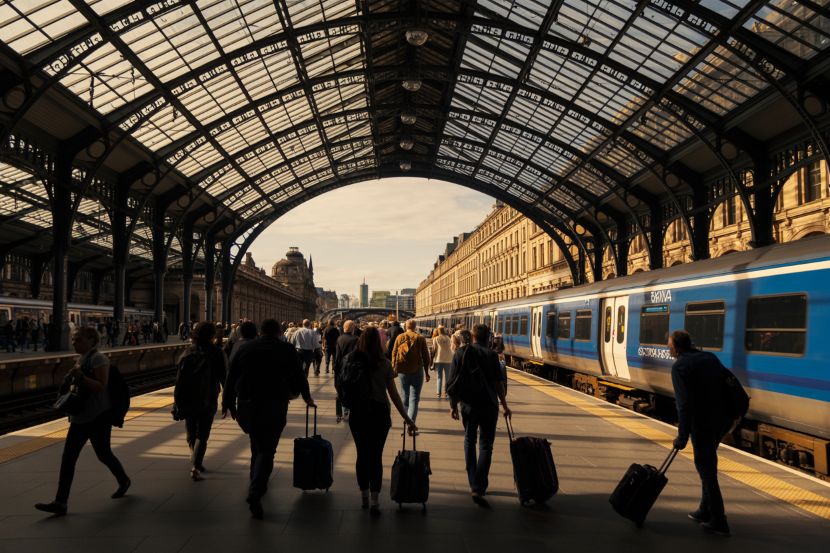
The rhythmic clatter of trains is once again the dominant sound at Glasgow Central Station, as the transport hub officially resumes a normal timetable this Wednesday. For the first time since a catastrophic fire decimated a nearby Victorian landmark, all platforms have been declared operational, signaling a major victory for Scotland’s infrastructure. The blaze, which erupted on March 8, caused a ten-day paralysis of high-level services, but the restoration of platforms one through six now completes the station’s recovery. While the Gordon Street and Union Street entrances remain cordoned off for safety, the return of a full schedule offers a significant boost to tourism and regional travel. By reopening Glasgow Central Station, authorities have successfully reconnected the heart of the city with vital destinations like Edinburgh, London, and the Ayrshire coast, ensuring that the architectural scars of the fire do not hinder the pulse of Scottish transit.
The Resurgence of Scotland’s Busiest Rail Arteries
The restoration of a full timetable marks the end of a period of significant logistical headaches for commuters and international visitors alike. Following the initial emergency, the high-level station—which handles the lion’s share of long-distance and suburban traffic—was entirely shuttered for over a week. Though a partial service resumed last week utilizing platforms seven to 15, the final piece of the puzzle fell into place this morning.
Travelers heading toward Edinburgh via the Shotts or Carstairs lines can now rely on their usual schedules. Similarly, the Cathcart Circle, Neilston, Newton, and Barrhead routes have transitioned from suspended or limited operations back to their standard frequency. For those looking to explore the rugged beauty of the southwest, services to Dumfries, Carlisle, and Stranraer have also returned to their original patterns. The efficiency of this recovery is paramount, as Glasgow Central typically manages over 32 million passenger entries and exits annually, making it the most frequented station in Scotland.
Navigating the Gateway: Strategic Access for Travelers
While the tracks are clear, the physical footprint of the station remains slightly altered. The historic Union Corner building, a structure dating back to 1851 that stood for nearly three decades before the station even opened, was so severely damaged that only a fragment of its façade survived. Consequently, the Gordon Street and Union Street access points are currently off-limits to facilitate ongoing debris removal and safety monitoring.
Advertisement
Advertisement
For tourists arriving with heavy luggage or those unfamiliar with the city’s grid, navigating the exclusion zone is essential. Entry and exit are currently funnelled through the Hope Street driveway and the upper Hope Street entrance. Additionally, the low-level platforms remain accessible via their dedicated street-level doors. While some high-street retailers near the station, including major supermarket branches and financial institutions, remain shuttered due to their proximity to the unstable ruins, the internal station facilities—including the ticket office, restrooms, and various kiosks—are fully open for business.
Passenger Services Resuming: Which Routes Are Returning to Normal?
The return of full service at Glasgow Central is not only a relief for local commuters but also for tourists traveling through the city. With the resumption of key routes, passengers can once again travel to popular destinations, including Edinburgh, Largs, and Stranraer. ScotRail services, which were severely impacted by the fire, will now resume on the following routes:
Advertisement
Advertisement
- Edinburgh – Glasgow Central via Shotts/Carstairs
- Paisley Canal – Glasgow Central
- Newton – Glasgow Central
- Barrhead – Glasgow Central
- Neilston – Glasgow Central
- Ardrossan South Beach/Harbour – Glasgow Central
Additionally, Avanti West Coast is also fully restoring its service, operating two trains per hour between Glasgow and London. This move will restore vital connections for both business and leisure travel, ensuring that tourism in the region picks up momentum. It is advised that all passengers check their train schedules before traveling, as some routes may still be affected by residual disruptions from the fire.
The Aftermath of the Fire: Lessons Learned for Glasgow’s Safety and Resilience
The tragic fire that impacted Glasgow Central Station serves as a stark reminder of the vulnerability of historic buildings and transport hubs in large cities. Following the devastating blaze, Glasgow City Council took swift action, ensuring that the site was secured and that the damaged building was safely demolished. As part of the ongoing recovery efforts, significant investments are being made to preserve the station’s historic integrity while upgrading safety standards for future generations.
Advertisement
Advertisement
These efforts are also a clear signal to tourists about the resilience of Glasgow’s tourism infrastructure. While certain areas of the city remain closed or restricted, Glasgow is actively working to restore normalcy and make the city even more tourist-friendly. The resumption of train services is not only a symbol of recovery but also a testament to the city’s ability to bounce back from crises, ensuring tourism and travel can resume unimpeded.
Preserving the Spirit of the “Second City”
The loss of Union Corner is a poignant chapter in Glasgow’s architectural narrative. Designed by the renowned James Brown of Brown & Carrick, the building was a masterpiece of the Victorian era, once home to the prestigious stationers Francis Orr & Sons. For decades, it was a visual anchor for the city, famously adorned with iconic neon advertisements for Bell’s Whisky and Irn-Bru. These signs were more than just marketing; they were luminous landmarks that greeted generations of travelers as they stepped out into the city’s bustling core.
In response to the devastation, the Scottish Government has introduced an £11 million recovery package. This includes £10 million dedicated to supporting local businesses and agencies as they rebuild, alongside £1 million specifically for the complex demolition costs. This financial injection is a testament to the station’s role as the “beating heart” of the city. For those visiting today, the absence of the building’s distinctive rooftop dome is a stark change, but the rapid clearing of the site—with teams working around the clock—demonstrates Glasgow’s resolve to maintain its status as a premier United Kingdom destination.
Cross-Border Expeditions and Coastal Escapes
The return to normalcy isn’t just a local victory; it has broader implications for United Kingdom transit. Avanti West Coast, the primary operator linking Glasgow with London Euston, has reinstated its full service of two trains per hour. This is a critical development for business travelers and tourists who use the West Coast Main Line to transition between the English and Scottish capitals.
For those seeking the salt air of the coast, the Ardrossan and Largs lines are back to their full capacity. This is particularly relevant for travelers heading to the Isle of Arran, as the train to Ardrossan Harbour is the primary link to the CalMac ferry terminal. The seamless transition from rail to sea is a hallmark of the Scottish travel experience, and the fire’s disruption had briefly made these “rail-and-sail” journeys more complex.
Vital Transit Intelligence for the Urban Explorer
Navigating a city in the aftermath of a major incident requires a bit of local “know-how.” While the trains are running, the surrounding streets are still adapting. Union Street, a primary corridor for the city’s bus network, remains closed to vehicular traffic. This means that if your travel plans involve a transfer from rail to bus, you will need to walk a few blocks to adjacent streets where diversions are in place.
Furthermore, visitors should take a moment to appreciate the history that was nearly lost. The fire started in a ground-level vape shop before climbing through the floors of the 19th-century Union Corner. In a city famed for its Victorian and Edwardian architecture—much of it designed by the legendary Alexander “Greek” Thomson or influenced by Charles Rennie Mackintosh—the loss of such a building is a somber reminder of the fragility of urban heritage.
Proactive Planning in a Reopening Landscape
Even with the “all clear” from Network Rail, the golden rule of modern travel remains: verify before you depart. While the normal timetable is officially back, minor operational adjustments can occur as the station settles back into its high-volume rhythm. Utilizing mobile apps for real-time tracking is highly recommended, especially when catching tight connections to Edinburgh or cross-border services to England.
The resilience shown by the city’s transport authorities has ensured that Glasgow remains an open and accessible destination. Whether you are visiting for the world-class museums, the legendary music scene, or as a starting point for a Highland adventure, the reopening of the station’s main platforms ensures your journey starts on the right track.