(Bloomberg) — The stock market isn’t particularly volatile. Still, it’s fragile.
A spike and quick reversal in volatility gauges on fairly benign S&P 500 Index moves over the past two weeks has renewed discussion about market fragility, with long periods of calm being broken up by sudden oversized swings.
Most Read from Bloomberg
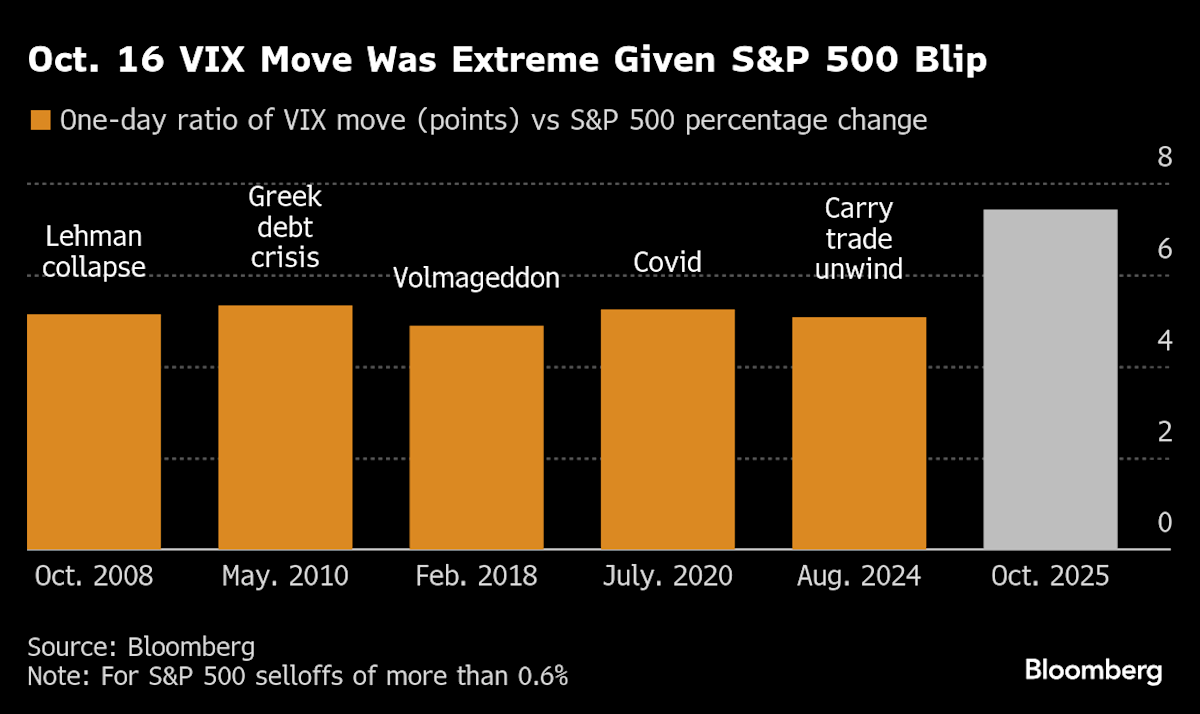
The latest example came on Oct. 16, when the Cboe Volatility Index surged to a six-month high as the S&P 500 dropped just 0.6% on concern about loan losses at regional banks. The VIX move relative to that of the benchmark index was more extreme than during the vol spike of August 2024, the Volmageddon episode in February 2018 and the aftermath of the Lehman Brothers failure in 2008, according to UBS Group AG strategists.

By Oct. 17, the VIX was back down to its level from days earlier, before US President Donald Trump started to upset markets with threats to impose higher tariffs on China.
UBS strategists including Kieran Diamond highlighted that S&P 500 option market makers on Oct. 16 became shorter volatility as the market fell, which could have exacerbated the VIX jump as those positions were covered. Furthermore, dealers were probably short VIX calls and the hedging of those positions added to the spike.
To Bank of America Corp. strategists, the jump that day had more the hallmarks of a technically driven move, they wrote in a report. VIX exchange-traded products probably didn’t contribute so much because investors cashed in their gains while market makers covered their shorts. In a 10-point increase in front-month VIX futures, only about 17% of long holders of volatility securities would need to sell in order to offset the dealer rebalancing, the strategists noted.
The pattern of calm interrupted by volatility spikes also underscores a push-pull in the market exacerbated by the massive growth of ETPs. On the one side are funds that sell options to overwrite stocks and collect premium, helping keep a lid on volatility. On the other are leveraged exchange-traded funds that trade swaps to deliver promised returns on the S&P 500 and Nasdaq 100 Index or, more recently, stocks with some of the biggest impact on the indexes.
“When I think about the VIX spike and the broader liquidity stress tied to leveraged products, what concerns me most is the potential for negative feedback loops driven by rebalancing in 2x and 3x ETFs,” said Garrett DeSimone, head quant at OptionMetrics, referring to the Oct. 16 jump in the volatility gauge.

