‘Being creative is not so much the desire to do something as the listening to that which wants to be done: the dictation of the materials,” the artist Anni Albers once said. She and her husband, Josef, who both trained and taught at the Bauhaus before they escaped Nazi Germany for America, were two of the most groundbreaking artists of the 20th century.
Their work is still hugely influential. The most recent evidence of that is a new collaboration between the Spanish luxury brand Loewe and the Josef and Anni Albers Foundation, which the couple — married for 50 years — founded in 1971. The collection of 60 pieces launches on Thursday.
Anni had a transformative approach to making textiles. She wove her threads with such kineticism that her wall hangings seem almost to move before one’s eyes. What’s more, they appear verging on synaesthetic. It’s almost as if they can be heard as well as seen.
Anni and Josef Albers at Black Mountain College in 1938
TED DREIER COURTESY OF THE JOSEF AND ANNI ALBERS FOUNDATION

Josef Albers teaching at Black Mountain College in 1944
JOSEF BREITENBACH COURTESY THE JOSEF AND ANNI ALBERS FOUNDATION

Anni Albers, c 1929-33
JOSEF ALBERS © 2025 THE JOSEF AND ANNI ALBERS FOUNDATION/ARTISTS RIGHTS SOCIETY (ARS), NEW YORK
Josef’s deployment of colour — especially in his series of Homage to the Square paintings, which he began in 1949 — was similarly revolutionary. His work peeled the eyeballs (in the best sense) of all who saw them. Those trios and quartets of squares — nested within each other like Russian dolls — come alive by way of chromatic interplay.
“Every perception of colour is an illusion,” he said. “We do not see colours as they really are. In our perception they alter one another.” Again, the resulting kineticism is as enthralling as it can be unsettling. These are living works.

A tie-neck plissé dress inspired by Josef Albers’ Homages, £5,400

The Madrid bag in shades of bright green and caramel, £4,400
IRVING STUDIO
Now a number of those “Homages” have been redeployed by Loewe across everything from a tie-neck plissé dress, in shades of bright green and caramel, to the Madrid bag, available in that same look-at-me colourway or in a stealthier combination of burgundy, blood red, brown and black (£5,400 and £4,400 respectively, loewe.com).
• Read more luxury reviews, advice and insights from our experts
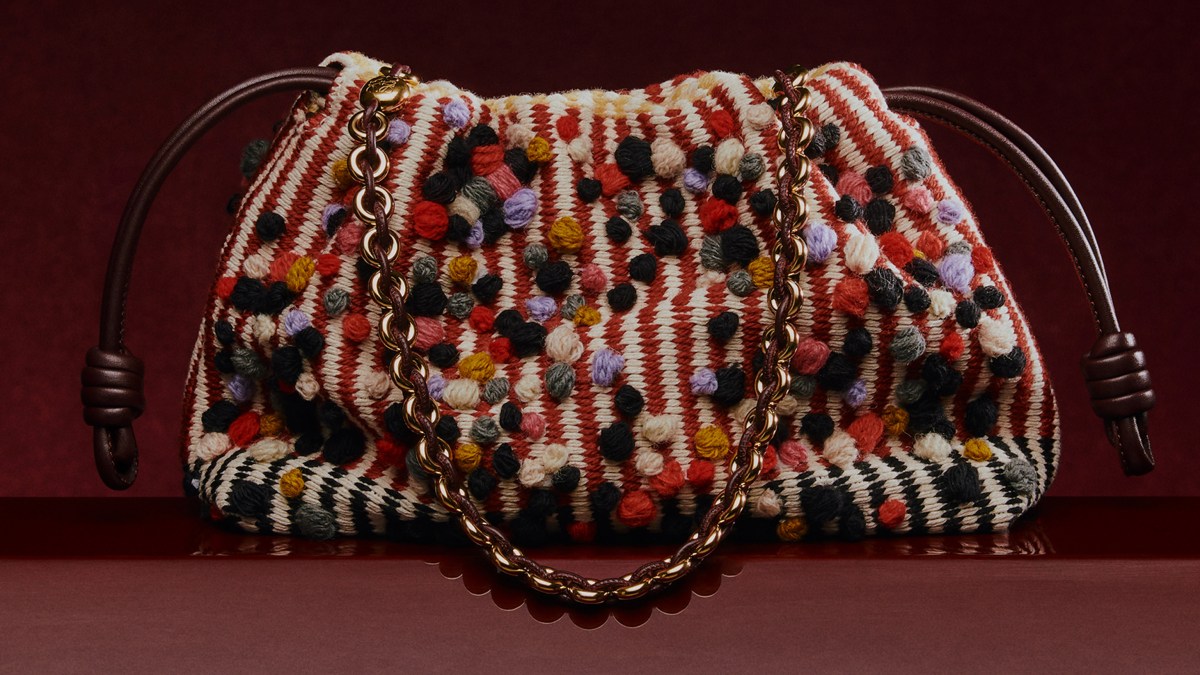
Anni’s Dotted weaving (1959), a multicoloured mash-up of dots — part-musical score, part-sweet shop, part-murmuration in the sky at sunset — has been retooled as a coat and assorted bags, including the Flamenco (£74,200 and £3,250 respectively). Nicholas Fox Weber, the executive director of the Josef and Anni Albers Foundation, describes that coat as “extraordinary”.

The multicoloured mash-up coat inspired by Anni Albers’ Dotted, £74,200
“Its shape and style would certainly have pleased Anni, and its use of her inventive, jubilant textile concept is quite exceptional.”
When Anni had reluctantly embarked on textile design — it was the sole discipline open to female students at the supposedly future-facing Bauhaus in the 1920s — she had feared that it might be “sissy, just these threads”. There’s nothing “just” about any of her work, which is at once subtle and declamatory. The same might be said of the Loewe reincarnations.

There are 60 pieces in the Loewe x Albers collection

The collaboration with Loewe is the perfect expression of the couple’s credo
What’s also striking is the contemporaneity of this collection. Nothing looks old, even though the sources of inspiration are often into their eighth decade. Anni would often talk about the value of the past, and would cite as inspiration the ancient weaving techniques of pre-Hispanic Peru and Mexico. In a charming squaring of that circle — not to mention a circling of her husband’s famous squares — Loewe has made that point again with this collaboration.
Fox Weber declares the end results to be the perfect expression of the couple’s credo. “They shared a notion that integrity is vital to beauty, and that form and function should be in harmony.”
He continues: “There is a lot that is negative in the world, especially at the moment. We need every opportunity where the eternal wonders of colour and form can flourish.”
Indeed we do.