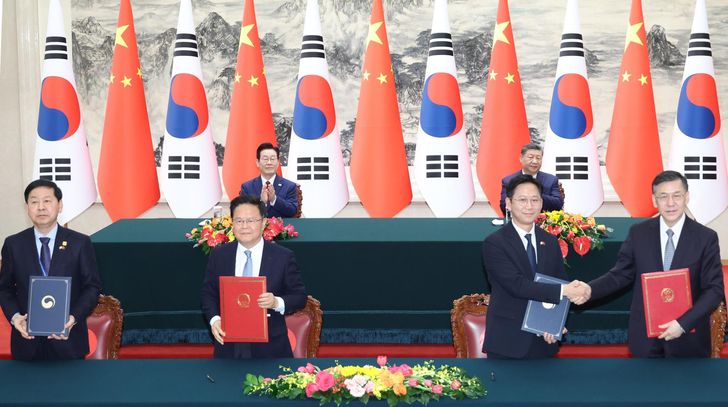

From left, Korean Industry Minister Kim Jung-kwan and Chinese Commerce Minister Wang Wentao, and Korean Food and Drug Safety Minister Oh Yu-kyung and Sun Meijun, director general of China’s General Administration of Customs, attend signing ceremonies for agreements on the establishment of a commercial cooperation dialogue and on food safety cooperation, respectively, with attendance by President Lee Jae Myung and Chinese President Xi Jinping, right in the second row, at the Great Hall of the People in Beijing, Monday. Yonhap
BEIJING — Korea and China signed a series of memorandums of understanding (MOUs) on cooperation in industrial exchanges, technology, the environment and other areas on the occasion of a summit between Presidents Lee Jae Myung and Xi Jinping in Beijing on Monday, Seoul’s presidential office Cheong Wa Dae said.
The 14 MOUs and a separate agreement on the return of Chinese historical artifacts in Korea underscored the joint efforts by Seoul and Beijing to deepen bilateral ties, as Lee pushes for “pragmatic” diplomacy to stably manage relations with China while ensuring a robust security alliance with the United States.
Among the MOUs was an arrangement on the creation of a regular dialogue platform between South Korea’s Ministry of Trade, Industry and Resources and China’s Ministry of Commerce to enhance commercial cooperation between the two countries.
On the technology front, the two sides signed an MOU on cooperation for science and technology innovation, as well as a separate MOU on digital technology collaboration.
They also inked MOUs to find and nurture promising startups and lay the groundwork for protecting intellectual property (IP) by using new technologies, and improving law enforcement against IP infringements involving imports and exports.
Additional MOUs were signed on food safety and quarantine procedures for fisheries, animals and plants.
In the environmental sector, the two countries signed an MOU to hold regular ministerial and working-level meetings on issues such as climate change — an effort to broaden the scope of bilateral cooperation beyond the issue of fine dust.
An agreement on transportation cooperation includes plans to collaborate on land transport, roads, railways and future mobility, as well as to set up a working-level consultative body.
On the occasion of Lee’s state visit, a pair of Qing Dynasty stone lion statues that the Kansong Art and Culture Foundation has kept in its collection since its purchase in 1933 will be returned to China. The National Museum of Korea signed a certificate with China’s National Cultural Heritage Administration to formalize the return.
Cheong Wa Dae said the decision to return the Chinese cultural artifacts paves the way for expanded cultural exchanges between the two nations.