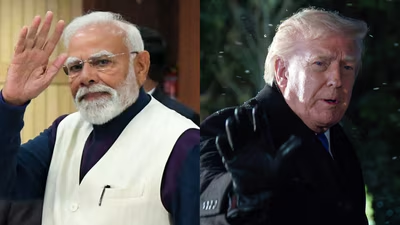
Contours of an interim trade deal between India and the United States may have been the headline on Saturday morning, but there was a single image that did a lot of talking — a map of India used by Donald Trump’s trade representative’s office on X.

The map apparently showed the entire Jammu and Kashmir region, including Pakistan-occupied Kashmir (PoK), as part of India. It also depicted Aksai Chin, a region claimed by China, within India. This is in line with India’s long-held stance on its territorial integrity.
Track India-US trade deal live updates
In the past, maps released by the US government or the state department often marked Pakistan-occupied Kashmir separately, largely in line with Islamabad’s position. This time, however, breaking from that long-standing practice, the Trump administration’s map made no such distinction.
While India has consistently maintained that Jammu and Kashmir (and Ladakh) is an inalienable part of the country, and that its territorial claims do not require validation from any external power, the US move holds strategic value. It marks a clear and deliberate departure from earlier US representations.
Why the timing matters
The map move at a sensitive moment in India-US relations, which have only now been reset, under President Donald Trump. Just months ago, Trump had imposed steep 50 per cent tariffs on Indian goods, the highest among US allies, while the trade deal took almost a year.
Under the interim agreement now in place, those tariffs have been slashed to 18 per cent, one of the lowest rates in Asia. The penalty tariffs in place over Russian oil imports have been removed.
The re-hyphenation debate
The map’s release also comes against the backdrop of Trump’s reported attempts to re-hyphenate India and Pakistan, a shift from the de-hyphenation policy initiated during the George W Bush administration and followed by successive US presidents. This approach has repeatedly been cited by the Opposition in India to criticise the government’s handling of foreign policy.
Adding to the complexity is Trump’s repeated claim that he brokered a ceasefire between India and Pakistan during last year’s military action in May. These assertions have been firmly rejected by India’s Ministry of External Affairs, which has maintained that all such matters are addressed bilaterally. Last year, Trump went all out against India and claimed that it has a “dead economy,” among other jibes.
Aksai Chin adds another layer
Beyond Pakistan, the map also showed Aksai Chin, which is located in northeastern Ladakh, as part of India. China has long claimed the region, dismissing India’s objections.
For years, the MEA has objected to what it described as incorrect representations of India’s borders – particularly Jammu and Kashmir and Arunachal Pradesh – in maps used by the US and some international agencies. The latest map appears to address that concern directly.
Defence analysts were quick to react. Retired army officer Major Gaurav Arya, known for his aggressive views, posted on X: “Full marks (to the US) for the map, though. Well done.”
Awkward timing for Pakistan
The timing could be awkward for Pakistan, especially as its diplomatic engagement with Washington has intensified over the past year.
Pakistan’s military chief, Field Marshal Asim Munir, has visited the US multiple times during this period and met Trump twice, including a high-profile lunch in June. That also marked the first instance of a US president meeting Pakistan’s army chief without civilian leadership present.
Going a step further, Islamabad officially nominated Trump for the Nobel Peace Prize – an accolade the Republican leader appeared to be actively campaigning for.
However, now Pakistan facees higher tariffs than India. Under the revised structure, Indian goods will be taxed at 18 per cent, compared to 19 per cent for Pakistan.