As a fragile, two-week ceasefire holds between the United States and Iran, diplomacy is not just unfolding at negotiating tables — it is also playing out online, with Iranian missions across the globe responding to Washington’s pressure with humour.

Since the outbreak of the conflict, Iranian embassies across the world have been posting sharp replies to repeated warnings and remarks from Donald Trump.
In one of the latest posts, the Iranian embassy in Tunis turned to cultural nuance to make a point about the Strait of Hormuz, a key global oil route now at the centre of the standoff. Track US-Iran war live updates.
“To all sailors: If you hear these phrases in the Strait of Hormuz, it’s called ta’arof in Iranian culture (Iranian politeness) — don’t take it literally,” the embassy said.
It followed up with a list of exaggerated courtesies: “Be our guest. You don’t have to pay every time. I’ll be upset if you pay. Let us pay for once! What money. If you pay, don’t come back!” The post was later deleted.
The irony, however, is hard to miss, as Tehran couches its messaging in “politeness”, an Iranian lawmaker had earlier said some ships were being asked to pay as much as $2 million to pass through the Strait of Hormuz, reported The Wall Street Journal.
‘But it’s open’
Earlier this week, the embassy has posted another satirical exchange mocking Trump’s assertion about the strait being closed.
The mission wrote that while Trump called to “open the Strait of Hormuz,” vessels from countries such as India, Pakistan, Russia, China, France and South Africa, continued to pass.
The post ended with a sad-face emoticon in place of Trump’s response, suggesting that friendly nations are still able to pass through without disruption.
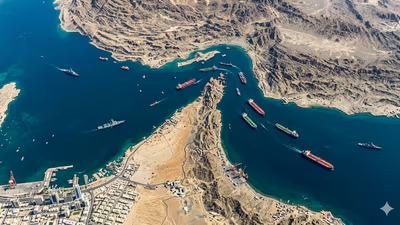
Traffic in Hormuz Strait after temporary truce
Despite the online sparring, the situation on the ground tells a different story. Ship traffic through the Strait of Hormuz has slowed dramatically, with only a handful of vessels moving through the critical energy corridor.
Just seven ships, all linked to Iran either by port calls or cargo, were seen exiting the Persian Gulf between Wednesday and early Thursday, reported news agency Bloomberg. In normal times, around 135 vessels pass through the strait daily in both directions.
Among the vessels that recently navigated the route was the India-flagged Green Asha, which arrived at Jawaharlal Nehru Port Authority on Thursday, April 9, carrying 15,400 tonnes of LPG. Three Chinese oil tankers transporting Saudi and Iraqi crude also approached the Strait of Hormuz the same day.
In a move seen as formalising greater control, Iran’s Ports and Maritime Organization has announced two designated “safe routes” for vessels.
According to state media, the routes are intended to help ships avoid potential anti-ship mines believed to be present in conventional sailing lanes.
The Strait of Hormuz has remained largely paralysed since the war began on February 28, with traffic still far below pre-conflict levels despite the truce.
Meanwhil, Iran’s new supreme leader, Mojtaba Khamenei, indicated a potential shift in Tehran’s approach to the waterway.
In a Telegram statement, he said Iran “will definitely bring the management of the Strait of Hormuz to a new stage,” without clarifying whether this meant asserting greater control, a long-standing demand rejected by the US.