Just before the end of the semester, I Was A Fashion School Serial Killer went and switched it up on us. Admittedly, the pivot from creators Doug Wagner and Daniel Hillyard was a little much: The already unlikely story of a serial killer/design student (the oddly charming Rennie) didn’t need to become the first half of Taken. At the same time, having the whole school basically serve as a front for human trafficking, and pushing Rennie to rescue her BFF Sofie, was a way to present real stakes and odds (and the kind of extended absurdity this duo relishes for their expertly-built characters).
In the end, I assumed that an effective landing in issue #5 would confirm if this pivot was a success, or if the creators had simply done too much without letting Rennie shine for what she is (another dark weirdo we’ve fallen for hard). As it turns out, I Was A Fashion School Serial Killer ended strongly enough — generally speaking.

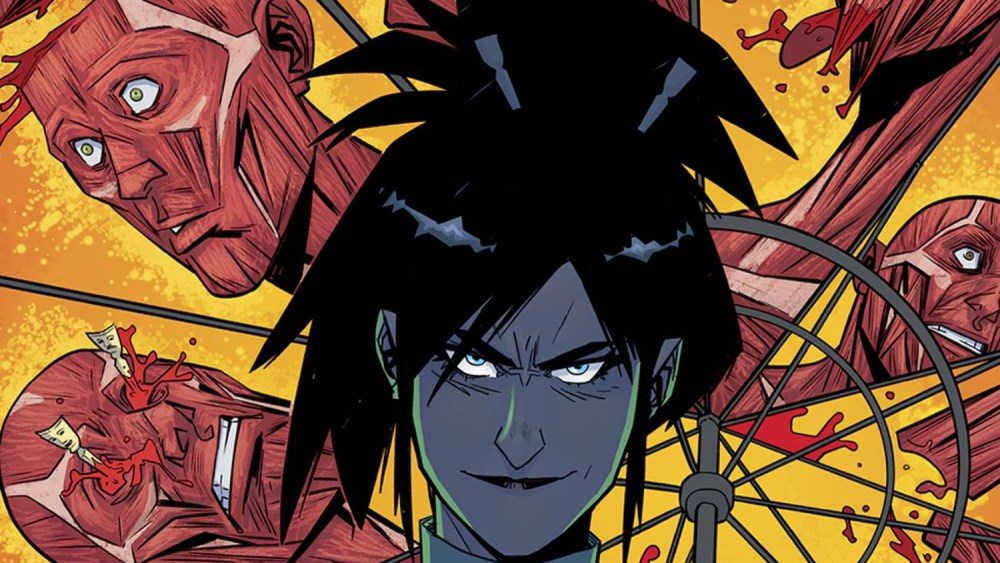
Variant cover by Vinnie. Courtesy of Image Comics.
I’d noted a few times already how I Was A Fashion School Serial Killer was basically Wagner and Hillyard playing around with sitcom tropes/energies in a way to make this story of a psycho killer with a golden heart feel different than previous projects (see Plastic). And that worked for a time — it was a way to inject a new level of humor and humanity into the mix, and to give us something truly endearing to latch onto amid the carnage. So for issue #5 to really excel, and to truly own the tone and deliberate nature of the aforementioned pivot, it had to engage with and then possibly bypass these sentiments. That’s effectively what we get in glorious, bloody fashion.
Issue #5 of I Was A Fashion School Serial Killer is basically a chance for Hillyard (alongside colorist Michelle Madsen) to show off the depths of their violent majesty. On the surface, we got some truly satisfying acts of savagery — heaps of blood being strewn about, heads cleaved and halved in wonderfully peculiar angles, and the use of perhaps my favorite new fictional weapon, a razor-sharp umbrella.
Hillyard is great when it comes to making violence feel both absurd and practical, and in that space we can both satiate some weird urges and also understand what they’re trying to say about these acts. (If I were to hazard a guess, and I likely should, I think it’d be what these acts say about us as social animals, and why we find joy in violence when non-violence might be more satisfying overall.) Then Madsen comes in and just seals the deal with those rich crimson tones and/or the dark hues of internal organs, and we cannot help but engage this madness with foaming mouth and full hearts.

Courtesy of Image Comics.
But this dispatching of low-level gangsters isn’t just a release (for both us and Rennie). No, you also have to look at how Rennie moves and acts through this carnage to see even deeper into the narrative core. It’s the sense of grace as she darts into shadows. The way she plots every kick of a fiery garbage can and swing of her umbrella. Even what she says during her killings and the tone you’d assumed she’s taken. All of it shows us as Rennie as she truly is: Smart, deliberate, enthusiastic, caring (for the right people), and more with it than any time before.
In short, we see that this young girl who struggles to make friends and keep her dual life stitched together has the grace and strength needed to be the person she wants. That for all her scrambling, she is more than ready to be a person who fights for what she wants. In that way, she begins to see herself as someone who may need to ride this line forever, and not fight but rather coalesce when and how she can. She remarks at one point, mid-savagery, that she’s not just a killer or a psycho but a design school student. Our little Rennie is growing up and it’s a sight to behold (if you don’t get queasy around blood, of course).
It’s a dichotomy that is made all the more clear toward the issue’s end, which is where some of my satisfaction starts wavering just enough to make it noteworthy. Without revealing too much, it’s Sofie who affirms Rennie’s double-sided nature, and that she likes having a friend who can do more than just make really nice clothes.

Courtesy of Image Comics.
It then becomes the impetus of the duo’s big plan moving forward, which makes sense logistically and is also a nice little return of those sitcom energies. (In the way that it embraces the slightly hokey, half-cocked nature of sitcoms that wrap everything up in a neat little bow.) But in case things felt too sweet and properly wrapped up, Rennie finds herself contending with an old affliction just as things are looking up. It’s a little like an ending to a mostly good, old-school horror flick — or that of “Thriller.”
And there’s good and bad to take away from this overarching ending. I like that it’s all about Rennie and Sofie; this burgeoning relationship has facilitated so much of Rennie’s evolution, and it makes sense that it continues so rewardingly. I also don’t mind the whole “but is she better/done killing bit?” because it makes sense that, even as she’s trying to make good on her two sides, there’d be some struggle involved. It’s not a perfect process, and of course having that tension keeps Rennie feeling raw/relatable.
No, I think the biggest issue was the actual feeling of the ending. It certainly left the door wide open for a sequel, but it also felt like this was The End. There’s plenty of directions to go with Rennie, and while something open-ended works as a device to hint at without ever making any pesky final choices, it just felt like we were meant to be left guessing in the worst possible way. Truly, that’s not what I want from I Was A Fashion School Serial Killer.

Courtesy of Image Comics.
Not solely because I like these characters and want even more of them, but it would be nice if the creators were more definitive in their efforts. The book nearly ended in a way that, while Rennie had work still left to do, she felt sturdy enough and far beyond where she was in issue #1. But by not being more resolute, or feeling a little under-committed to a definitive ending either way, what we got wasn’t quite sturdy enough.
It just felt like they don’t know if they’ll come back, but clearly ought to if they can. So we got the ending that was open and vaguely mysterious, but not in a way where they felt committed to a direction for Rennie that leaned fully into “this is a new version of her moving forward, with new challenges and opportunities.” It was an ending that committed but didn’t entirely, and it felt a little feckless in parts. Which is the exact opposite of the deliberate arc throughout issue #5, and how they made it rather clear that it’s possible to change and step up and still have doubts or struggles to manage.
I don’t want to say the ending totally ruined I Was A Fashion School Serial Killer. Rather, I think it was a gesture where the creative team recognized that the industry is fickle, and this is very likely the end. Or, that it truly is the end, and they’re OK with only ever hinting at stories that no one can ever read because that’s somehow the most rewarding direction.

Courtesy of Image Comics.
Either way feels like a sturdy enough betrayal of Rennie’s journey, and how she has become stronger in her efforts to be both a builder of beautiful clothes and a murderer, and the people who love her see both sides and recognize that to love another is to feel this existential every darn day. And so it’s that lesson I choose to focus on when I think of I Was A Fashion School Serial Killer: Being alive is a hard and rocky journey, but it’s one made easier by having people who let you be who you are, however that looks moment to moment.
That’s the real secret of a good enough life, and something we got to see this potent, extra-engaging character learn in an extra compelling manner. A slightly iffy ending doesn’t take away from that even as you don’t get quite as much visceral satisfaction from this closing chapter. Just remember the friendship and the gallons of blood, and I promise you’ll feel like a kid on the last day of school.

‘I Was A Fashion School Serial Killer’ #5 ends the story with big emotions, buckets of blood, and a little too much uncertainty
I Was A Fashion School Serial Killer #5
My reasonable issues with the ending aside, ‘I Was A Fashion School Serial Killer’ was a warm and bloody tale about friendship, growing up, and finding balance however you can in life.
The violence in the finale is as bloody as it is inventive.
The sitcom vibes serve as a really satisfying bookend for this overarching story.
Rennie learns big lessons in a way that feels exciting and relatable.
The ending works but it also doesn’t, and the whole thing just lands in a smidgen too unsatisfying.
It’s not clear (or really unclear enough) if the story is truly over, and that’s a touch irksome.