Since electrification became a viable form of transportation in the US, Toyota has been at the forefront. Indeed, for most of the past two decades, it’s led the way among other OEMs in terms of hybrids, starting with the Prius and its US debut at the turn of the century. However, when it comes to total BEV sales in the US today, the picture is rather different. Here, Hyundai has charged ahead and can see Toyota in its rearview mirror. So, what’s the game plan for these two manufacturers?
Toyota Sees Things Very Differently
|
Specification Highlights |
2025 Hyundai Ioniq 5 |
2025 Toyota bZ4X |
|---|---|---|
|
Platform |
E-GMP (dedicated platform) |
E-TNGA (adapted platform) |
|
Battery |
Up to ~84 kWh |
~71-73 kWh |
|
Range |
Up to ~318 miles |
Up to ~252 miles |
|
Fast charging |
800V, up to 250 kW |
Up to 150 kW |
|
Power |
Up to 320 hp |
Up to 214 hp |
|
2024 Sales |
~44,400 |
~18,570 |
It didn’t take very long for the hybrid Prius to become shorthand for green driving and to find its place in taxi fleets or become a status symbol for celebrities out west. Toyota seemed to have its foot firmly on the pedal with other mainstream hybrid hits like the Camry, Corolla, and RAV4. And by 2024, Toyota and its Lexus stablemate sold more than 1 million electrified vehicles in the US, as hybrids made up more than 40% of Toyota’s total U.S. sales.
But when you look at the full electrification picture, the story is very different. Toyota may have pioneered the hybrid, but Hyundai is the only one of the two to go all-in on pure electric, or battery electric vehicles. The Japanese company is very unsure about the future ahead and has decided to focus its strategy on hybrids and plug-in hybrids to give it a safe and profitable niche, but that leaves it out of the main argument for pure EVs.
Meanwhile, Hyundai has seen opportunity in risk and the Korean automaker is stealing the headlines and sales momentum in the pure EV push. No longer is the brand associated with value, entry-level cars alone, as it now features higher quality, bolder designs, as well as luxury in the shape of its Genesis sub-brand.
The E-GMP Gives Hyundai A Head Start

Hyundai’s push in the pure EV sector revolves around its electric global modular platform, or E-GMP. The company launched this in 2021 as a very modern architectural platform, and exclusively for its BEVs. Engineers designed the platform for high efficiency and scalability, and to cope with blistering charging speeds. Meanwhile, Toyota had a different approach and as it hesitatingly introduced the bZ4X as its first pure electric vehicle, it adapted existing platforms to cope.
Hyundai’s E-GMP operates on an 800 Volt system, which is very different to the 400 Volt setup favored by most rivals.
Ioniq 5 or Ioniq 6 cars can recharge from 10% to 80% in about 18 minutes, when their owners plug them into a 350 kW DC fast charger. This is quicker than a Tesla Model Y on that company’s Supercharger network and very far ahead of the Toyota bZ4X. This peaks at just 150 kW and will take roughly double the time to charge.
You’ll also get bidirectional charging with E-GMP for vehicle-to-load (or V2L) capability. This means that owners can power camping gear, appliances, or even reboot their house in the event of an outage. Toyota doesn’t have anything similar in its current U.S. EV lineup.
The skateboard-like E-GMP platform gives designers plenty of flexibility to introduce flat battery packs and compact motors, to stretch wheelbases and free up masses of interior space. This allows them to provide roughly the cargo space of a mid-size SUV within the Ioniq 5, even though this car is only 182 inches long. Over at Toyota, the bZ4X struggles with interior volume by comparison as it’s sitting on Toyota’s e-TNGA platform that the company shares with Subaru.
Looking forward, Toyota is planning to debut a new dedicated EV platform and is talking about a solid-state battery breakthrough in the years ahead. Still, Hyundai has already made headlines of its own, and at least currently, is not looking over its shoulder at Toyota in this space.
The Ioniq Breakthroughs And The EVs That Toyota Doesn’t Have

Hyundai has secured some headlines with its Ioniq series. For example, the Ioniq 5 immediately made waves when it debuted in late 2021. It looked like nothing else on the road with its sharp creases, hatchback-to-crossover proportions and pixelated lights. It had a flat floor inside with reclining rear seats and a sliding center console for additional flexibility. And it rapidly became the fourth bestselling EV in America in 2024 and only behind the Model 3 and Model Y from Tesla, and the Mach-E from Ford.
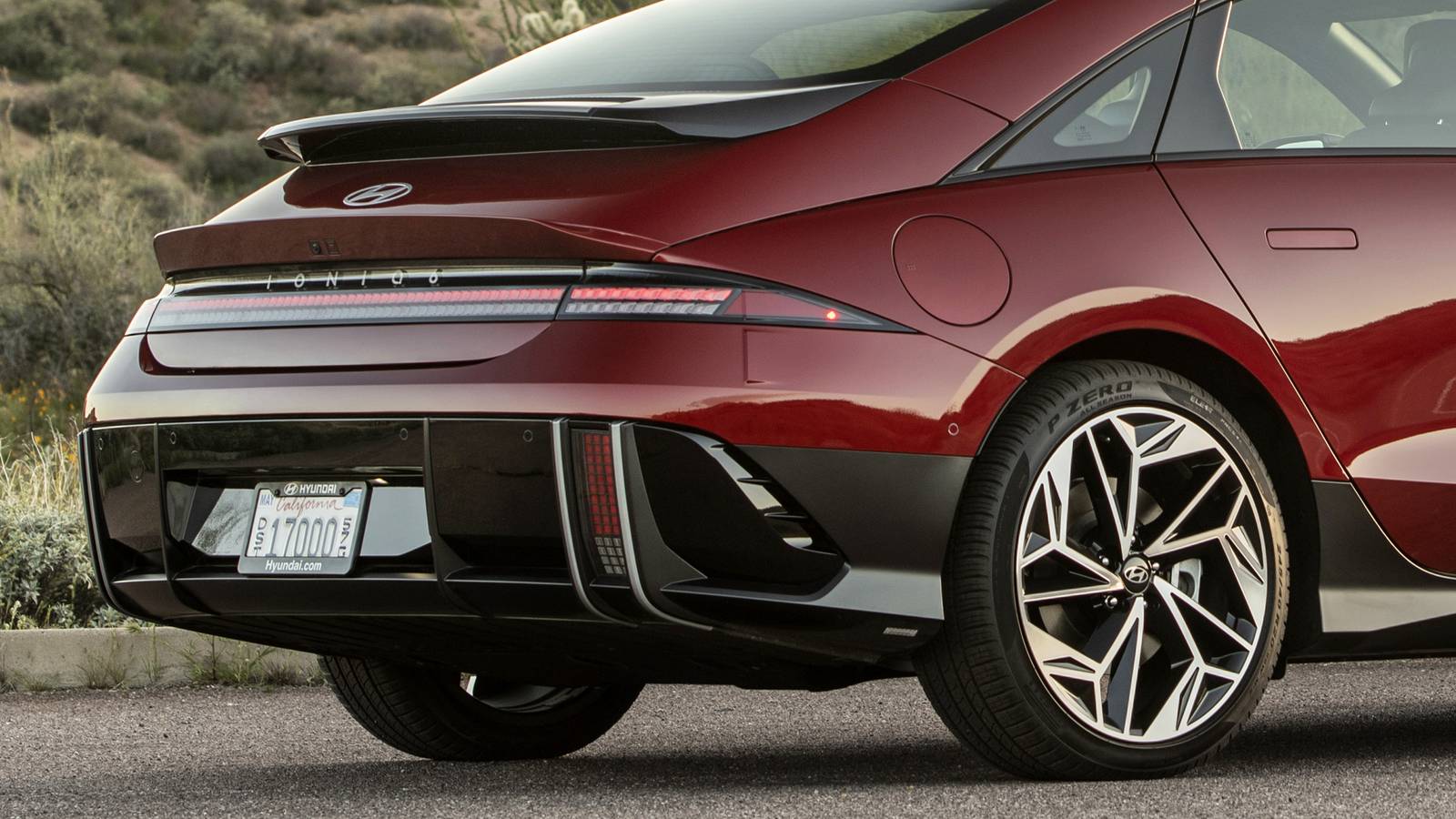
In 2022, Hyundai launched the Ioniq 6 to compete with the Tesla Model 3. It had a very low drag coefficient and could deliver up to 361 miles of range in rear drive SE Long Range trim. It’s also promoting the SEVEN, which will be a three-row SUV according to the concept, and its sister brand, Kia, has the EV9, which has also attracted strong reviews.
Toyota only has the bZ4X in the US battery electric vehicle space (although Lexus does also have its RZ with tiny sales). The bZ4X is competent enough but not exactly inspiring, with conservative styling and an unremarkable cabin. You’ll get up to 252 miles of range in front drive form and charging speeds of about 150 kWs. Toyota also has a three-row EV planned but no firm launch date and as all this goes on, Hyundai and Kia continue to assert themselves in family EV showrooms around the nation.
Performance Credibility

Hyundai shows that EVs do not need to be soulless appliances as its Ioniq 5N has certainly got plenty of drama. This is not just a cosmetic package with some software tuning but instead it features dual motors and up to 641 hp in N-GRIN Boost mode. It also has a simulated dual clutch gearbox feel, an electronically controlled limited slip differential, and even a rally-inspired Drift mode. So, this EV feels generally engaging on the road and goes a long way to reinventing the electric dream.
By contrast, Toyota doesn’t have a performance EV. Certainly, its Gazoo Racing division has a lock on gas performance cars in the shape of the GR Corolla, GR86, Supra, and others, but crickets are chirping in the EV space. And while Hyundai may only sell a relatively small number of Ioniq 5N headliners, it has definitely sent a signal to the market that the company can make EVs aspirational and fun, with deathly silence coming from Toyota.
Sales Figures To Compare

In the United States, battery electric vehicle sales hit 1.3 million in 2024 to account for just over 8% of all light vehicle sales. The Hyundai Group as a whole, including Hyundai, Kia, and Genesis, sold 124,065 BEVs in that year, giving the group the second spot behind Tesla.
Toyota sold 18,570 units of its bZ4X and that was less than half the volume of the Ioniq 5 alone. And when you consider that Ioniqs 5 and 6 won the World Car of the Year awards in 2022 and 2023 respectively, the difference with Toyota becomes quite clear.
Consumers now look at Hyundai as one of the technology leaders, which was something quite unimaginable two decades ago. And while Toyota may have been the trailblazer in hybrid sales, it’s now becoming increasingly conservative when it comes to full EV adoption. It’s certainly not pushing the boundaries of EV design in any shape or form.
Toyota’s Hybrid Safety Net May Start To Fray

There’s no doubt that Toyota’s hybrid strategy is still wildly successful. After all, the RAV4 Hybrid is the bestseller, and hybrids make up a sizable share of the company’s overall sales. Many consumers see hybrids as the sensible middle ground at the moment, being unsure whether to jump back to gas or forward to EV, but the ground is shifting. Several states are talking about 100% zero emission new car sales by 2035. So those hybrids are unlikely to satisfy regulators forever and, in that respect, Toyota’s clock is ticking. It is betting big on the idea of solid-state batteries, and it reckons that these units will offer ten-minute charging and up to 620 miles of range. And if Toyota does pull that off, it could leapfrog the market, but it does remain to be seen what transpires.
The Race Is On
Hyundai is defining the pure EV era while Toyota has a lock on the hybrid scene. The Korean manufacturer has award-winning designs, a very purposeful and dedicated platform, and real market share, topping that up with a halo performance car. And while Toyota is very profitable and remains the giant in the global auto industry, it’s looking increasingly cautious in the fast-moving U.S. EV space, while Hyundai is the one looking bold.
Sources: Toyota, Hyundai, Cox Automotive.