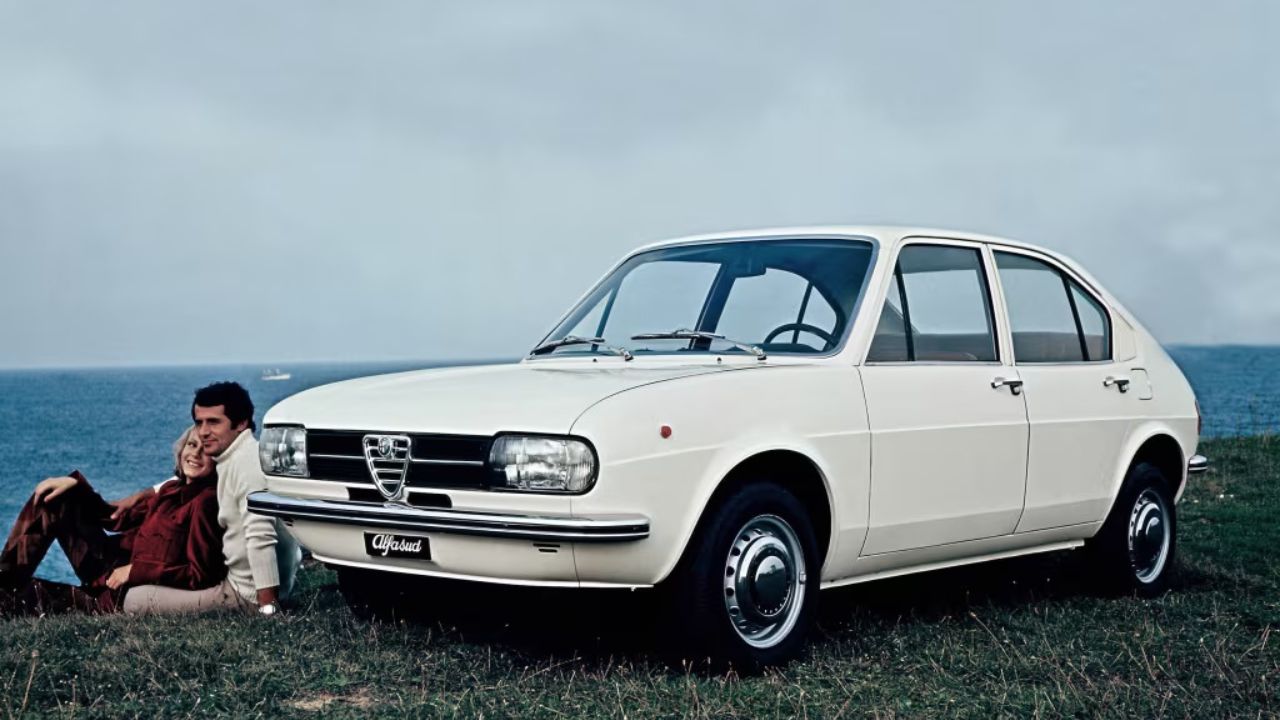
There are moments in automotive history when a single model reshapes not just a brand’s future but also its reputation for decades. For Alfa Romeo, that moment arrived in the late 1960s with a car that was bold, innovative, commercially successful—and ultimately infamous. That car was the Alfa Romeo Alfasud.
Among enthusiasts, a dark joke has endured ever since: “Corrosion was invented in Turin.” While exaggerated, the saying reflects how deeply the Alfasud’s rust problems scarred Alfa Romeo’s image, particularly outside Italy.
A Prestigious Brand Forced to Change Course

Founded in 1906, Alfa Romeo built its reputation on racing success, elegant design, and technically advanced cars. Legends such as Tazio Nuvolari and even Enzo Ferrari were part of its early competitive legacy. Yet racing glory never guaranteed financial stability. By the 1930s, Alfa Romeo survived only thanks to Italian state intervention.
After World War II, the company struggled again. Its Milan factory had been bombed, and Italy was barred from military production. Models like the 1900 helped Alfa return to the market, but it was the Giulietta, selling over 200,000 units by the mid-1960s, that finally restored some financial balance.
By the late 1960s, however, the European market was changing rapidly. Front-wheel drive, compact packaging, and mass-market appeal were becoming essential. Alfa Romeo faced a choice: evolve or fade into irrelevance.
The Birth of Alfasud

In 1967, Alfa president Giuseppe Luraghi launched a project for a small, affordable car, something the brand had never done before. State funding came with a condition: the factory had to be built in southern Italy, an economically depressed region with high unemployment. Thus, Alfa Romeo received a massive loan and built its plant in Pomigliano d’Arco.
The workforce posed another challenge: nearly 15,000 employees with little or no automotive experience. Political tensions, union influence, and frequent labor strikes would soon complicate matters further.
Development was entrusted to Austrian engineer Rudolf Hruska, whose résumé included Volkswagen and Porsche. Design duties went to Giorgetto Giugiaro. The result was technically impressive: front-wheel drive, a water-cooled boxer engine, excellent handling, and strong performance for its class.
Acclaimed to Drive, Disastrous to Own
The Alfasud debuted at the 1971 Turin Auto Show, sharing the spotlight with the radical Lamborghini Countach. British magazine Autocar praised its ride, grip, and driving dynamics, calling it one of the best-handling small cars in Europe.
But problems soon surfaced. Production delays caused by strikes slowed deliveries, and the car’s relatively high price limited its appeal. Worse still, corrosion appeared at an alarming rate. Rust attacked body panels, seams, and structural components, sometimes within just a few years.
Blame was widely spread. Some pointed to poorly trained workers, others to the storage of unfinished bodies outdoors. A persistent theory accused low-quality steel sourced from Eastern Europe during Cold War trade arrangements. Alfa attempted fixes, including sealing body seams with silicone, but the damage was already done.
A Hot Hatch Pioneer With a Tarnished Legacy

Despite its flaws, the Alfasud remained popular, especially in sportier versions. The Alfasud Ti arrived in 1973, effectively becoming one of the earliest hot hatches. Later came the Alfasud Sprint coupe and increasingly powerful engines, culminating in the Quadrifoglio Verde.
By the time production ended in 1983, nearly 900,000 Alfasuds had been sold, plus over 120,000 Sprint models. Yet the car never turned a profit. Rust scandals pushed buyers toward German competitors, and Alfa Romeo once again slid into crisis, ultimately being sold to Fiat in 1986.
An Uncomfortable but Crucial Chapter

Today, the Alfasud is remembered as both a savior and a saboteur. It helped Alfa Romeo survive a critical period, but at the cost of long-term trust. Even decades later, the shadow of rust still follows the brand.
And yet, many engineers and journalists still argue that, dynamically, the Alfasud was the best small car of its era. Brilliant to drive. Painful to own. A contradiction that perfectly captures Alfa Romeo itself.
This article originally appeared on Autorepublika.com and has been republished with permission by Guessing Headlights. AI-assisted translation was used, followed by human editing and review.