Looking to get healthier ahead of spring and summer? I was too. But while I knew I wanted to increase my fitness levels, I didn’t actually know where to begin.
To determine an accurate plan, I decided to dive more into where my health and fitness levels currently are. If you’re interested to do the same, read on for more details on how I determined where I am — and what I’m prioritizing for a healthier spring.
Discovering a proactive, unique new way to measure and monitor your health
In the course of research health monitoring and measurement products and solutions, I randomly came across NiaHealth, a start-up Canadian health monitoring service.
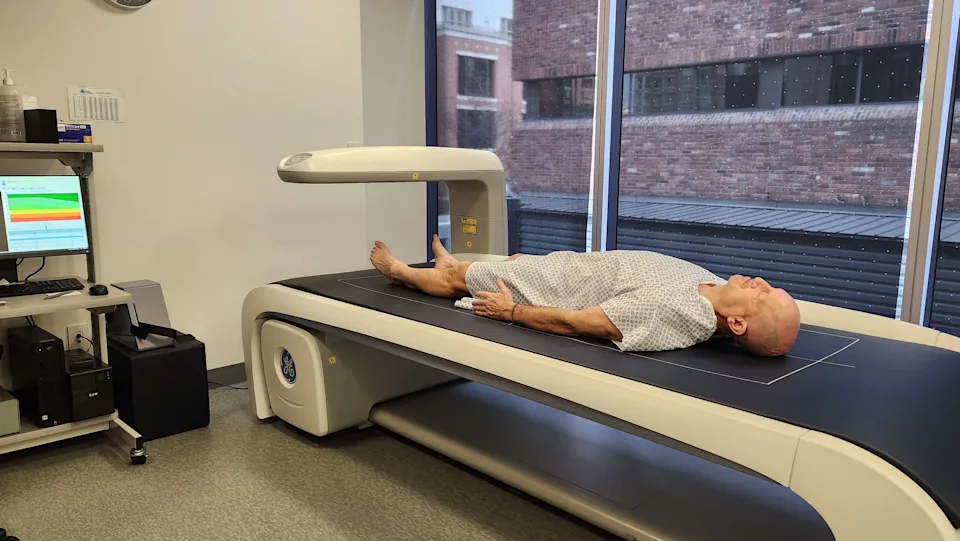
Getting a DEXA scan at NiaHealth. (Photo courtesy Mark Douglas Wessel)
(Mark Douglas Wessel)
The company provides clients with a detailed analysis of their existing health through various means. Testing that includes: comprehensive bloodwork, V02 max testing (which measures how much oxygen your body uses during oxygen and is a strong indicator of cardiovascular health and DEXA scans (detailed body composition readings).
Between crunching that testing data, alongside input from any wearable devices, you end up with a score that essentially tells you where you’re at health-wise — and why.
The score (ranked from a low of B- to a high of A+) is linked to several key things: the health of your heart, kidney and urinary, liver, metabolic, micronutrients, blood, hormonal, fitness level and body composition. The assessment gives you a score for each of the above-mentioned key areas, as well as a detailed explanation. For instance, my metabolic score was B+ — it would have been higher, but my ferritin levels (a protein that stores iron) were below optimal levels.
The assessment then provided a “get healthier” list, including consider sleep apnea treatment, eat more vegetable and fatty fish, and do more low-impact cardio.
I was put through the ringer to determine measures like my V02 Max. (Photo courtesy Mark Douglas Wessel)
(Mark Douglas Wessel)
My overall score was a B+, but after a few weeks, I was retested by a partner company for V02 and DEXA scans, and those tests came in at an A+. My overall score was upgraded to an A. It was great to see the tangible steps I was making start to pay off. NiaHealth’s packages start at $299 CAD.
Scaling things up
Of course, not everyone can afford health monitoring services. As part of my health monitoring journey, I also researched a variety of products you can use at home or in tandem with services like I did. That let me to two next generation scales: the InBody H30 and the Garmin S2 Smart Scale.
Both scales provide health readings most consumer wouldn’t think about. For me, the InBody produced such personal readings as a body mass index of 26.5 kg/m2, muscle mass of 89.1 lb., percentage body fat of 14.8, a visceral fax level of 5 and a waist hip ratio of .84. All of which might sound “Greek” to the average consumer — including myself. But the scale tallied all its readings, giving me a D-body type reading, meaning “stronger and more athletic.” Other potential InBody scores include C-shape (greater need to reduce fat/increase muscle) and I-shape (healthier but still need to add muscle/reduce fat.)
The Garmin S2 scale focuses on such essential measurements as: body fat percentage, body mass index, skeletal muscle and bone mass. But instead of porting those numbers into a dedicated scale app, like InBody, the scale uploads the data into a Garmin Connect app. A common console that also incorporate how Garmin’s watches track your activities and corresponding fitness.
So, while using a Garmin watch (which I’ll get in to), the company app gave me a fitness age of 62, a number arrived at by combining my exercise activities in tandem with the measurements from the S2 Smart Scale.
The app then advised that I could lower the fitness age by as much as four years by reducing my overall body fat percentage, and maintaining a lower resting heart rate, while increasing the number and frequency of vigorous minutes of exercise per week.
Keeping better watch
Stepping off of the scales, I was also able to demo two industry-leading smart fitness watches: the Samsung Galaxy Watch Ultra and Garmin’s fēnix 8. One of the most important readings these watches provide is your resting heart rate, a good indicator of whether your heart muscle is in good condition.
Both watches confirmed my resting heart rate is currently in the low 50s. Respectable, but still 10 beats higher than when I was running more frequently. Genetics could also be positively impacting on my score (my no exercise dad always had a decent RHR). In addition to physical activity, other factors affecting RHR include smoking, alcohol consumption and certain medical conditions.
Additionally, both the Ultra and fēnix 8 produce an extensive range of health readings, giving you good indication of your current state of health. For instance the fēnix 8 produces a Pulse Ox Acclimation reading tied to your body’s blood oxygen levels, with readings below 92 percent considered low.
My results were typically above that range. But there were times (mid day) when they fell below 92 percent. Not surprisingly, when my energy level also felt. And part of the advice the watch shared to raise those levels? Get up from your desk and get moving.
Other interesting stats the fēnix 8 provides tied to measuring energy levels is a Body Battery score out of 100 (using a combination of heart rate, heart rate variability, sleep and activity to estimate your energy reserves), with my lows and highs ranging from as little as 5 and maxing out at 75. And no doubt related to some of those lows, a Sleep Score out of 100 (with my last, sleepless night reading coming in at 59 or poor).
On the road — or trail — to better health. (Photo courtesy Mark Douglas Wessel)
(Mark Douglas Wessel)
Comparable to the fēnix 8’s Body Battery, the Ultra also produces an Energy Score as well as such unique numbers as your Antioxidant Index, relating to your body’s ability to fight cell damage from free radicals. My last score was 46 or “very low”. That reading was accompanied with a gentle reminder to eat more foods like fruits, veggies, nuts and whole grains. Another useful feature of the Ultra and earlier generation Samsung watches (including my Samsung 6) is it can measure your blood pressure after calibrating the watch with a physical blood pressure monitor.
On the road to better health
In the wake of all those studies, it became apparent to me that to not only maintain my currently health but address shortfalls in certain areas, there was still work to be done, including paying closer attention to my exercise regime, diet and getting a better night’s sleep. Since then, I’ve my next steps have literally included getting more steps in.
Let us know what you think by emailing us or threading us @yahoocanada. Follow us on TikTok, WhatsApp and Instagram.