The Easter weekend in Serie A was inevitably spent contemplating resurrection. The national team’s failure to qualify for the World Cup was spoken about in almost biblical terms. “We are all guilty,” Inter coach Cristian Chivu said, as if the defeat in Bosnia and Herzegovina was an act of martyrdom. Italy died for calcio’s many sins.
For they do not know what they are doing.
It certainly felt that way in the press conference in Zenica when the president of the Italian Football Federation, Gabriele Gravina, asked the coach, Gennaro Gattuso, and the head of the delegation, Gigi Buffon, to stay on. The positives they found in the performance, some of them legitimate, were nevertheless illustrative of a disconnect between the trio and the world outside. Outrage at the result only intensified when resignations did not instantly follow Esmir Bajraktarevic’s final penalty kick.
Gravina, in particular, was perceived to have no shame. He did not quit the last time Italy failed to qualify in 2022, and he seemed reluctant again, only for a disparaging remark about the country’s unprecedented recent success in skiing, tennis, and other “amateur” sports to make his position untenable. It was with some “bitterness” that, upon returning to Rome, Gravina finally bowed to public opinion and political pressure.
Buffon followed swiftly afterwards, admitting what everyone already knew. His sense of responsibility was such that his primary impulse at full-time in Bosnia was to quit there and then, only for Gravina to persuade him to take a few days to reflect. Gattuso left his post on Friday, having reportedly renounced whatever money was owed to him to help the FIGC do right by his staff.

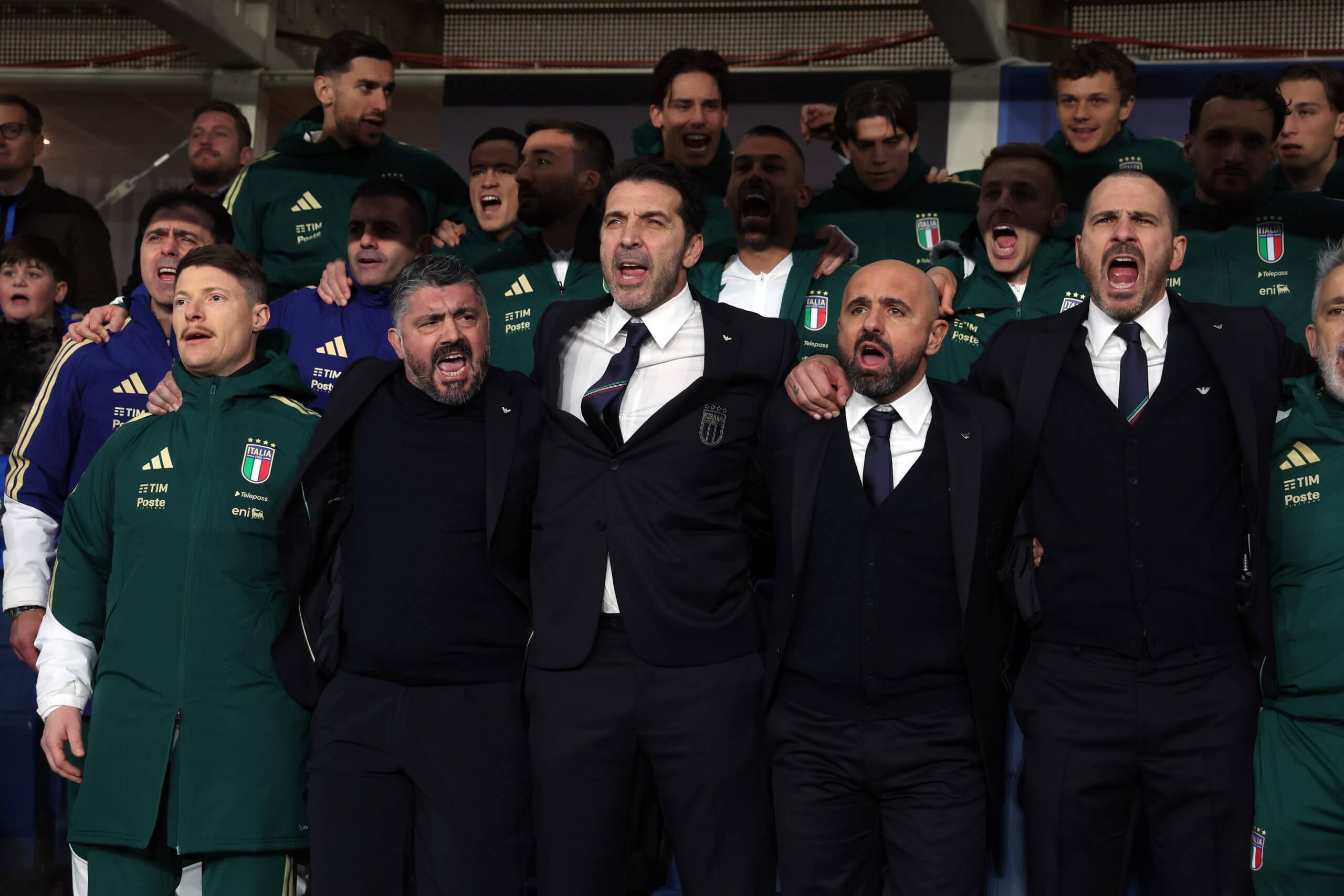
Buffon, centre, and the Italy staff, including Gattuso, left of centre, sing the national anthem before the World Cup play-off defeat (Marco Iacobucci/SOPA Images/LightRocket via Getty Images)
Protective of his players to the last, he was not the only one. Inter is the club from which the core of the national team is derived. Federico Dimarco had already been forced to explain why he appeared to celebrate drawing Bosnia over Wales in the play-off final. Alessandro Bastoni’s qualification-compromising red card in Zenica attracted the most vitriol. Francesco Pio Esposito’s penalty miss in the shootout was largely forgiven because of his potential and the courage he showed, at his age, to take the first one. Beppe Marotta, the Inter president, told DAZN: “It’s shameful that Alessandro Bastoni is being strung up as if he were guilty of who knows what.”
Bastoni’s sending off in Zenica need not have been the deciding factor last week. Better Italy teams, such as the 1994 vintage against Norway, overcame a sending off to win. But Bastoni’s antics, particularly the way, in February, he duped the referee into ejecting Pierre Kalulu in the Derby d’Italia and then celebrated the decision, turned the sizeable Juventus side of the country and some neutral football fans against him. The environment around him is now comparable to that around David Beckham after England-Argentina at the 1998 World Cup, when, upon leaving his team with 10 men in Saint Etienne, he became a hate figure.
The Athletic broke the news at the beginning of the international break about interest from Barcelona in Bastoni. On the radio last week, a despairing Beppe Bergomi, the Inter legend and Sky Italia pundit, expressed his fear that Bastoni will now have to “leave the country for his own good”. Chivu tried to remind an unsympathetic public that Bastoni had, for better or worse, put his body on the line for Italy. He’d left him out of Inter’s last squad before the World Cup play-offs because of an injury sustained against Atalanta. “Basto was on crutches for 10 days, and then I saw him playing for the national team,” Chivu observed. Recognition of that spirit of sacrifice was negligible unless it presented itself as a criticism of Gattuso: why did you play him then?

Bastoni, sitting on the turf after wiping out Amar Dedic, is shown a red card (Elvis Barukcic/AFP via Getty Images)
The opprobrium did not diminish when La Repubblica claimed a group of players had inquired about whether or not qualification for the World Cup would entitle them to split a pre-established €300,000 bonus. The story was viewed from within as gratuitous, as no demands were made of the FIGC. Not every player knew that a bonus payment is a formality when Italy qualify for a major tournament.
As Serie A resumed, it was hard to enjoy the actual football. A lot of what was on show was blamed for the state of the Italian game; too many foreign players featuring for too many teams playing 3-5-2.
So, how does the game move forward?
In 76 days, a conclave will be held to decide the new FIGC president and Italian football’s strategic direction. It will take place on the same day France play Iraq in Philadelphia and Argentina take on Austria in Arlington; painful reminders of Italy’s recurring absence from the tournament that matters most.
You’d hope it focuses the mind. “To find ourselves back here for a third time…,” Alessandro Del Piero shook his head. “It was already shocking enough the first time. The second time it was like: ‘Ah, come on. This is a nightmare’. The third time is embarrassing and hard to justify.”
Italians want a legend of the game in a position of power, a figurehead who puts football, not politics, at the heart of their mandate. Del Piero’s name has been suggested, as has that of Paolo Maldini. We have, in many respects, been here before. Demetrio Albertini served as FIGC vice-president and may return. Roberto Baggio and Arrigo Sacchi have been technical supervisors, entrusted with setting the curriculum for youth development. Billy Costacurta acted as a commissioner with special powers when the government staged an intervention in the wake of Italy’s failure to qualify in 2017.
Baggio’s case, in particular, has come in for a lot of retrospective attention in the past week.
You will perhaps have seen the now viral video of him holding the 900-page report he oversaw, a plan to bring much-needed renewal to Italian football. He resigned in 2013 under the impression the FIGC wouldn’t let him get on with the job. Baggio waited five hours to present the project, only to get 15 minutes to speak. He felt the report was a “dead letter”. Very few people have had the privilege to read it, which makes its recent portrayal on social media as calcio’s book of revelation especially curious.

Roberto Baggio at a Serie A match earlier this year (Nicolo Campo/LightRocket via Getty Images)
Over lunch in Miami last summer, Baggio, with typical humility, told The Athletic it wasn’t all his own work. He drew on the experience “of countless coaches who had worked in youth sectors” and said: “It wasn’t something I came up with, invented, or wrote on my own.” He wanted to “educate people to be people first and footballers second. Not everyone will become a player, but everyone will be a person. That was the foundation”. Whether it would have brought about a transformation or not is, for now, unknowable. But the effort and duty of care from someone who loves his country and the talent it is still capable of producing was as clear as the disillusion he felt at the project falling on deaf ears.
The FIGC president who accepted Baggio’s resignation in 2013, Giancarlo Abete, is, at 75, one of the frontrunners to replace Gravina. Currently the head of non-League football in Italy, Abete helms the body that has the most delegates and the highest vote share on the FIGC board, meaning that even if he doesn’t become president again, he will have the biggest say on who follows Gravina.
His rival is Giovanni Malago, the 67-year-old dapper, blue-blooded master of ceremonies at the Milano-Cortina Winter Olympics, an event he delivered with great success on and off piste. Malago, as head of the Italian Olympic Committee, oversaw the intervention of the FIGC in 2017. Who should emerge out of it once the commission fulfilled its remit? One Gabriele Gravina. What was the immediate outcome? Italy won the Euros and went on a FIFA record 37-game unbeaten streak.
This is among the reasons Gravina held on to power until the last. The system voted him back in three times. For the record, Gravina’s share of the vote at the last election in 2025 was 98.7 per cent. It came on the back of Italy winning the Under-17 (2024) and Under-19 European Championships (2023), for which UEFA awarded the FIGC the Maurice Burlaz prize, an award for the best results at youth level. At the Women’s Euros last year, Italy were seconds away from reaching the final, only for England’s Michelle Agyemang to equalise in the last minute of normal time and Chloe Kelly to win it in the last minute of extra time.

Italy’s players collapse to the ground after the Women’s Euros semi-final last year (Alex Caparros – UEFA/UEFA via Getty Images)
Gravina wanted to be judged on that record and the reform plan he was voted in on last year, rather than just the repeated failure of the men’s first team in World Cup qualifying. It again pointed to a disconnect with national sentiment, even if the Milan coach, Max Allegri, insisted, more broadly, that not everything in Italian football needs throwing in the bin.
But right now, any sense of continuity is, understandably, unpopular, and the sight of the same group of snowy-haired executives in the FIGC’s standard issue Armani suits is unlikely to pass muster with the Italian public, who look at the existing system and consider it irretrievably broken. As such, the political manoeuvring to position one of them for a leadership bid feels like deep-sea divers rearranging deck chairs on a thrice-sunk Titanic.
Anti-establishment feeling is high. “It isn’t time to rebuild. We need to destroy. EVERYTHING,” the former player turned pundit Lele Adani wrote in an editorial for Corriere della Sera. “Because, without getting bogged down in political battles – which are often just power struggles – we need to focus on football if we are to turn things around. The most credible person to lead us down this new path is Pep Guardiola, and no one else.”
If an Italian can coach Brazil, why can’t a Catalan coach Italy?
Adani’s many critics have pointed out one such reason: the expected cost. The FIGC can’t afford Guardiola. It needed Puma and other sponsors to help with Antonio Conte’s salary in 2014. Maybe if Serie A’s clubs put the national interest first and spent some of the €250m they lavished on agents’ commissions last year, it would enable the FIGC to put a contract offer together. After all, Guardiola is fond of Italy and went to watch his old club Brescia play Pro Patria in February.

Guardiola in action for Brescia during the 2001-02 season (Grazia Neri/AllSport)
For now, this is an aspiration, a long shot, and any serious discussion about Gattuso’s replacement, even amid the rumours about Conte or Roberto Mancini returning, will only take place as the election for the new FIGC president approaches in June. One person alone, even a generation-defining coach, is unlikely, on their own, to be enough to reform an entire system.
Guardiola is a provocative suggestion. It comes as Fabio Capello, no less, continues to make the assertion that Guardiolismo, specifically Pep’s poor imitators, has corrupted Italian football like a computer virus. Italy needs to remain true to itself without looking back. It needs to embrace difference and learn from coaches such as Cesc Fabregas, who is proposing something new from within Serie A at Como.
Instead, it already looks like continuity is the way. This, lest we forget, is still the land of Giacomo Leopardi and Leonardo Sciascia, where changes are made so things remain the same.
Italian football has been performatively reforming for 16 years. You just wouldn’t know it and that’s precisely the point.