The first look of Demna’s debut collection for Gucci does not feature clothing, but a human-sized monogram trunk, immortalised in a gilded frame and subtitled ‘L’Archetipo’ – the archetype. The trunk, after all, is where Gucci began: after working as a porter in London’s Savoy hotel – and witnessing the growing need for luggage amid the burgeoning travelling classes – Guccio Gucci would return to Florence to begin the leather atelier which would become an empire.
The image is photographed by radical American photographer Catherine Opie, and introduces a catalogue of other archetypes that the Georgian designer and former creative director says encapsulate the ‘different facets of Gucci’s personas’ (one might imagine them having stepped out of the trunk, as if Demna is unpacking his vision for his tenure ahead). What unites them, he says, is that they are ‘unapologetically sexy, extravagant, and daring’ – a departure from previous creative director Sabato de Sarno’s more restrained vision, which focused on refining the everyday wardrobe over bold design statements.
La Famiglia: Demna’s first collection for Gucci
(Image credit: Catherine Opie)
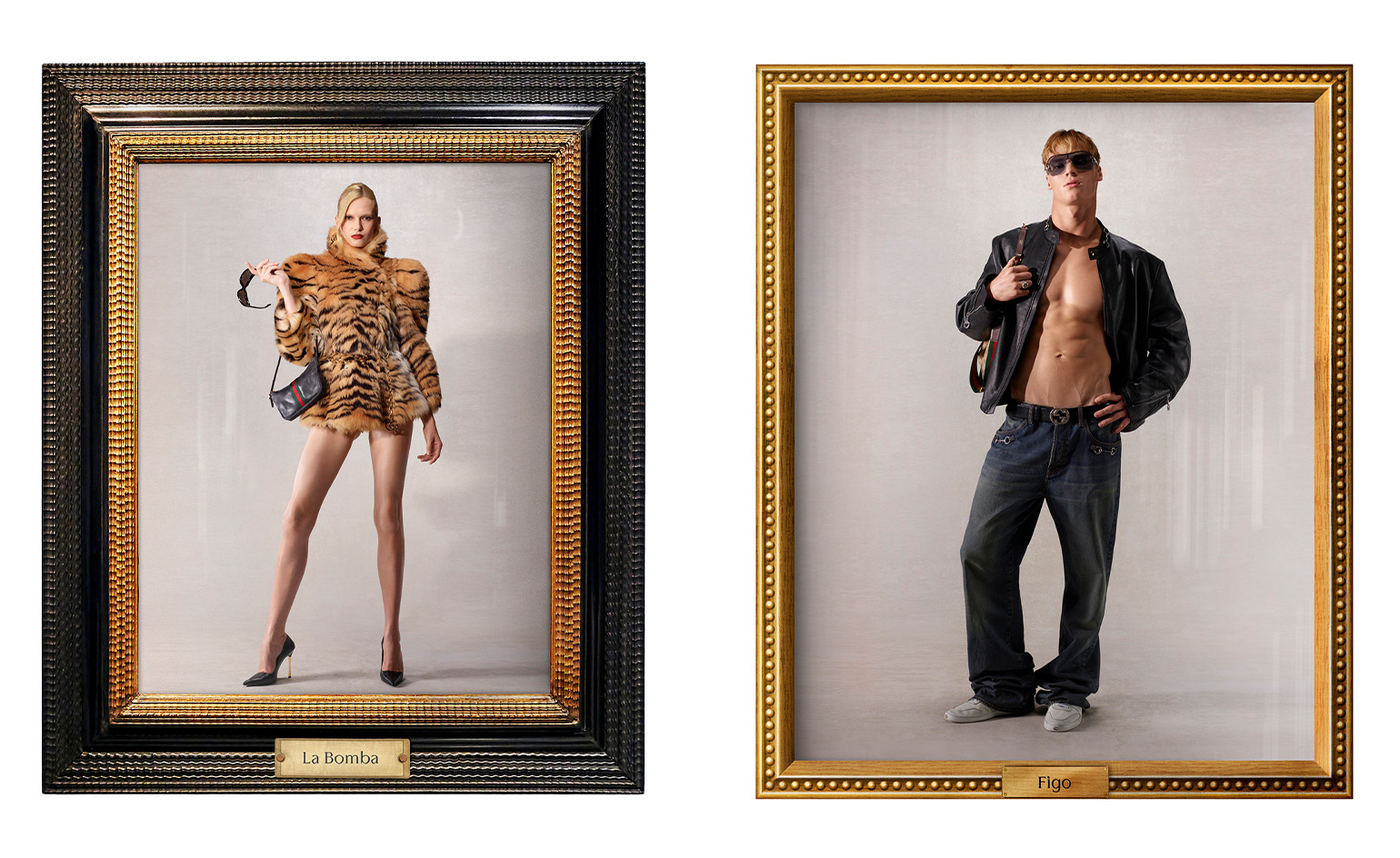
Some of Demna’s ‘La Famiglia’ are distinctly Italian: there is ‘La Bomba’ (legs bared and clad in a tiger-striped ‘fur’ coat), ‘Ragazzo’ (black Speedos, sunglasses, and a pair of Gucci sandals), and ‘La Principessa’ (a shimmering pink gown with ostrich-feather cuffs), while others capture more universal archetypes: ‘La VIP’, ‘Nerd’, ‘Gallerista’ and ‘L’Influencer’ all feature in the line-up. There are also moments of irony and irreverance typical of the designer: ’Miss Aperetivo’, who wears a micro sequinned mini and monogram tights, ‘is simply preoccupied with having the time of her life,’ he says.
Elsewhere, there are nods to the Gucci archive: a dress is adorned with a version of the Flora print, which first featured on a silk scarf made for Princess Grace of Monaco after a visit to the Gucci store in Milan in 1960, while the Bamboo 1947 bag and the Horsebit loafer, appear in new iterations. In its unabounded sensuality – several of the looks see models bearing skin – it recalls the tenure of Tom Ford in the 1990s, which would see the American designer reverse Gucci’s fortunes with his erotically charged vision of Italian glamour. Demna will, no doubt, hope he can perform his own turnaround of the label.

(Image credit: Catherine Opie)
This is the first of the major debuts to follow this season: later this week in Milan we will see first collections from Simone Bellotti at Jil Sander and Louise Trotter at Bottega Veneta, with a slew of other big names to follow in Paris, including Matthieu Blazy at Chanel, Jonathan Anderson’s first womenswear collection for Dior and Pierpaolo Piccioli’s debut at Balenciaga, where he takes over from Demna (the handover was more than amicable: Piccioli came out to support Demna’s final haute couture show for the house). Eschewing a runway show this season might be a canny move: with this release, the designer feels ahead of the noise.
That said, tomorrow in Milan, Demna will offer a further glimpse into his vision for the house: a presentation, heralding the start of the city’s fashion week, will take place at 7pm at Palazzo Mezzanotte. What this comprises of, Gucci remains tight-lipped, though a short film is expected (looks from the collection will also go on sale in ten Gucci stores worldwide). His debut runway show, meanwhile, is slated for February next year.

(Image credit: Catherine Opie)